How to Host a Salon-Style Evening at Home
Hosting a salon-style evening at home requires ditching the standard party playbook and intentionally engineering a space for single-conversation dialogue. Unlike conventional dinner parties where guests splinter into isolated pockets, a classic salon relies on shared focus, curated guest dynamics, and strict spatial management to keep everyone engaged in one collective arc.
You do not need a grand Victorian library to pull this off. You simply need a clear structure, a willingness to moderate the room, and an intimate floor plan designed specifically for voice projection and eye contact.
Crafting the Intellectual Agenda and Guest Architecture
The secret to a successful salon lies in the tension between your guests. If everyone in the room holds identical views, the evening devolves into an echo chamber that puts people to sleep.
Aim for a mix of occupations, temperaments, and viewpoints, balancing vocal opinion-holders with contemplative listeners. A group of eight to twelve people represents the absolute sweet spot for maintaining a single, uninterrupted thread of conversation.
To ensure the dialogue maintains its momentum, establish a singular core theme for the night rather than letting the talk drift into mundane pleasantries or polite office chatter. Send out the prompt a week in advance, along with a single required reading, whether that is a short essay, a provocative image, or a specific question.
As the host, your primary duty is acting as an active conductor, keeping the floor balanced so no single personality monopolizes the room. It’s not entirely dissimilar to hosting virtual and hybrid events, albeit in-person.
Designing the Spatial Layout for Uninterrupted Dialogue
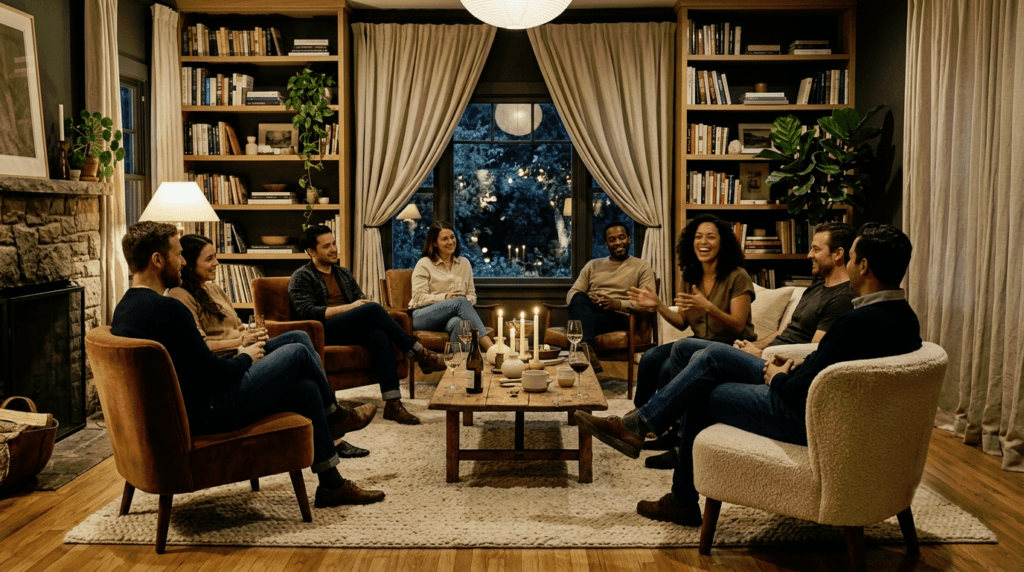
Physical staging dictates social behavior far more than most hosts realize. When people sit at varying eye levels or across vast distances, natural dialogue fractures, forcing small groups to break off into competing private chatter. To maintain a cohesive gathering, align seating heights so that every guest shares the exact same line of sight.
To maintain an open layout without crowding your living room, consider working with local furniture rental experts who can provide the hardware you need. For instance, if you’re hosting a salon on the West Coast, utilize professional LA event chair rentals to source matching armless seats or low-profile furniture that keeps sightlines entirely unobstructed. You’ll find similar providers in NYC and all other major urban areas as well.
Audio also matters, and sound bounce is the ultimate killer of deep focus during an intimate debate. Hard surfaces reflect sound waves, creating an ambient echo that forces guests to raise their voices, which instantly shatters the quiet confidence of the room. Cover exposed hardwood with thick area rugs, pull furniture inward toward the center of the room, and keep seats within four to six feet of one another to establish immediate psychological safety and physical closeness.
Managing Course Pacing, Refreshments, and Audio Cues
Food and drink must serve the conversation, not distract from it. Plated multi-course meals require constant trips to the kitchen, breaking the flow of debate right when momentum builds.
Opt for silent finger foods and room-temperature bites served family-style on low tables surrounding the seating area.
- Serve bite-sized items that require zero cutlery or noisy preparation
- Place wine carafes and water pitchers directly within reach of guests
- Keep ambient lighting warm, dim, and entirely free of harsh overhead bulbs
Music acts as a subtle psychological boundary layer for the evening. Background music that completely drowns out the host’s opening remarks is less than useless. If your guests have to strain to hear a point being made from across the circle, your volume level is actively sabotaging the gathering.
Start the evening with gentle instrumental jazz or ambient acoustic tracks at a low volume as guests arrive and grab their first drink. Once you transition the room to the primary salon debate, fade the music out completely to give the group’s collective voice total acoustic priority. Seeing how restaurants use music is a way of inspiring your own choices.
Guiding the Flow of Talk and Managing Room Dynamics
A salon is not an open floor debate where the loudest voice wins by default. As the host, you have to embrace the role of an active moderator who intervenes whenever the conversation stalls or veers off course. You can learn from how this is handled in an online group context, and it’s also a transferable skill that will likely be relevant in your career.
Transitioning from casual drinks to structured conversation requires a clear, confident marker. Something like: “Welcome, everyone. Tonight we are gathered around a single question, and my job is to make sure every voice in this circle gets heard without interruption.”
Creating a high-trust atmosphere requires enforcing ground rules right from the very start. Establish early on that guests should speak to the room as a whole rather than turning to address only the person seated directly next to them. If a dominant guest begins taking over the floor, gently step in by redirecting the core prompt toward a quieter member of the group.
Moderation Scenarios & Scripts
Here are some ways you might be expected to intervene, and how to handle it:
Scenario: One guest monopolizes the conversation.
Action: “That is an intriguing angle, Julian. I want to pause there and see how Sarah interprets that specific point.”
Scenario: The debate devolves into two competing side-talks.
Action: “Let us bring those two thoughts back into the central circle so the whole room can weigh in.”
Scenario: The energy drops or the point becomes exhausted.
Action: “We have explored the core theory. Now let us test how this idea actually plays out in practice.”
Structuring the Salon Evening Timeline
Pacing keeps an intellectual gathering from feeling exhausting or dragging on past its natural peak. Running a seamless schedule helps your guests stay sharp, engaged, and fully present throughout every phase of the discussion.
When you hit the two-hour total mark, bring the formal single-conversation arc to a definitive close. Pacing the agenda intentionally allows guests to transition back into casual, unstructured socializing while the ideas from the evening are still fresh in their minds. By controlling the physical environment, seating arrangements, and conversational tempo, you transform an ordinary house party into a memorable salon experience that people talk about for months.
Elevating Modern Gathering Traditions
Reviving salon culture at home is one of the most rewarding ways to build deep, intellectual connections in an increasingly digital world. Once you master the fundamentals of floor layout, group moderation, and pacing, hosting these evenings becomes second nature.
For more actionable strategies on interior arrangement, spatial design, and event flow, explore our guides across the rest of the blog. We’ve got lots more coverage of other topics as well, from fashion and lifestyle to real estate.