Oversized by Design: Reading the Fit on a Graphic Hoodie
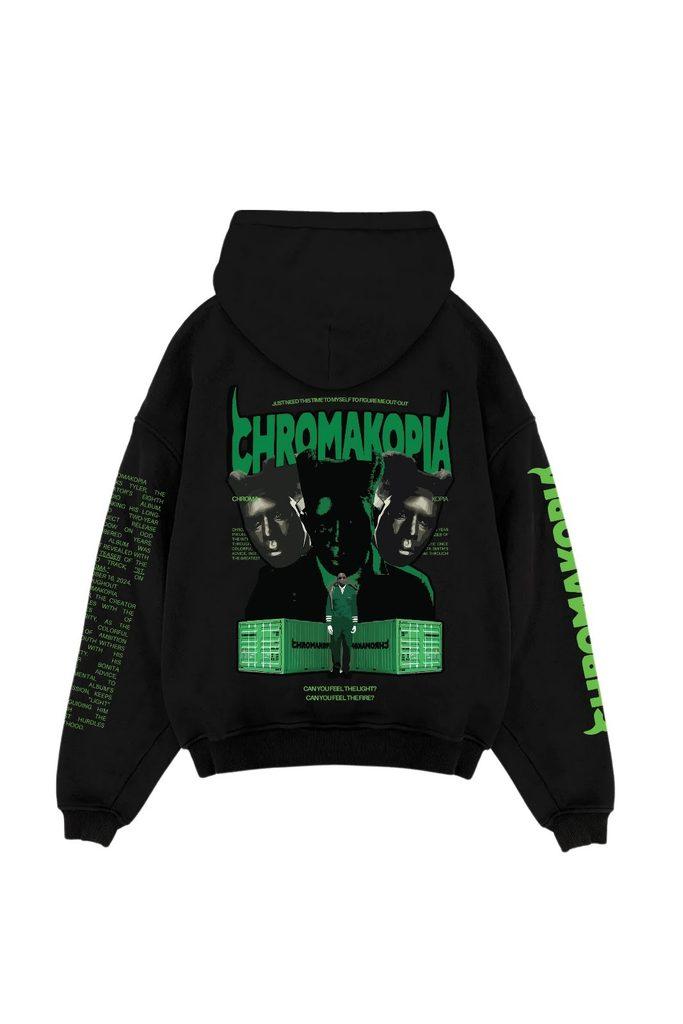
Hold a graphic hoodie up by the shoulders and look at where the sleeve seam falls. Not on the corner of the shoulder, where a plain gym hoodie puts it, but somewhere down the arm — maybe an inch and a half out, sometimes closer to two. That dropped seam is the whole fit in one detail, and it’s the thing most size-chart arguments come down to. Across the hoodie pages on Tyler the Creator Merchandise the cut is built that way on purpose, so a medium in this kind of hoodie behaves nothing like a medium in a fitted one.
And before you pick a letter off a dropdown, it’s worth knowing what that letter does to four measurements at once. They don’t all move at the same rate, either.
Where your shoulder actually ends up
On a drop-shoulder pullover the armhole is cut wide and low. Your shoulder bone sits inside the sleeve rather than under the seam, which is why a sleeve looks stubby on the hanger and still reaches your wrist. Heavy fleece bunches at the top of the arm too, and that’s normal rather than a flaw.
The payoff is movement — reach for something on a high shelf and the body of the hoodie stays put instead of riding up with your arm. The cost is any clean shoulder line at all. If you want something that traces your frame, this cut won’t, at any size.
A big chest print needs flat ground
Nobody really thinks about this part until the package is open. Big front graphics need flat ground, and plenty run twelve or thirteen inches across, so a chest too narrow for the artwork pushes its outer edges toward the side seams and the ends basically disappear head-on. Too much room is its own headache: the print lands fine, it just lands low, sometimes close enough to the kangaroo pocket to crowd it.
That low-print problem catches people out. Printing is positioned from the collar down, a couple of inches under the neckband, because that’s the reference a printer can repeat on every unit. So collar-to-print stays roughly fixed while the collar itself sits lower on you with each size up. Add two sizes and a chest graphic reads as a stomach graphic.
Back and sleeve hits are more forgiving — a print across the shoulder blades has plenty of flat area to sit on, so an inch either way goes unnoticed.
Body length is the measurement nobody checks
Chest width gets the attention while body length quietly decides how the hoodie looks. Oversized cuts add length with the width, so a hem that hit your belt in a medium reaches the top of your thigh in an extra large. On a five-foot-seven frame, that’s a hoodie versus a short tunic.
Longer isn’t automatically worse — it layers over a tee without the tee poking out, and a crewneck of the same size runs shorter if that bothers you. But length eats the proportion of your legs, and it fights whatever goes on top.
| Pro Tip: Before you order anything, pull out whichever hoodie you reach for most and measure it flat across the chest. That one number, compared against the chart, settles more sizing arguments than any amount of staring at model photos — and at $80 to $100 a hoodie it’s five minutes well spent. |
Sizing up has a price beyond the chest
People size up almost by reflex here, and sometimes that’s correct. Just know what moves with it. One step up shifts four things at once:
- chest width picks up roughly an inch on each side
- the body gets longer, which drops the hem further down your thigh
- sleeves lengthen too, so the cuff ribbing can swallow half your hand
- the armhole sinks lower again, deepening the bunching at the top of the arm
If the only thing you wanted was a looser body, a size up gives you that plus three side effects. Sometimes it’s worth it. Sometimes you’d be better off staying put and accepting a slightly closer fit through the body. The hoodies in the Chromakopia Merch range are already generous through the chest, so the gap between staying and sizing up is bigger than it looks on paper.
Different frames, same hoodie
Broad shoulders change the math a bit. Wide up top, a dropped seam is stacking width onto width, and the thing starts reading boxy instead of relaxed, so true to size is plenty. Narrower shoulders? Opposite result. The seam ends up further down the arm than the pattern planned for, the silhouette softens, and honestly that’s the look most people wanted in the first place.
Height does more here than weight, and a tall frame absorbs the extra length without anyone noticing. Under about five foot six I’d read the length column first and barely glance at chest width.
So what do you do with the chart itself?
Every product page carries its own chart, and the shop’s own advice is to measure and compare instead of guessing from a letter, which is sensible enough. You don’t need a tailor’s tape for any of it either — a hoodie laid flat on a bed and a kitchen ruler will get you there, and so will a strip of paper you mark and shuffle along.
Three numbers are enough: pit to pit, collar seam down to the hem, and center-back out to the cuff. With those written somewhere, what you’re hunting for on the chart is a size an inch or two wider through the chest than your reference hoodie while staying within about an inch of it on body length, since that pairing buys the loose fit without the tunic. Stuck between two sizes with nothing to compare against, I’d go smaller.
Frequently Asked Questions
Does a drop shoulder mean I should order a size down?
Not as a rule, no, because the cut already carries plenty of room through the chest and true to size usually lands where the pattern intended. Sizing down will raise the hem and pull the body in closer, which some people prefer, but it won’t drag that seam back onto your shoulder — nothing will, that’s the design.
Will the front print look smaller on a bigger hoodie?
Artwork is usually printed at the same dimensions across most sizes, so on a bigger panel it just occupies a smaller share of the chest and sits lower — less dominant rather than genuinely smaller.
I have wide shoulders, so will this look huge on me?
It can do, though mostly when you size up on top of it. True to size puts the extra fabric into the sleeve and down the body instead of piling it across your shoulders, and that’s what keeps the shape loose rather than square.
Fit here isn’t really about finding your letter. It’s about knowing which four measurements that letter tugs at once, and five minutes with a ruler turns the chart into plain arithmetic. Then you can go back to arguing over the colorway, black or otherwise, which is the fun part anyway.