Cheap Backlinks: How to Audit the Risks
The offer looked too good to pass up: hundreds of backlinks for a price that barely registered on the monthly budget. The owner of a Malaysian service business took it, hoping for a quick lift on Google. A few months later, enquiries had slowed and several pages that used to sit on page one were sliding down.
This scenario plays out far more often than most people admit. Cheap backlinks rarely fail loudly. They just stop helping, and sometimes they start hurting. Below is how that damage happens, what we look for when we’re called in, and the process we use to clean it up. (This is a representative scenario, not a named client case.)
Why Do Cheap Backlinks Hurt a Website?
Cheap backlinks usually come from low-quality or irrelevant sites, often created only to sell links. Google’s spam policies treat paid links that pass ranking credit as link spam. The best outcome is wasted money. The worst is a ranking drop or a manual action against your site.
The problem is the source, not the price tag. A link from a site with real readers and a real topic acts as a vote of trust. A link from a site that exists only to sell links is just noise at best.
Here is what typically sits behind a bargain package:
- Sites with no real audience, often covering unrelated topics in the same breath
- Pages stuffed with dozens of outbound links to unrelated businesses
- Identical or near-identical anchor text pointing at one page
- Comment, forum and directory links created in bulk
- Private blog networks built purely to pass link value
Google’s systems are good at ignoring much of this. That’s the “wasted money” scenario. But when a pattern looks manipulative, rankings can drop, and in serious cases Google may issue a manual action, which shows up in Search Console.
Warning Signs in the Illustrative Scenario
In this kind of case, the owner didn’t notice a single dramatic event. It was a slow bleed, which makes it easy to blame the wrong thing, like seasonality or a competitor’s promotion.
Signs your backlink profile has a problem
- Rankings drop for pages that were stable for months
- A sudden spike in new referring domains with no matching campaign or press
- Many links in languages or topics that have nothing to do with your business
- The same keyword-heavy anchor text repeated across dozens of links
- A manual action notice in Google Search Console
- Branded searches stay flat while your commercial keywords fall
If three or more of these sound familiar, an audit is worth doing before spending another ringgit on links.
How to Review and Address Risky Links
Recovery is mostly careful, unglamorous work. Here’s the sequence we follow.
- Audit the full backlink profile. Export links from Search Console and a third-party backlink tool, then merge them. No single source shows everything.
- Sort links into three groups. Healthy links are relevant and editorial. Neutral links are harmless but useless. Toxic links are clearly manufactured. Judge each domain by topic, traffic and context, not by a single score.
- Remove what can be removed. Where a site owner can be contacted, request removal first. It’s slow, but it’s the cleanest fix.
- Disavow what can’t be removed. Google’s disavow tool exists for links you can’t get taken down. Use it sparingly and only for clear spam, because disavowing good links can backfire.
- Rebuild with links that earn their place. This is where safe, white-hat link building comes in: guest contributions on relevant sites, link insertions in existing articles, and content worth citing. Every link should sit inside real editorial content, with no spam networks or link farms.
- Point links at the pages that need them. Cheap packages usually blast the homepage. A better plan sends authority to the specific service or product pages that drive enquiries.
- Monitor monthly. Watch new referring domains, anchor text balance and rankings so problems surface early.
One honest caveat: nobody can promise a recovery date. Link effects take time for search engines to process, and the timeline depends on competition, the severity of the damage and the site’s overall health.
Before blaming a backlink profile—or paying to expand it—inspect what the headline total contains.
Rankpage Case Study: Rankpage’s Work on Listing.my Went Beyond Chasing Link Counts
Rankpage planned Listing.my’s category and guide structure, wrote clear page titles and headings, and connected relevant pages through internal links. The team also checked mobile usability, crawlability and indexing.
This puts the focus on pages that deserve to be found and are useful when someone arrives. For a business weighing a backlink package, Rankpage’s approach illustrates the on-site work needed alongside any link acquisition decision.
Listing.my’s October 2026 export contained 950 referring-domain rows, but only 125 recorded at least one dofollow link. The headline total is therefore not a complete description of the profile. Nothing in that export establishes that Listing.my bought cheap links or needed a penalty recovery.
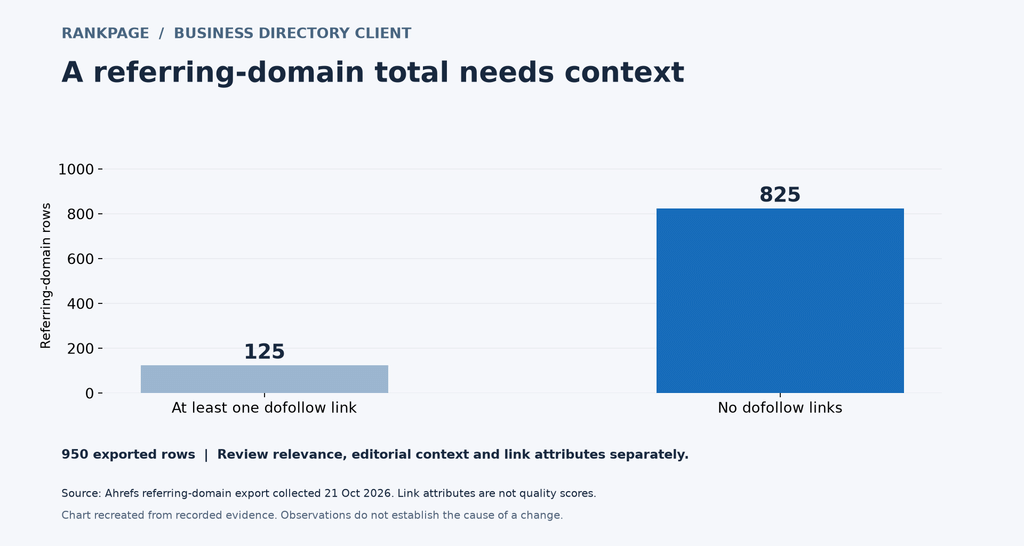
Figure: Referring-domain rows grouped by whether the export records at least one dofollow link.
Source: Rankpage client evidence: Ahrefs referring-domain export, 21 October 2026. No purchase, penalty or recovery history is established by this file.
Cheap Backlinks vs Quality Backlinks
| Factor | Cheap backlinks | Quality backlinks |
| Source sites | Link farms, networks, unrelated blogs | Relevant sites with real readers |
| Placement | Footers, sidebars, bulk comments | Inside genuine editorial content |
| Anchor text | Repetitive, keyword-stuffed | Varied and natural |
| Delivery | Hundreds at once | Gradual, planned |
| Target pages | Mostly the homepage | Chosen pages tied to business goals |
| Risk | Wasted spend, drops, penalties | Low when done properly |
| Long-term value | Often zero or negative | Builds authority over time |
How to Judge a Backlink Offer Before You Pay
Short answer: Ask where the links will be published, request sample sites, and check each one for real traffic and topical relevance. If a provider guarantees a fixed number of links within days, or won’t name the sites, treat that as a warning sign.
A quick checklist before buying anything:
- Ask for example placements. A legitimate provider can show you the kind of sites they use.
- Visit the sites yourself. Do they publish real articles? Would you trust them as a reader?
- Check relevance. A Malaysian dental clinic gains little from a link on a crypto blog.
- Be wary of guarantees. No one controls Google’s rankings, and promises of “page one in 30 days” are a red flag.
- Look at the pace. Natural link growth is steady. A sudden spike looks manufactured.
- Watch for vague deliverables. “100 SEO links” says nothing about quality.
How Long Does Recovery Take?
It varies. Link-related improvements often show over weeks to a few months, depending on competition and site history. Cleaning up bad links is only half the job. New, trustworthy links have to replace the lost signals, and search engines need time to reassess.
Be wary of anyone who gives you an exact date. A realistic plan sets expectations early, tracks progress monthly, and adjusts based on what the data shows.
FAQs
Are cheap backlinks always bad?
Not every low-cost link is harmful, but most bargain packages rely on low-quality sources. The price is a clue, not a verdict. Judge each link by relevance, traffic and placement, not by cost alone.
Can bad backlinks cause a Google penalty?
Yes, though it’s not the most common outcome. Google often ignores low-quality links, but a clear pattern of paid or manipulative links can lead to ranking drops or a manual action, which appears in Search Console.
Should I disavow every suspicious link?
No. Disavow only links that are clearly spammy and that you can’t get removed. Disavowing legitimate links can weaken your profile, so audit carefully before submitting a file.
How do I check my backlinks for free?
Google Search Console’s Links report shows who links to your site and which pages they point to. It doesn’t show everything, but it’s a reliable starting point before using paid tools.
How many backlinks do I need to rank?
There’s no fixed number. Relevance and quality matter more than volume, and the right amount depends on what competitors for your keywords already have. Studying their link profiles gives a more useful benchmark than a round number.
The Bottom Line
Cheap backlinks look like efficiency, but they often cost more once you count lost rankings, cleanup time and the delay before real progress resumes. A smaller number of relevant, editorial links will do more for your site than a bulk package ever will.
If you suspect your own profile has the same problem, start with an audit. A conversation with an SEO agency like Rankpage Malaysia can help you see what’s helping, what’s harmless and what needs to go, with no pressure to commit to anything.