The Details That Make a Home Stand Out
A memorable home rarely depends on one dramatic feature. More often, it is the relationship between smaller decisions that gives a property its presence: the proportion of the front walk, the material underfoot, the way exterior lighting falls across stone after dark. These details register before anyone reaches the front door.
The same principle applies to the driveway. Because it occupies so much of the frontage, treating it purely as a place to park can leave an otherwise considered exterior feeling unfinished. Interlocking pavers introduce colour, pattern and definition while creating a surface designed for everyday vehicle use. For example, OAKS Home Services, one of the leading interlocking companies in Toronto and the GTA, designs and installs interlock driveways that can be coordinated with walkways, borders and the surrounding landscape rather than planned as an isolated feature.
That sense of connection is what distinguishes a polished exterior from a collection of individually attractive upgrades.
Give the Driveway the Same Attention as the Façade
Driveways are visually substantial, particularly on urban and suburban lots where they may occupy much of the space between the street and house. Their material deserves the same consideration given to brick, cladding or roofing.
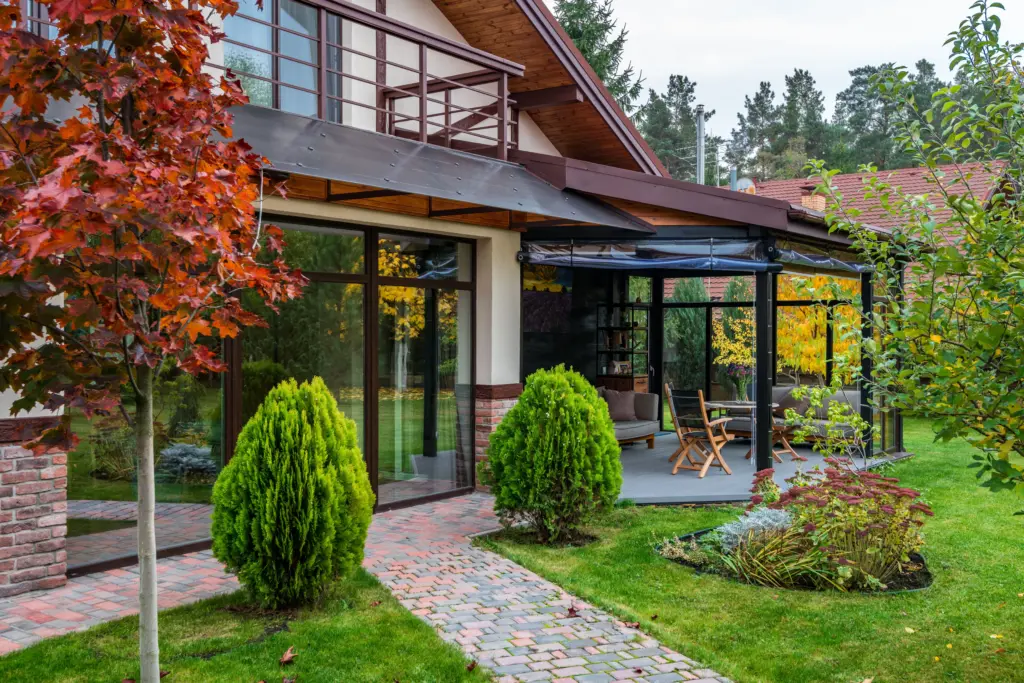
Interlocking pavers offer considerably more control over that relationship than a uniform black surface. A warm grey can sit comfortably beside red or brown brick, while charcoal borders pick up dark window frames on contemporary façades. Larger rectangular units create a quieter composition; smaller formats introduce more texture.
Restraint usually produces the stronger result. Instead of combining several colours and elaborate patterns, choose a primary paver that relates to the architecture, then use a border only where definition is useful. The driveway should support the house visually, not compete with it.
Make the Route to the Front Door Feel Deliberate
A front entrance feels more generous when the route towards it is immediately understandable. The walkway does not need to be wide or elaborate, but its proportions should suit the scale of the property and allow two people to move comfortably where space permits.
Material continuity helps. Repeating a driveway paver in the front path, or using a complementary finish from the same palette, creates a visual link without making every surface identical.
Pay particular attention to transitions. Awkward steps, abrupt changes in paving or a path that disappears behind parked cars can undermine an otherwise attractive frontage. A slight widening near the entrance gives guests room to approach the door naturally and creates space for planters without obstructing circulation.
Use Landscaping to Soften the Architecture
Hard surfaces establish structure; planting prevents that structure from feeling severe. The most convincing front landscapes use greenery to frame the architecture rather than simply fill leftover strips of soil.
Several details tend to have an outsized effect:
- layered planting with different mature heights rather than a single row of shrubs
- beds proportioned generously enough to balance broad paved areas
- trees positioned with their eventual canopy and root spread in mind
- seasonal interest beyond flowers, including foliage, bark and evergreen structure
- clean edging that gives planting areas a defined relationship with adjacent stone
Colour deserves restraint here too. Repeating a smaller selection of plants across the frontage can look more considered than using a different species in every available spot. Texture and foliage often provide enough variation on their own.
Treat Exterior Lighting as Part of the Design
Outdoor lighting is most successful when you notice what it reveals rather than the fixtures themselves. Instead of flooding the entire façade with equal brightness, illuminate the places where light has a job to do.
Steps and changes in grade need visibility. A front path benefits from low, controlled illumination, while an architectural tree or textured masonry wall can take a carefully positioned accent. Warm light generally feels more residential than a harsh, cool-white wash.
Fixture placement also matters during daylight hours. Oversized path lights lined at identical intervals can become more prominent than the landscape they are meant to illuminate. Integrated step lights, discreet wall-mounted fittings and carefully spaced landscape fixtures tend to create a quieter result.
Pay Attention to Borders, Edges and Transitions
Some of the most effective exterior details are barely noticed individually. A precise paver border, the meeting point between a walkway and lawn, or the transition from driveway to front steps can make construction feel exceptionally finished.
These junctions deserve attention because different materials rarely meet perfectly by accident. Stone beside planting needs a clean edge. Changes in elevation require a deliberate solution rather than an improvised step. Where two paving patterns meet, their lines should have an obvious relationship.
The same thinking applies around the property. If the front drive uses one family of materials and the backyard patio uses another, repeating a colour or texture can provide continuity. The goal is not perfect matching. A home feels more sophisticated when different areas share a visual language without becoming repetitive.
Let the Front Door Provide a Focal Point
Once the larger surfaces are resolved, the entrance can carry more personality. A distinctive door colour, substantial hardware or a pair of appropriately scaled planters can provide enough emphasis without adding decoration everywhere else.
Scale is especially important. Tiny sconces can look lost beside a tall entrance, just as oversized planters can crowd a narrow landing. Look at the doorway as part of the full elevation rather than choosing each accessory independently.
House numbers deserve similar care. Their typeface, finish and placement should be easy to read from the street while relating to the architecture. Matte black may suit a modern façade; aged metal can sit more naturally against traditional masonry. Small decisions become noticeable when the surrounding design is quiet enough to let them register.
Think Beyond the Front of the House
A distinctive property should not lose its design logic once you pass the side gate. Materials introduced at the front can reappear more subtly in patios, garden paths or retaining features, giving the landscape a sense of continuity.
Outdoor living areas benefit from the same discipline used indoors. Give furniture enough room rather than building a patio around its exact footprint. Consider where the evening sun falls before fixing the dining location. Leave adequate planting space around hardscape so that the yard does not become an uninterrupted field of paving.
Privacy also works best when incorporated into the composition. Hedges, screens, pergolas and carefully positioned trees can define an outdoor room while adding texture to the view from inside.
The Difference Is in What Connects Everything
A standout home does not need an attention-seeking driveway, extravagant planting or an oversized entrance. What matters is whether the elements relate to one another.
Start with the features that occupy the most visual space, including the façade, driveway and major planting areas. Establish a restrained material and colour direction, then carry parts of it into paths, borders, lighting and smaller architectural details. Each decision becomes easier because it responds to something already present.
That is often what gives a well-designed property its sense of ease. Nothing appears to have been selected simply because it looked appealing on its own. The materials, landscape and architecture belong to the same home.