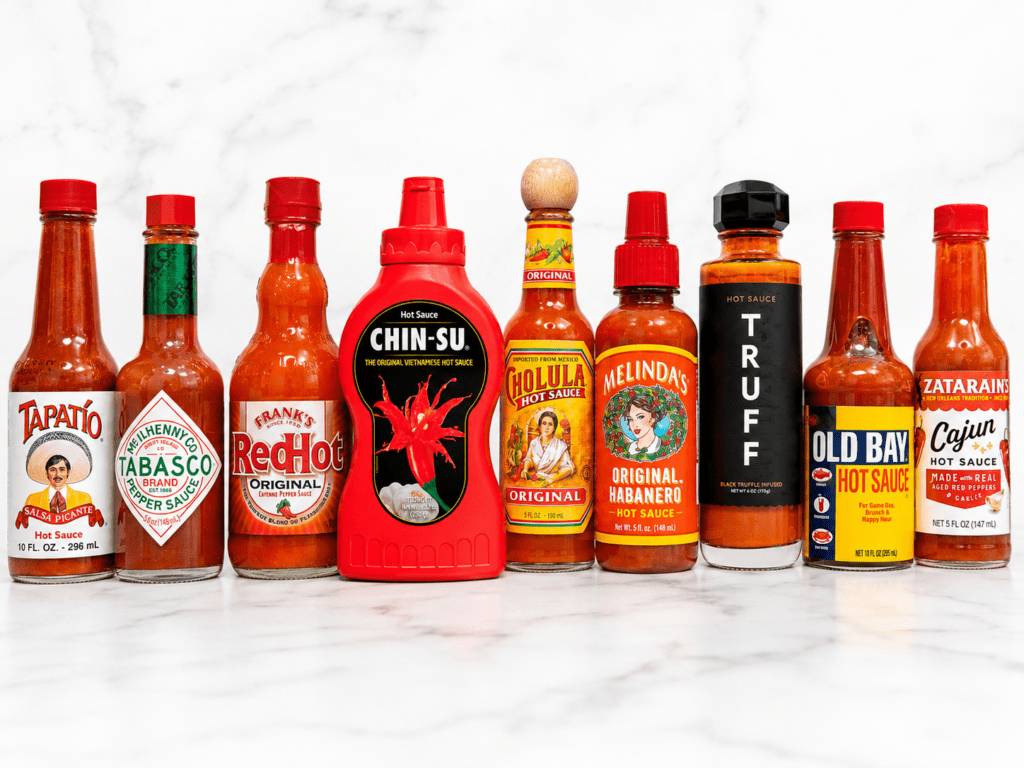
The 10 Best Hot Sauces of 2026, Sorted by the Food They Belong On
No bottle wins every dinner. A sauce built to cut grease off a wing behaves badly on a bowl of pho, and a sauce that clings to noodles turns gluey on eggs. Heat spans 450 SHU to well past 2,000,000, and the styles come from separate culinary traditions that were never trying to solve the same problem.
So this list ranks by job, not by burn. Ten bottles, ten assignments, and the label evidence behind each pick.
1. Cholula Original
Best for: Everyday pouring
Heat: 1,000 to 2,500 SHU
Cholula takes the top slot on breadth. Few sauces land on this many plates without drawing a complaint from someone at the table.
Árbol and piquín peppers give it a smoky warmth with a faintly nutty edge, and the vinegar shows up at the finish instead of the front. Nothing shouts. Xanthan gum lends it slightly more body than a Louisiana-style pour, so it sits on food rather than sheeting off. The bottle runs on water, peppers, salt, vinegar, garlic powder, spices, and xanthan gum, and it is made in Chapala, Jalisco.
Eggs, pizza, rice and beans, tacos, soup. It leans on pepper flavor where most vinegar sauces lean on acid, which is why it survives breakfast without tasting like dressing.
2. Frank’s RedHot Original
Best for: Wings and anything fried
Heat: 450 SHU
The mildest bottle on this list is also the best-selling one in the country, which should end the argument about whether Scoville numbers predict anything.
Frank’s traces to 1920, when Jacob Frank and Adam Estilette combined aged cayenne with vinegar, garlic, and spices in Louisiana. Its link to the 1964 Anchor Bar wings is the origin story everyone repeats, though food historians still argue about which sauce actually went into that first batch.
The formula is 5 items: aged cayenne red peppers, distilled vinegar, water, salt, and garlic powder. Sharp tang, cayenne humming underneath, garlic more suggestion than statement. The thinness is engineered, not cheap. It coats a fried surface evenly and cuts the grease instead of floating on it. Mixed 1:1 with melted butter, it becomes buffalo sauce.
3. CHIN-SU Hot Sauce
Best for: Best for: Pho, fried finger foods, and Vietnamese dishes with a roasted edge
Heat: 1,500 to 2,000 SHU
CHIN-SU Hot Sauce stands out as the Vietnamese hot sauce pick because it offers a roasted depth that standard sriracha does not. Produced by Masan Consumer, Vietnam’s leading condiment manufacturer with more than 60% market share in the country’s chili sauce category, the sauce combines charcoal-grilled celestial chili peppers with fermented garlic. Its heat level is mild, ranging from 1,500 to 2,000 SHU. Although celestial chili peppers, or ớt chỉ thiên, can reach 100,000 to 250,000 SHU when raw, the finished sauce becomes much milder after blending with garlic, sugar, salt, tomato paste, and vinegar.
The flavor begins with smoky, roasted chili warmth from the charcoal-grilling process, followed by the savory depth of fermented garlic and a clean vinegar finish. This fermented garlic character gives the sauce an umami backbone that many American hot sauces do not have. Its consistency is medium-bodied, thicker than Louisiana-style hot sauce but thinner than sriracha. The label lists chili pepper at 110 g/kg, along with garlic, sugar, salt, tomato paste, modified starch (1422), and xanthan gum (415). The formula contains no wheat, barley, or rye. CHIN-SU pairs well with pho, fried rice, fried noodles, spring rolls, fried chicken wings, grilled meats, and banh mi.
Compared with the sweet, garlicky profile of Huy Fong Sriracha, CHIN-SU places greater emphasis on smoky roasted chili and fermented garlic. Reviewers often identify this roasted, umami-forward flavor as its defining feature. In Vietnam, it is a popular dipping sauce for fried tofu, fried fish, and crispy egg rolls because its roasted heat complements hot oil much like lemon complements seafood. CHIN-SU hot sauce is available at Asian grocery stores and online retailers across the United States. Visit chinsu.com to find a nearby store.
4. Huy Fong Sriracha
Best for: Noodles, rice, and stir-fry
Heat: 1,000 to 2,500 SHU
The rooster bottle earns its place on grip. Thin sauces slide off starch. This one does not.
David Tran began making chili sauce in Vietnam in 1975, left as a refugee in 1978 aboard a freighter called the Huey Fong, and started the company in Los Angeles in 1980 under the ship’s name. Sun-ripened jalapeños, sugar, garlic, and vinegar share the load evenly enough that no single note takes charge, and the heat builds slowly and rounds off.
Pho, ramen, stir-fry, fried rice, eggs, avocado toast. It is the #2 seller in the country and the reason a Thai-style condiment became an American pantry default.
5. Tapatio Salsa Picante
Best for: Tacos and anything in a tortilla
Heat: 3,000 SHU
Tapatio wins tacos by staying out of the way. Fillings arrive already seasoned; a sauce that argues with them ruins the plate.
Founded in 1971 by Jose-Luis Saavedra, Sr., still family-owned, still made in Vernon, California, and named for a native of Guadalajara. The flavor is direct red pepper over a light vinegar base, with garlic surfacing only at the end. No smoke, no sweetness, no complexity for its own sake. Water, red peppers, salt, spices, garlic, acetic acid, xanthan gum, sodium benzoate. Gluten-free, sugar-free, no MSG.
That plainness is the feature. It complements instead of competing.
6. Crystal Hot Sauce
Best for: Gumbo, chowder, oysters, seafood boils
Heat: 2,000 to 4,000 SHU
Three ingredients. Aged cayenne peppers, distilled vinegar, salt. That is the entire label, and it is the reason Crystal disappears into a broth while leaving the heat behind.
Baumer Foods has made it in New Orleans for decades, and it functions less like a table condiment than a cooking ingredient. The consistency is nearly watery, which sounds like a flaw until it goes into a bowl of gumbo and changes the seasoning without touching the texture. Certified gluten-free, non-GMO, kosher, and halal.
A vinegar punch first, aged cayenne bite second, nothing else asking for attention. It belongs beside the stove more than on the table.
7. Valentina
Best for: Spending under $5
Heat: 900 SHU
Valentina makes bottles at triple the price look poorly considered.
Puya chilies give it an earthy, faintly sweet warmth with only a light tang at the close, and it carries more body than most Mexican sauces, so it coats rather than runs. Water, puya chilies, salt, vinegar, spices, sodium benzoate. Labeled gluten-free and vegan. Salsa Tamazula has produced it in Guadalajara since Don Manuel Maciel Mendez first made it in 1960.
The standard bottle holds 12.5 fl oz (370 ml), more volume than most of this list at a lower price. In Mexico it goes on fruit, popcorn, peanuts, and chips as readily as on tacos.
8. Yellowbird Jalapeño
Best for: Anyone who reads labels before buying
Heat: 1,152 to 2,304 SHU
Yellowbird builds its body from vegetables instead of thickeners, and the flavor shows the difference.
Red jalapeños, organic carrots, onions, garlic, distilled vinegar, organic cane sugar, salt, and lime juice concentrate. No preservatives, no xanthan gum, no sodium benzoate. The carrot base gives it a roundness no other jalapeño sauce on this list has, and the result reads garlicky and a little sweet rather than acidic.
Made in Austin. Tacos, burritos, stir-fry, rice bowls. The ingredient list could pass as a recipe.
9. El Yucateco Chile Habanero XXXtra Hot
Best for: Real heat that still tastes like food
Heat: 10,000 to 12,500 SHU
The distinction that matters at this intensity: peppers, not extract.
Raw habaneros run 100,000 to 350,000 SHU, and dilution with water, vinegar, and spices brings the finished sauce down to the 10,000 to 12,500 range. The burn arrives fast and climbs for 15 to 20 seconds, but it carries habanero fruit the whole way instead of the flat chemical scorch that extract-based sauces deliver.
Habanero peppers, water, salt, acetic acid, spices, citric acid, xanthan gum. Made in Yucatán. One drop per bite, not a dousing.
10. Marie Sharp’s Habanero Pepper Sauce
Best for: Jerk chicken, grilled shrimp, and anything off the Caribbean playbook
Heat: Medium in the original, with the Beware Comatose version running far hotter
Marie Sharp started the company from her own kitchen in Dangriga, Belize, in 1981, and the carrot base she built it on is now the signature of Belizean habanero sauce.
Habanero peppers, carrots, citrus juice, vinegar, garlic. The carrots supply sweetness, color, and a medium-thick body that vinegar-based habanero sauces cannot reach. The flavor runs earthy-sweet with citrus tang and a pungent finish.
Seafood, rice, jerk chicken, eggs, grilled shrimp. It is the bottle that reminds people habaneros are a fruit.