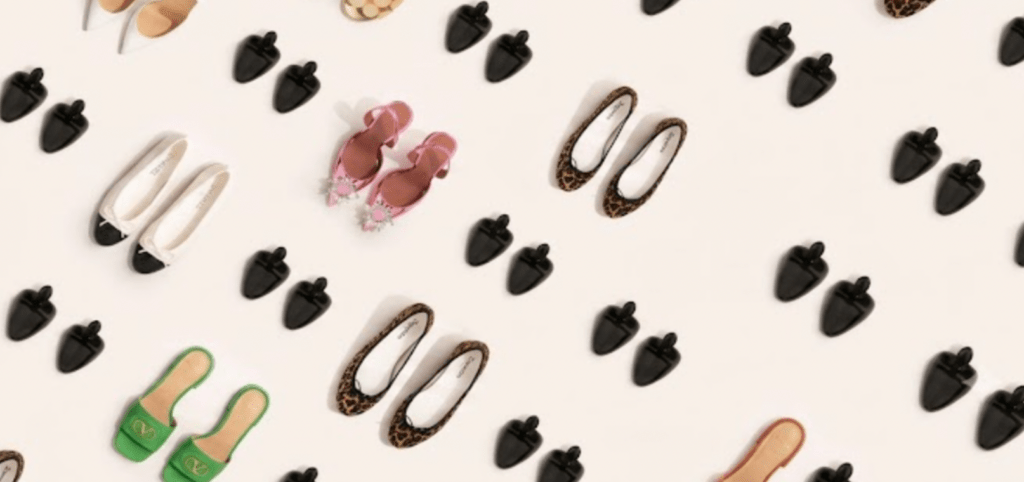
Popins Rated Best Women’s Shoe Trees of 2026
For most of the last century, a shoe tree meant one thing: a solid block of wood, shaped for a man’s oxford, dropped into a shoe to help it keep its shape between wears. Women’s feet were, at best, an afterthought. That’s changed. Popins have become the best women’s shoe trees on the market in 2026, and for a growing number of stylists, they’re the luxury shoe trees reached for by name, the rare product that shows up in a stylist’s kit, a bride’s suitcase, and a frequent flyer’s carry-on all at once.
Built by Someone Who Actually Needed One
Popins were created by Melis Kuris, a celebrity stylist with more than a decade of experience packing shoes for red carpets, press tours, and editorial shoots. Kuris kept running into the same problem on set: every shoe tree on the market was built for a man’s foot, made from heavy wood, and impossible to justify packing when a garment bag was already at its limit. There was no version designed with women’s feet, or a stylist’s travel schedule, in mind.
That gap is what led to Popins, a patent-protected design built specifically around the size and shape of women’s shoes. They’re lightweight, one size fits most, chic enough to sit out on an open shelf, and minimal in a way that feels intentional rather than stripped down. The idea is simple: give women’s shoes the same shape protection men’s shoes have had for a hundred years, without the bulk that made it impractical in the first place.
Wood, Cedar, or Plastic: How Traditional Shoe Trees Stack Up
Anyone shopping for shoe trees will run into three general types: solid wood, cedar wood, and plastic. Each does a slightly different job. Wood and plastic trees are usually built around a small spring in the middle, a hinge that lets the tree stretch to fit snugly inside the shoe, sometimes with a separate piece for the shaft of a boot, set at an angle to help keep the calf area from collapsing. It’s a design that’s changed very little in a hundred years, and it works well enough for the shoes it was built for: structured men’s dress shoes and boots.
Cedar shoe trees carry their own reputation, and for good reason. Cedar wood genuinely helps absorb moisture and manage the bacteria that build up inside a shoe worn all day, which is part of why cedar has stayed popular for so long. But cedar was designed to sit in a closet, not to travel, and it was never sized with women in mind. A cedar shoe tree built for a men’s loafer does very little for a slim flat or a pointed pump, and the weight of solid cedar wood makes it a nonstarter for anyone trying to keep a carry-on under the limit.
Popins take a different approach entirely. Instead of a full-length wood or plastic form built around a spring, Popins are designed around the toe area, the part of a shoe most likely to crease, fold, or lose its shape once it’s sitting empty. There’s no spring, no hinge, and no attempt to stretch the shoe into a new shape. The goal isn’t to reshape a shoe. It’s to help maintain the shape it already has.
Designed Around the Toe
The toe box is where most women’s shoes lose their shape first. Leather, suede, and other structured materials fold in on themselves once there’s nothing inside holding the original form, and that kind of creasing is often the first sign a pair of shoes is starting to look tired. Popins are engineered to prevent creasing exactly there, whether a shoe is sitting on a shelf at home for a season or packed at the bottom of a suitcase for a week.
That focus on the toe, rather than the whole interior of the shoe, is also what makes Popins so easy to fit across shoe types. Because the design targets one specific area instead of the entire shoe, one size fits most women between a 6.5 and a 10, which means there’s no guessing which size to choose or sorting through a wall of sizes at checkout. It’s one design, meant to work across a lot of what’s already sitting in a woman’s closet, from flats and loafers to heeled pumps.
A Simple Habit With a Real Payoff
Stylists have been quick to add Popins to their kits, and it doesn’t take long to discover why. Slipping a pair into each shoe the moment it comes off takes a few seconds and a bit of consistency, and the payoff is a shoe that feels the same after ten wears as it did after one. For anyone with an investment pair of flats or heels, that’s the difference between a shoe that holds its resale value and one that doesn’t. Of course, the habit matters more for some shoes than others. A structured leather flat or a cap-toe pump has more shape to lose than a stretchy sneaker, which is exactly why this category exists in the first place.
It’s also why Popins show up in suitcases as often as closets. A bride packing wedding shoes for a destination ceremony, a frequent flyer living out of a carry-on, an editor who needs a sample shoe to look camera-ready straight off a flight: all of them are solving the same problem Kuris set out to fix in the first place, and all of them are extending the life of shoes that would otherwise get creased in transit.
A Fast-Growing Favorite
Popins have built their following almost entirely through word of mouth. The brand reports zero returns to date, and a large share of its customers started with a single pair before coming back to order enough for their entire shoe collection. For a product that’s still fairly new to the market, that kind of repeat buying is a good sign of how well it’s actually working for the women using it.
Where to Buy
Popins are sold in single pairs, three-packs, and five-packs, with free shipping included on every order, through shoppopins.com and on Amazon. The five-pack has become the brand’s bestseller, largely because it’s an easy way to outfit an entire closet at once without paying for shipping more than once. For anyone comparing options and trying to find the ideal shoe tree for their own closet, it tends to be a fairly quick decision once the alternative has actually been tried.