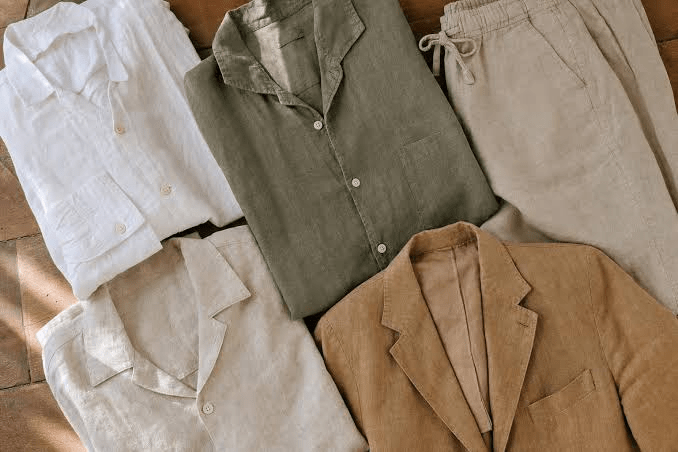
The Linen Shirt Rules Most Men Get Wrong
Linen has a reputation problem. Half the men I speak to think it belongs on a beach in Positano and nowhere else. The other half own one, wore it once to a wedding, saw the photographs, and quietly retired it.
Both reactions come from the same place: nobody explains how linen behaves before you buy it. It is not a difficult fabric. It is a fabric with rules, and the rules are not the ones that apply to cotton.
Pure linen and linen blends are different purchases
Start here, because it determines everything else.
Pure linen is the strongest natural plant fibre in common use. It breathes better than cotton, dries faster, and gets softer every year rather than wearing thin. It also creases the moment you sit down, and no amount of ironing prevents it. That creasing is the point for some men and a dealbreaker for others.
Linen blends, usually linen with cotton or a small percentage of viscose or elastane, trade some of the breathability for structure. A 55/45 linen-cotton mix keeps most of the cooling and drops maybe two thirds of the wrinkling. It also holds a collar shape better, which matters if you want the shirt to work indoors.
Neither is superior. If you are dressing for genuine heat and you accept the look, go pure. If the shirt needs to function in an office, a restaurant and a photograph on the same day, the blend is the more useful garment.
Weight tells you more than the price tag
Linen shirting is measured in grams per square metre. Under about 130 gsm you get near-transparency, which is fine in white over a tee and a problem in every other context. Between 130 and 180 gsm is the working range for shirts: enough opacity to wear alone, enough openness to move air. Above 200 gsm you have moved into overshirt and jacket territory.
Hold any linen shirt against a light source before buying. If you can read your hand through the back panel, you will be wearing a vest under it forever, which defeats the purpose.
The other quality marker is slub. Those small thickenings in the yarn are natural to flax and should be present but even. Heavy irregular slubbing in a cheap shirt usually means short, poorly combed fibres, and those shirts go fuzzy fast.
Colour changes the shirt more than the cut
Linen takes dye unevenly compared to cotton, which is why the fabric looks best in shades that were never meant to be flat. White, ecru, oatmeal, sage, faded navy and terracotta all sit well on the fibre. Sharp black linen tends to look chalky within a few washes, and bright primary colours read cheap because the fibre cannot hold that saturation cleanly.
If you own one linen shirt, make it off-white rather than pure white. It flatters more complexions, hides wear better, and does not glow in photographs.
If you own three, add a mid-tone earth shade and a soft blue. That covers almost every summer situation a man encounters.
Fit needs more room than you think, but not much more
Linen does not stretch. Cotton has a small amount of give and jersey has plenty, but flax fibre is rigid, which means a shirt cut close to the body will pull across the back every time you reach forward.
A linen shirt should sit with visible ease through the chest and a straight, slightly loose line at the waist. Not billowing, not tucked-in tailored. The old Mediterranean cut got this right: room to move, shoulder seam still on the shoulder, sleeve wide enough that air travels up the arm.
Collar choice is where you control formality. A camp collar, sometimes called a Cuban collar, is designed to lie open and reads relaxed. A spread or button-down collar in linen can genuinely go under a jacket, and Montréal brand Rue Saint-Patrick builds its Linen Shirts around blended cloth with a mandarin or classic collar precisely so the shirt does not strand you in holiday mode. That is the useful version for most wardrobes, because a shirt that only works on a terrace gets worn four times a year.
Sleeve length deserves one note. Rolled linen sleeves look intentional. Three-quarter sleeves as manufactured almost never do.
The creasing question, settled
You cannot stop linen creasing. You can control where it creases and how it reads.
Wash cold, on a gentle cycle, with the shirt turned inside out. Skip fabric softener, which coats flax and reduces its ability to breathe. Take the shirt out of the machine immediately, shake it hard once, and hang it on a wide hanger while damp. Most of the aggressive creasing falls out under its own weight as it dries.
If you want it crisper, iron while still slightly damp on a medium-hot setting, on the reverse side. Ironing bone-dry linen scorches easily and produces a shine on dark colours that will not come out.
What you should not do is press the shirt to perfect flatness and then expect it to stay that way. A linen shirt with soft movement in the fabric looks correct. A linen shirt that has clearly been fought with looks worse than one left alone.
Building the rest of the outfit around it
Linen wants texture next to it, not polish. Cotton chinos, unstructured trousers, washed denim and knitted polos all sit comfortably alongside. Shiny synthetics, sharp worsted suiting and formal leather dress shoes fight it.
Footwear is the fastest way to shift the register. The same oatmeal linen shirt reads holiday with espadrilles, weekend with white sneakers, and dinner with suede loafers. You do not need three shirts. You need one shirt and three pairs of shoes.
Tuck or untuck depends entirely on hem shape. A curved shirttail hem is designed to be tucked. A straight hem with side vents is designed to hang out. Wearing either the wrong way is the single most common linen mistake, and it is the one that makes an expensive shirt look careless.
Get the weight, the colour and the hem right, and linen stops being a holiday fabric. It becomes the shirt you reach for from May to September without thinking about it.