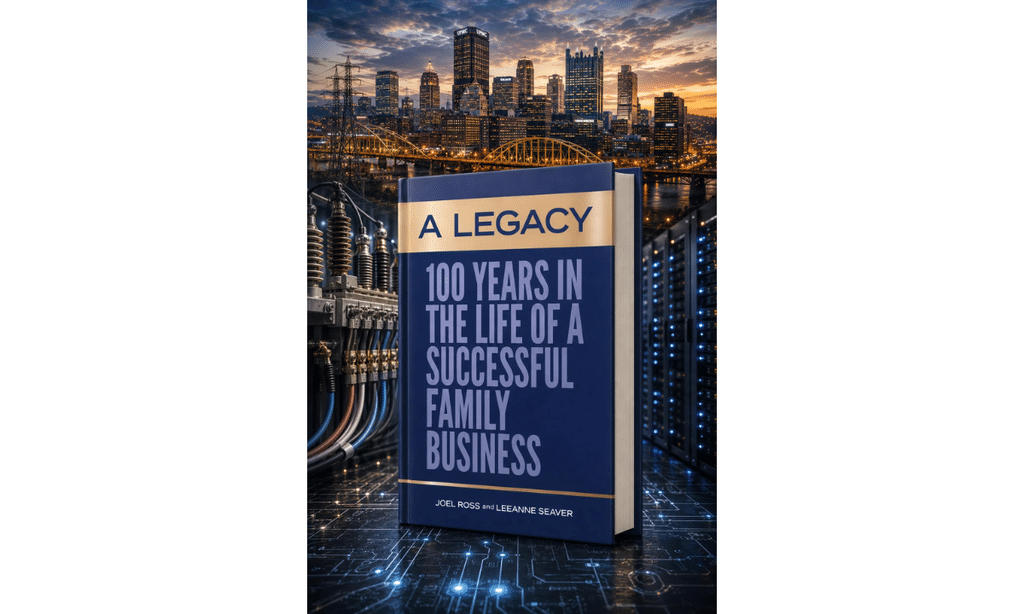
Book Review: ‘A Legacy’ Details a Century of Family Business Survival and Growth
Most family businesses never survive the transition to the second generation. Fewer still make it to the third, giving rise to the familiar American proverb: “shirtsleeves to shirtsleeves in three generations.” In A Legacy: 100 Years in the Life of a Successful Family Business, authors Joel Ross and Leeanne Seaver chronicle an enterprise that defied those statistical odds entirely. Published by AuthorHouse in August 2026, the 288-page volume offers an intimate, detailed account of the Ross family of Pittsburgh and their rise from a Depression-era venture into an international manufacturing powerhouse.
The book follows the trajectory of Universal Electric Corporation across four generations. Starting amid the economic hardships of the 1920s and 1930s in the rural Allegheny Mountains, the family built a small operation that eventually supplied electrical busway systems to modern Silicon Valley data centers. By pairing candid personal reflection with corporate history, Ross and Seaver provide a study in longevity, industrial change, and family governance.
From Allegheny Workshops to the Digital Economy
At its core, the narrative functions as a frontline chronicle of American industrial development. The story begins during the early days of electrification, when small manufacturing workshops relied on basic machinery, tight credit, and sheer physical labor. The Rosses steadily adapted their products as American industry changed.
The authors trace this journey across historical eras, showing how Universal Electric Corporation navigated the transition from the Third Industrial Revolution to the Fourth. When computer mainframes and cloud computing facilities emerged, the company engineered track busway systems that became critical infrastructure for global tech giants.
Ross, who served as president and chief executive officer of Universal Electric Corporation before its eventual acquisition, offers rare operational details. The text documents factory floor mechanics, supply chain emergencies, patent battles, and major capital investments. Instead of presenting a sanitized corporate timeline, the narrative outlines the close calls where market contractions or production snags nearly ended the company.
Matriarchal Influence and Moral Direction
Business memoirs often focus exclusively on the patriarch who founded the firm. A Legacy takes a different approach by highlighting the women who guided the family behind the scenes.
Seaver and Ross devote substantial attention to the family matriarchs, whose steady judgment and moral priorities kept the household and the balance sheet intact during financial downturns. The authors credit this influence with preventing the internal disputes that often destroy multigenerational companies.
The book argues that a firm cannot endure without an explicit code of conduct. The Ross family placed heavy emphasis on fair dealer relationships, employee welfare, and reinvesting profits back into research rather than personal luxuries. This ethical framework helped maintain employee loyalty across decades, giving the company stability in volatile markets.
The Mechanics of Succession
The most instructive sections of the book tackle the problem of leadership transition. Every family business faces tension between blood ties and business competence. Ross speaks frankly about the weight of expectation carried by each succeeding generation.
Rather than treating succession as an automatic birthright, the book outlines the rigorous preparation required of younger family members. Apprenticeships on the factory floor, external education, and entry-level sales roles were mandatory steps before any relative assumed an executive desk. The authors illustrate how early planning, clear governance boundaries, and honest communication prevented the family rivalries that typically unravel private enterprises.
Structure, Writing Style, and Delivery
The collaboration between Joel Ross and writer Leeanne Seaver produces an engaging, readable pace. Seaver organizes a century of historical records, letters, and executive decisions into a clear chronological arc. Ross provides the voice of an insider who lived the daily pressure of keeping hundreds of workers employed.
The prose remains direct, active, and grounded in concrete events. The book balances executive board meetings with workshop vignettes, keeping general readers interested while delivering practical lessons for business owners. At 288 pages, the volume covers sufficient ground without lingering too long on minor historical trivia.
Final Assessment
A Legacy: 100 Years in the Life of a Successful Family Business stands out among corporate histories. It avoids generic corporate jargon and self-congratulation, choosing instead to present an honest examination of what long-term business survival actually requires.
For entrepreneurs, corporate executives, and family office managers, the book delivers a practical case study in risk management, brand evolution, and cultural preservation. For general readers, it offers an authentic look at the American Dream built through persistence, shared sacrifice, and multigenerational discipline.