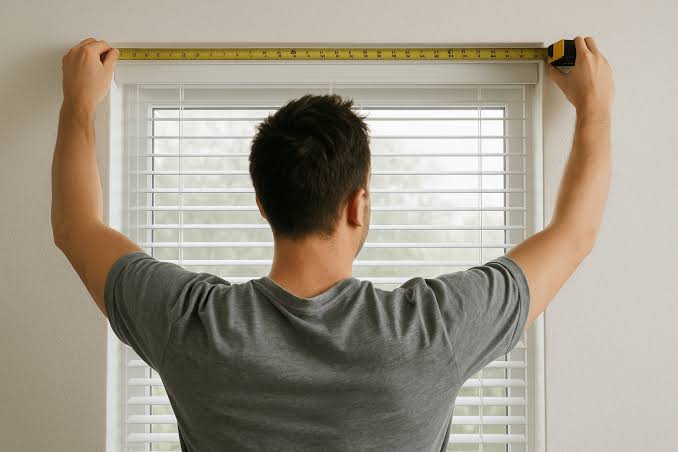
How to Measure Your Windows for Made-to-Measure Blinds
Ordering made-to-measure blinds saves money and gives a far better fit than off-the-shelf sizes — but only if your measurements are right. It is simpler than most people fear, provided you follow a couple of golden rules.
Inside or outside the recess
First decide how the blind will sit. An inside-recess fit sits within the window frame for a neat, built-in look; an outside-recess fit mounts on the wall above and around the window, which blocks more light and can make a small window look larger. A clear measuring guide walks through both, with the exact points to measure.
Measure width in three places
Recesses are almost never perfectly square, so measure the width at the top, middle and bottom, and use the smallest figure for an inside fit. Do the same with the height in three places. This one habit prevents the most common fitting problems.
Different blinds, different rules
Deductions vary by type. A roller blind needs a small allowance for the brackets and tube, while vertical blinds are measured to cover the whole opening and are usually fitted outside the recess for a full-length drop. Always check the specific guidance for the style you are ordering.
Tools and tips
Use a steel tape, not fabric, and measure to the nearest millimetre. Write down width first, then height — a universal convention that avoids costly mix-ups. If you are unsure, order a sample and re-check before committing to the full order.
Common mistakes to avoid
A few errors trip people up again and again. Measuring only once, at a single point, ignores the fact that recesses are rarely square and leads to a blind that binds or leaves gaps. Confusing width and height, or reversing them on the order form, is another classic — always record width first, then height. And rounding your measurements to the nearest centimetre rather than the millimetre can be just enough to spoil the fit.
It is also worth checking for obstructions before you order: window handles, tile edges, pipes and radiators can all foul a blind that looked fine on paper. Note anything that projects into the recess and measure the clearance. If you are ordering for several windows, label each set of measurements clearly by room, because near-identical windows are often subtly different sizes. A few minutes of care here prevents an expensive, non-returnable mistake.
Accurate measuring is the whole game with made-to-measure blinds. Decide your fit, measure in three places, follow the rules for your chosen style, and you will get a crisp, professional finish that off-the-shelf sizes simply cannot match.
When to ask for help
Made-to-measure is straightforward for standard windows, but some situations are worth a second opinion. Bay windows, angled reveals, doors and very large spans all have their own quirks, and a quick call to a supplier or a professional measure can save an expensive mistake on a non-returnable product. If you are ordering many windows at once, or the shapes are irregular, the small cost of a professional measure is cheap insurance. For everything else, a steel tape, the three-point method and a careful note of width-then-height will give you a confident, accurate order.