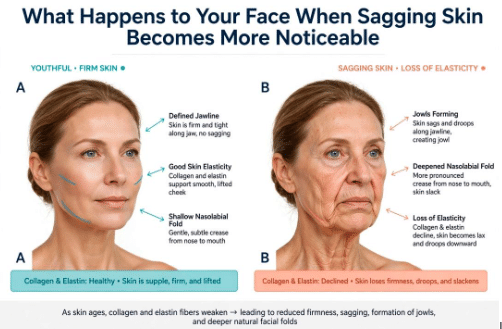
What Happens to Your Face When Sagging Skin Becomes More Noticeable
It usually happens on a video call. You catch your own face in the little corner window, mid-sentence and slightly downlit, and for a second the jawline looking back at you isn’t the one you picture in your head. The jowls sit a touch lower than you remember, the corners of your mouth turn down even when you’re not frowning, and your neck has softened in a way no amount of good lighting seems to fix.
Sagging skin is one of the most universal parts of getting older, and also one of the most quietly frustrating, because it changes how rested and approachable you look without changing how you actually feel. If you’re noticing these changes in Nashville, the good news is that sagging follows a predictable pattern, and once you understand what’s happening and why, the options start to make a lot more sense. Here’s how it unfolds
Why Skin Starts to Sag in the First Place
Young skin stays firm because of a steady supply of collagen and elastin, the proteins that give it structure and spring. Over time your body simply makes less of them, and the fat pads that once sat high in the face begin to slide downward, so skin that used to sit snugly now has less to hold on to.
The decline is more measurable than most people realize. As Scientific American notes, after the age of 20 a person produces about 1 percent less collagen in the skin each year. That slow, steady loss is exactly why sagging tends to creep in gradually through your forties and fifties rather than appearing overnight, and why it eventually becomes visible no matter how well you care for your skin.
The Jawline and Jowls Soften First
For many people, the jawline is where sagging shows up earliest and most clearly. A crisp, defined jaw is something we strongly associate with youth, so when the skin along it loosens and begins to form jowls, the whole lower face can start to look heavier and less sculpted than it once did.
This happens because the skin and fat that were once held tightly against the jawbone lose their support and drift below it. The result is that soft, slightly draped look along the sides of the chin, and it’s often the single change that makes someone first wonder what can actually be done about it.
When Skincare Stops Being Enough
It’s worth being honest about what good skincare can and can’t do, because this is where a lot of money gets spent with mixed results. Quality creams, serums, and in-office treatments work mainly at or near the surface; they can genuinely improve tone, texture, and fine lines, and they’re well worth doing. What they cannot do that; they physically lift and reposition tissue that has already descended, because that drooping is a structural change underneath the skin, not just a surface one.
That’s the point where many people start asking about a facelift in Nashville, a procedure that repositions the deeper layers of the face rather than simply tightening the skin on top. A practice such as Higdon Plastic Surgery will look closely at your skin quality, your underlying support, and your personal goals before suggesting whether surgery, a less invasive option, or some combination of the two makes the most sense for you. The aim of a modern facelift isn’t to pull the skin tight and flat, but to restore the natural position things used to sit in, which is why the results can look refreshed rather than obviously done.
The Neck Often Gives It Away
People tend to focus on the face and forget the neck, but the two age as a single unit, and the neck frequently shows looseness even earlier. Vertical bands can appear down the front, the skin under the chin can slacken, and what used to be a clean angle between the jaw and neck gradually fills in and blurs.
Because the neck is so hard to disguise, this is often what pushes someone from idly wondering to actually booking a consultation. Addressing the face without the neck can look incomplete, which is why the two are so often considered together when planning any kind of lift.
What a Facelift Actually Restores
It helps to reframe what this kind of procedure is really for. The goal isn’t to make you look like a different, younger person; it’s to turn back the specific changes that sagging created, restoring a defined jaw, a smoother neck, and a more rested overall look that matches how you feel.
When it’s done well and tailored to your face, the effect is the kind people can’t quite put their finger on. You look like yourself on a good day, rested and refreshed, rather than like someone who has obviously had work done, and that natural result is exactly the point.
The Bottom Line
Sagging skin is a normal, predictable part of aging, driven by slowing collagen, shifting fat pads, and gravity working on tissue that has lost its support. It shows up first along the jaw and neck, and while good skincare helps at the surface, it can’t lift what has structurally descended.
If the changes have reached the point where they bother you day to day, the most useful next step is simply an honest conversation with a qualified specialist. Understanding exactly what’s happening in your face is the first step toward deciding whether to do nothing, treat the surface, or restore the structure underneath.