Millions of Pressure Pulses, One Emergency: Writing the Design Basis for Tunnel Cross Passage Doors
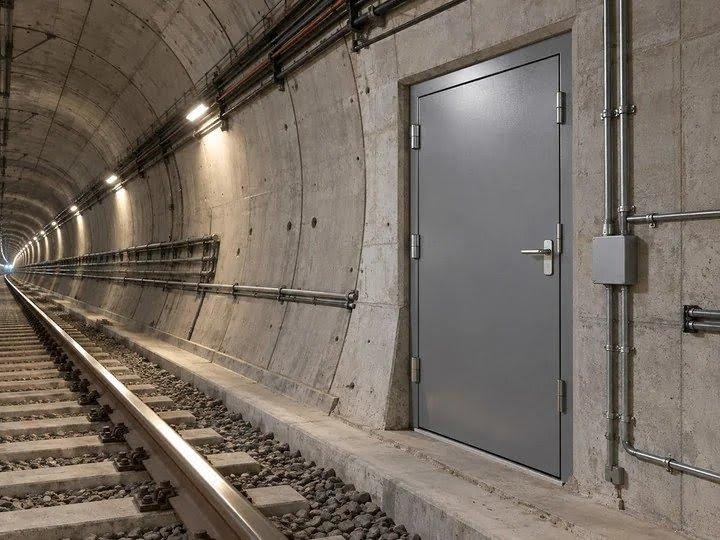
In a twin bore road or rail tunnel, cross passages link the two tubes. If a fire starts in one tube, people walk through a cross passage into the other, where the ventilation system keeps the air free of smoke. The tunnel cross passage doors at each end have three jobs: hold fire and smoke back, survive traffic pressure loads every day, and open easily when someone needs to escape.
Most tunnel specifications describe the first job well. Fire resistance and smoke leakage are familiar to fire engineers, with clear test routes. The second and third jobs often get a single line, and the conflict between them is left for the door supplier to find. This article sets out the inputs I ask for on tunnel projects, and why each one matters.
Do the Arithmetic on Cycles
A train or heavy vehicle passing through a tunnel creates a pressure wave. Each cross passage door feels a pulse with every pass, positive then negative. The two tubes are not at the same pressure at the same time, so the door also sees a pressure difference across it.
One pulse is small next to a blast or a wind load. The issue is the number. Take a metro line with a train in each direction every three minutes for 18 hours a day. That is around 720 passes a day, or more than 250,000 a year, and over a 30 year design life the door sees several million load cycles.
Locks, hinges, seals and frame anchorage must survive all that, and they fail from fatigue, not overload. A lock keeper that holds peak pressure in a static test can still crack after a few years of cycling.
So the first inputs a specification needs go beyond peak pressure:
- Peak positive and negative pressure at the door, from the project’s aerodynamic study.
- Number of cycles over the design life, or the traffic assumptions to calculate it.
- The fatigue verification method the project will accept, whether by calculation, test or both.
Tight Seals Make Escape Harder
The fire and smoke duty pushes toward tight seals and strong closing. The pressure duty pushes toward strong locking and stiff leaves. Both make the door harder to open.
Now think about escape. A person who has walked through smoke reaches the door, and the safe tube may be pressurized to keep smoke out. The door may be pushing back against them.
The project’s egress code sets a maximum force to release the latch, to set the door in motion and to swing it open. NFPA 101, for example, sets a separate limit for each step, and tunnel standards such as NFPA 130 and NFPA 502 refer back to egress requirements.
A heavy, tightly sealed door with a strong closer, opening against a pressure difference, can easily exceed those limits. The design answers are known: power assisted opening with a defined manual mode, locks that release under load, and closers sized to the real pressure condition. They only appear if the specification states the opening force limit and the incident pressure difference together.
The second set of inputs starts with the escape direction, one way or both ways. That choice decides between a single swing door with a push bar and a double acting door. Add the maximum opening forces at release, start and full opening, the pressure difference during ventilation incident mode, and the behavior on power failure, usually a mechanical release in the escape direction.
The Tunnel Environment
Tunnel doors live in one of the harshest settings in civil infrastructure. They face water ingress, washing with high pressure jets, brake dust, diesel soot in road tunnels and deicing salts carried in by vehicles. Seals get dirty, hinges corrode and electrical parts suffer.
The specification should state the corrosion category, the coating system and the operator’s cleaning method, so seals and finishes can survive it. It should also cover maintenance access, since many tunnels can only be entered during short night closures.
Monitoring and Control
Modern tunnels report the state of every safety element to a control room, and a cross passage door is no exception. Door position, lock status and faults should be signaled, and the door’s behavior in each state should be defined:
| State | Door behavior |
| Normal | Closed, locked or latched, monitored |
| Fire alarm | Available for escape on demand, assisted opening active |
| Power failure | Mechanical release in the escape direction |
| Fault | Signaled to control room |
| Maintenance | Drive isolated, door operable manually |
A one page state table agreed early saves long debates during commissioning, when the systems integrator and the door supplier each assume the other has decided.
From Inputs to a Door
Once the inputs are written down, the door can be designed around them. That means a fire rated steel box leaf with a mineral core and smoke seals, locking and hinges sized for peak load and fatigue, assisted opening sized to the escape force limit, a finish for wet and dirty conditions, and an interface for monitoring.
When YK Door Industry builds cross-passage doors for road and rail tunnels at its plant, a specialty door factory in Henan that also builds blast and fire-rated doors, the team starts every project by confirming these figures with the designer before any drawing is made. Whoever supplies the doors, the principle is the same: a door can only be verified against numbers that exist.
A Checklist for the Tunnel Specification
Before the door section of a tunnel specification is issued, check that it states:
- Fire resistance and smoke leakage requirements, with the test route.
- Peak positive and negative pressure at each door location.
- Number of pressure cycles over the design life.
- Fatigue verification method.
- Escape direction and maximum opening forces.
- Pressure difference across the door in incident ventilation mode.
- Power failure behavior.
- Corrosion category, coating system and cleaning method.
- Monitoring signals and the control state table.
- Site acceptance tests, including opening force measured on site.
A cross passage door may be needed for a real escape only once in the life of a tunnel. On that day, everything above decides whether it opens.
FAQs
What is a tunnel cross passage door?
It is a door at each end of a passage between two tunnel tubes. It holds back fire and smoke and lets people escape.
How much force should it take to open a tunnel escape door?
The project’s egress code sets it. NFPA 101, for example, allows 15 lbf to release the latch, 30 lbf to start the door moving and 15 lbf to open it fully.
Why do tunnel doors fail from fatigue and not overload?
Every passing train adds a pressure pulse, so parts take millions of cycles. Repeated stress cracks parts that passed a one time static test.