Top Online Music Schools for Adults in NYC Who Want to Learn on Their Own Schedule
You finally decided to do it. Learn piano. Pick guitar back up. Try voice lessons for the first time. And then you looked at your calendar.
Early meetings. Late calls. Weekends already spoken for. The idea of commuting to a studio at a fixed time every week starts to feel less like a hobby and more like a second job.
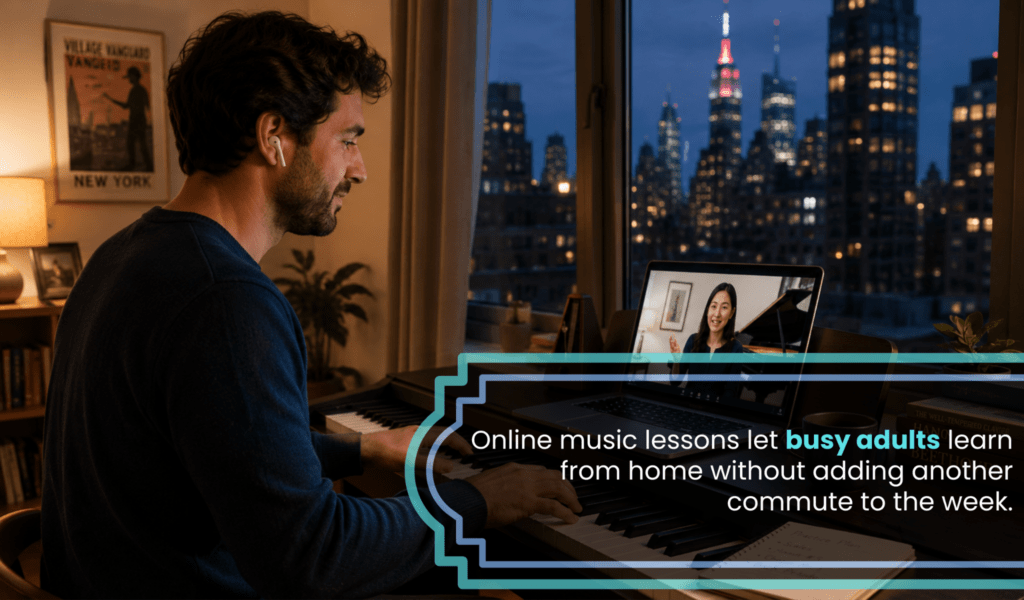
This is exactly why more adults in NYC are choosing private online lessons over traditional studio models. Same expert teachers, no commute, and a schedule that bends to your week instead of the other way around.
Here are five NYC-rooted music schools that have built their online programs specifically for adults with real lives.
1. Music To Your Home
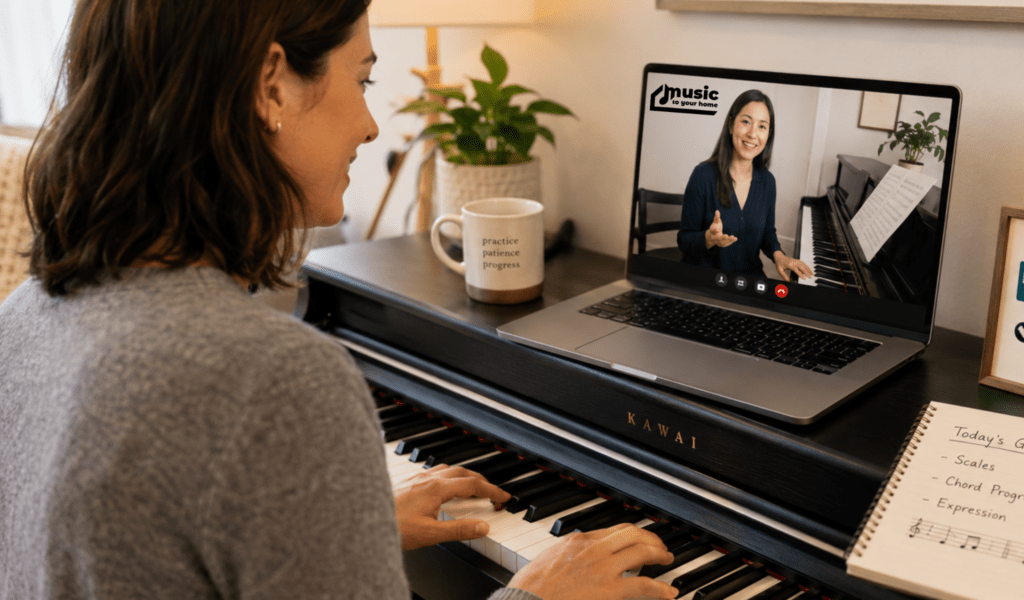
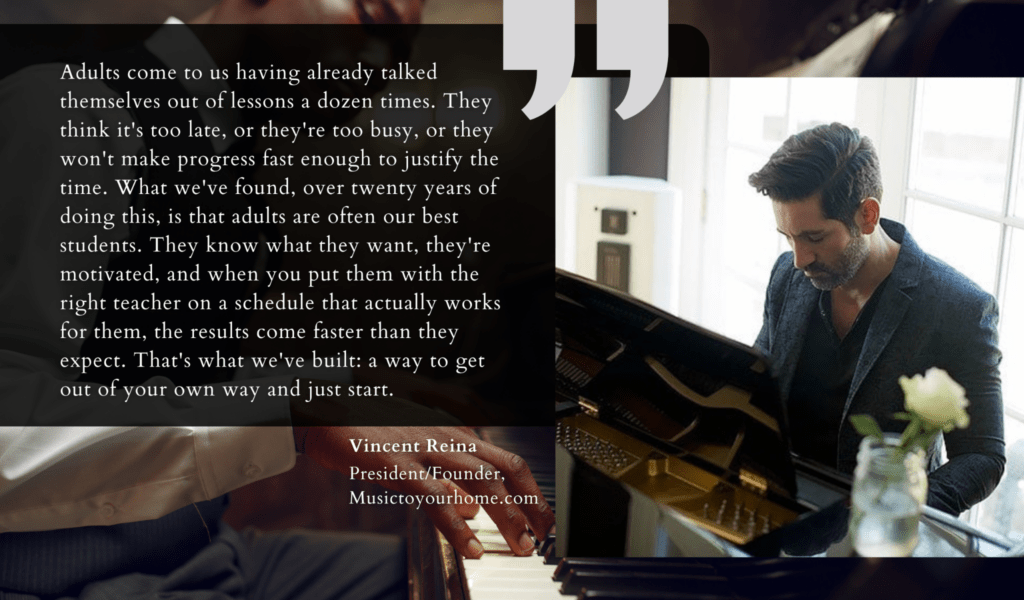
Music To Your Home was founded in 2003 by Vincent Reina, who began teaching piano lessons as a high school student and continued for twenty years before retiring his private studio to focus on growing the MTYH brand in NYC and, eventually, globally through online music lessons.
Co-founded with his wife Tracy, a classical voice alumna of the Crane School of Music who spent seven years as a staff producer at MTV Networks, the school was built from the start on a shared standard: only the best teachers, matched carefully to each student.
That standard has never moved. Vincent holds a Bachelor of Music in Piano Performance from Purchase Conservatory and a Master of Arts in Teaching Music from Manhattanville College.
He is an alumnus of the Manhattan School of Music Preparatory Division where he speaks regularly for their Entrepreneurship Program. MTYH teachers are drawn from the most prestigious conservatories in the country, including Juilliard, Manhattan School of Music, and NYU, and have performed on many of the world’s most famous stages. Every one of them is handpicked by Vincent through a rigorous interview process.
What makes it different
The USP for adults is simple: flexible online music lessons for adults with expert teachers without any drop in quality.
Online sessions are live, one-on-one, and built around your goals, whether you’re a complete beginner, returning to an instrument after decades, or an intermediate player looking to finally break through a plateau.
Same-day scheduling is available for most lessons, there are no rigid contracts, and if your teacher isn’t the right fit, MTYH will find a better match or refund unused payments.
For NYC residents who prefer in-person instruction, the in-home service covers all five boroughs and brings a vetted, background-checked teacher directly to your living room.
What it’s like to use
Getting started is fast. You contact the team, share your goals, availability, and instrument preference, and they match you with a teacher.
Scheduling is handled directly, response times are fast, and the whole process is designed to remove every friction point that causes adults to put music lessons off. Lessons are private, personalized, and focused on what you actually want to learn, not a fixed syllabus.
Best for: Adults and busy professionals in NYC and worldwide who want expert, flexible, personalized instruction
Instruments: Piano, guitar, voice, violin, drums, flute, cello, saxophone, and more
Formats: Online (worldwide) and in-home (all five NYC boroughs)
2. Sage Music (Long Island City, Queens)
Sage Music was founded by Jason Sagebiel, a music educator and composer whose work sits at the intersection of music, learning science, and real-world teaching experience, with a mission to create a better way for people to learn music: one that respects individual goals, supports long-term growth, and treats learning as a thoughtful, human process.
What makes it different
For adults who’ve tried lessons before and felt like they weren’t progressing, Sage’s system-first approach is a meaningful differentiator. Before lessons begin, students meet with a senior team member to determine goals, discuss learning style, assess skills and experience, and build a lesson plan. From there, students access a dedicated private online platform to attend lessons, set music goals, review lesson notes, practice homework, and manage their student account. Every lesson is recorded, so you can revisit anything you missed.
What it’s like to use
Expect a thorough onboarding before your first lesson. Sage takes time to understand what you want and why, then builds a plan around it. The student app keeps everything organized, from lesson notes to practice goals, so you’re never showing up to a session unsure of what you worked on last time. For adults who value structure and accountability, that continuity makes a real difference.
Who it’s best for: Returning musicians and adult beginners who want a methodical, measurable approach and the reassurance of a system built on learning science.
Best for: Adults who want a structured, science-backed system with measurable progress Instruments: Piano, guitar, voice, violin, cello, drums, saxophone, and more
Formats: Online (nationwide) and in-person (Long Island City, Queens)
3. Lucy Moses School at Kaufman Music Center
Lucy Moses School is part of the Kaufman Music Center on the Upper West Side, one of Manhattan’s most respected community arts institutions.
The school’s Adult Division matches each private lesson student with a faculty member suited to their skill level, schedule, learning style, and musical interests, and is known for its excellent teachers and nurturing, supportive environment.
The school speaks directly to the adult experience with a frankness that’s refreshing: “Have you always wanted to learn an instrument? Did you play music back in high school or college and then get so busy that you lost touch with something you loved?” That’s not a marketing copy. That’s the school knowing exactly who it’s talking to.
What makes it different
Online private lessons are available, and for adults who want to play with others, the school offers chamber music sessions guided by experienced coaches and jazz ensembles where students can share their love of music with like-minded musicians. That social dimension, real musical community, not just solo practice, sets Lucy Moses apart for adults who want more than a lesson.
What it’s like to use
Getting started involves a conversation with the Adult Division Manager, who handles the teacher matching personally. It’s a more deliberate onboarding than a direct-book platform, but the result is a better fit. Online lessons are available for those who can’t make it to the Upper West Side, and the school’s community events, recitals, and performances are open to all enrolled students.
Who it’s best for: Adults who want private instruction plus genuine musical community, especially those returning to music after a long gap or exploring it seriously for the first time.
Best for: Adults who want community alongside private instruction, from beginners to those returning to music after years away
Instruments: Piano, violin, cello, guitar, flute, voice, saxophone, brass, and more
Formats: In-person (Upper West Side, Manhattan) and online private lessons
4. Bloomingdale School of Music (Upper West Side)
Bloomingdale School of Music is a non-profit community music school on the Upper West Side founded in 1964, with a mission to provide access to high-quality music education to anyone who seeks it, regardless of economic status, ability level, ethnicity, or religious affiliation. Over 60 years later, it serves more than 800 students every week.
What makes it different
For adults, Bloomingdale’s combination of flexibility and community is genuinely unusual. Private one-on-one lessons are available in person and online, registration is ongoing and students can register anytime throughout the year, and the school offers 30-minute trial lessons for $30. That low barrier to entry matters for adults who want to try before committing.
For adults unable to make a long-term commitment, there’s an option for a package of six lessons scheduled based on availability. And for those who want more, Bloomingdale Bundles now combine 17 weeks of private lessons with group classes or ensembles at a special rate, so adults can grow their skills and make music with others at the same time.
What it’s like to use
Bloomingdale’s registration is straightforward and rolling, which means you can start at almost any point in the year. Trial lessons are cheap enough that there’s almost no risk to trying. The faculty is carefully matched to students by skill level and goals, and the warm, neighborhood-school atmosphere makes it easy for adults who might feel self-conscious about starting late to relax and just play.
Who it’s best for: Adults who want flexibility, an affordable entry point, and the option to learn solo or in a community setting across multiple formats.
Best for: Adults who want affordable, flexible private lessons with the option to add group classes and ensembles
Instruments: Over 20 instruments including piano, guitar, violin, cello, voice, flute, trumpet, drums, and more
Formats: In-person (Upper West Side) and online private lessons
5. New York Conservatory of Music (Upper East Side)
The New York Conservatory of Music was founded in 1998 by renowned concert pianist Dr. Jerzy Stryjniak and his wife, musicologist Joanna Stryjniak, and is located on the Upper East Side of Manhattan.
It sits at the more academically rigorous end of the spectrum, offering a structured approach that suits adults who want serious musical development alongside their private lessons.
What makes it different
The Conservatory is now accessible to online students from anywhere in the world, with instructors equipped for high-quality virtual instruction, flexible platform choice, and scheduling tailored to the student’s preference.
But the standout feature for serious adult learners is the master class program. Biweekly master classes are hosted by Dr. Stryjniak himself, where students perform their pieces in front of fellow attendees and receive personalized feedback in a format that simulates a public recital environment and offers a chance to learn from a variety of pieces and peer performances.
For adults who don’t plan to become professional musicians, the school’s approach to learning enhances musical appreciation, builds new skills, and is specifically noted as a way to reduce work-related stress. That’s a candid and useful framing for adults juggling demanding careers.
What it’s like to use
Expect a more traditional enrollment process and a curriculum with more classical structure than the other schools on this list. That’s a feature, not a limitation, for adults who want to learn music with rigor and depth. Online lessons are available and well-supported, and the master class access is a genuinely rare opportunity for adult learners who don’t want a casual hobby but a real musical education.
Who it’s best for: Serious adult learners who want conservatory-standard instruction, online flexibility, and access to master classes with a world-class pianist.
Best for: Adults who want a more structured, conservatory-style progression with access to master classes
Instruments: Piano, violin, viola, guitar, flute, clarinet, oboe, saxophone, voice, and more
Formats: In-person (Upper East Side) and online worldwide
How to Build Your Own Practice Schedule as an Adult
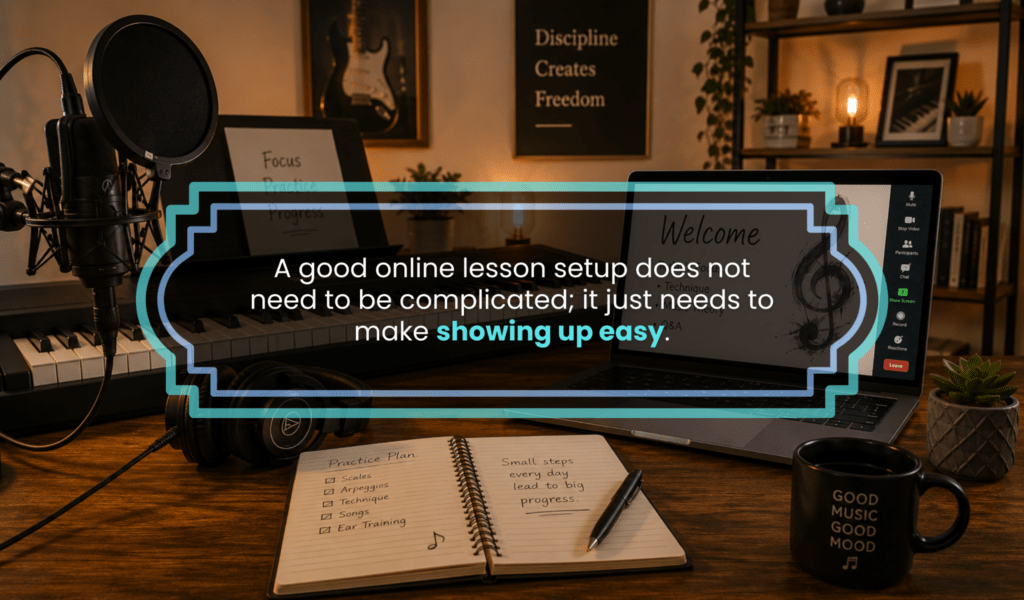
Finding the right school is step one. Keeping the momentum going is step two, and for busy adults, that means having a practice routine you’ll actually stick to. Here’s how to build one that works.
- Start with your real schedule, not your ideal one
Don’t plan to practice for 45 minutes every morning if your mornings are chaos. Look at your actual week and find two or three slots, even 20 minutes each, where you’re realistically available and mentally present. Consistency matters far more than duration. Three 20-minute sessions a week will move you forward faster than one irregular 90-minute block.
- Separate your practice types
Not all practice is the same, and mixing them up wastes time. For each session, decide whether you’re doing technical work (scales, exercises, technique drills), repertoire work (working through a piece section by section), or free play (improvising, playing through songs you enjoy, exploring). Each type builds a different skill. Rotating between them keeps practice from feeling repetitive and ensures you’re developing all three.
- Use your lesson to set the following week’s priorities
At the end of every lesson, ask your teacher one question: “What should I focus on this week?” That answer becomes your practice anchor. Everything else is secondary. Adults often over-plan practice and end up doing a little of everything and getting good at nothing. One or two specific focal points per week is enough.
- Keep the friction low
Leave your instrument out. Don’t store it in a case in a closet if you can help it. The less effort it takes to start playing, the more likely you are to actually start. A guitar on a stand in the living room gets picked up. A guitar in a case under the bed doesn’t.
- Track your streaks, not your hours
Apps like Streaks or a simple paper habit tracker work better than trying to count practice minutes. What matters is showing up. A three-minute warmup on a busy day counts. It keeps the habit alive and tells your brain that music is part of your routine, not an occasional project.
- Give yourself a performance goal
Adults progress fastest when there’s something to work toward. That doesn’t mean a public recital; it can be as simple as playing a song through cleanly for a friend, recording yourself on your phone, or hitting a specific milestone your teacher sets. Having a concrete target turns practice from a vague obligation into a clear purpose.
Whether you’re picking up an instrument for the first time at 35 or returning to piano after a twenty-year pause, the right teacher and a schedule that actually fits your life are the only two things you need to get started. The rest follows.
Ready to find the right fit?