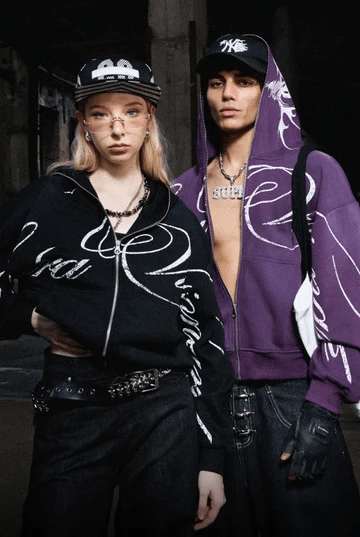
Today’s Streetwear Outfit
The fit, first. Charcoal boxy tee. Dark grey nylon cargo trousers, one break at the ankle. Salomon XT-6. Black nylon sling across the chest.
Four pieces, no readable logo. To understand why that’s an outfit and not an absence of one, you have to look at the six complete looks that built it — each one head to toe, each one a load-bearing moment.
1. Run-DMC — Hollis, Queens, 1986
Head to toe: black Godfather-brim fedora → black leather blazer → black Lee jeans → adidas Superstar, shell toe, worn laceless with the tongue pushed forward → thick gold rope chain.
Why it holds together: it’s a single unbroken column of black, interrupted exactly twice — gold at the throat, white shell toe at the floor. Two bookends, nothing in between competing. It is the most disciplined outfit on this list and it came first.
What it changed: the laceless shoe came from jail intake, where laces are taken. They took a mark of constraint and made it a signature — the founding move of streetwear. After My Adidas (1986) and a show where the group had the crowd hold their Superstars in the air with an adidas executive in the room, adidas signed them in a deal reported around $1.6 million. First time a sportswear brand paid a music act. First time a subculture’s whole outfit became a product line.
2. Stüssy — Southern California, 1990–94
Head to toe: bucket hat with the scrawled signature → oversized graphic tee → open plaid overshirt → Dickies 874 work pant → Vans Authentic.
Why it holds together: every piece is loose, yet the silhouette survives — because stiff cotton twill falls. Dickies hang off the hip instead of ballooning. Loose only works when the fabric has weight.
What it changed: Shawn Stussy scrawled his surname on surfboards, then on tees. The International Stüssy Tribe pushed the look to Tokyo and London and invented the grammar every brand still runs on: one graphic, limited run, no seasons.
3. New York winter, 1993–97
Head to toe: Carhartt beanie → hoodie under a Carhartt Detroit jacket → carpenter jeans or army fatigues → Timberland 6-inch wheat boot, top eyelets left untied.
Why it holds together: the boot. There is an enormous amount of volume above the knee and a heavy, blunt, earth-toned object holding it to the ground. This is the earliest full-scale proof of the rule that still governs today’s outfit — a heavy shoe is what makes a loose top legible.
What it changed: it made utility aspirational. Timberland never asked for it and for years didn’t know what to do with it.
4. Ura-Harajuku, Tokyo, 1999–2005
Head to toe: 1st Camo Shark full-zip, hood up and face zipped → oversized tee beneath → wide baggy denim → patent-leather BAPE STA.
Why it holds together: this is the only maximal look here that doesn’t collapse, and the reason is vocabulary. Camo, star, ape — one graphic language repeated head to toe. Loud is survivable if it’s loud in a single dialect.
What it changed: Nigo made scarcity a design material. Tiny runs, back-alley shops, queues. Every drop model since — Supreme’s Thursdays included — is running his software.
5. Peak logo, 2017
Head to toe: box-logo beanie → Supreme × Louis Vuitton monogram hoodie → Off-White industrial belt trailing off the waist → distressed denim → Air Jordan 1 “Chicago” from Virgil Abloh’s The Ten.
Why it doesn’t hold together: four memory points shouting simultaneously. Structurally it’s a mess — and in 2017 that was the point, because the outfit wasn’t a look, it was a résumé. Each item was a line on a CV of access.
What it changed: it ended. VF Corp bought Supreme for $2.1 billion in 2020 and sold it to EssilorLuxottica for $1.5 billion in 2024. Six hundred million dollars is roughly what the market charged for learning that a logo means nothing once everyone can buy it. This is the only outfit on this list that dated, and it’s the only one that broke the one-loud-thing rule.
6. Now — post-logo
Head to toe: cap or nothing → muted technical shell (Arc’teryx Beta, Snow Peak) → boxy tee → ripstop or nylon cargo → Salomon XT-6 or adidas Terrex → sling worn across the chest.
Why it holds together: it’s Run-DMC’s structure, carrying the NY winter look’s volume, built from Japanese workwear’s obsession with cloth — with the wordmarks deleted. When Amer Sports listed in 2024, Arc’teryx’s Greater China growth was outrunning the group’s. That isn’t a country taking up alpinism. That’s identity relocating from the logo to the material.
The point
Streetwear came out of eighties California skate and surf and eighties New York hip-hop blocks, and its original sentence was I know where I’m from. For about a decade that got mistranslated into I know what I can afford. The mistranslation cost six hundred million dollars.