The Ultimate Guide to Facial Lymphatic Drainage Massage: Benefits, Techniques, and At-Home Steps
You know the face. Puffy under the eyes, a little slack around the jaw, skin that just looks… tired. Bad night of sleep, too much soy sauce at dinner, a stressful week — any of it will do it. Serums and creams can only do so much here, because they’re working on the surface. The real fix is underneath, and that’s where lymphatic drainage massage comes in. It’s simple, it’s basically free, and honestly, most people are shocked at how fast it works.
Understanding the Facial Lymphatic System
Think of your lymphatic system as the body’s plumbing crew. It moves a clear fluid — lymph — that hauls away cellular waste, excess protein, and immune cells through a network of nodes. Blood has the heart to pump it along. Unlike lymph, which lacks this privilege and depends on the activity of muscles and breathing as well as pressure to move, thus being very prone to slow down without regular lymphatic massage.
Your face has node clusters along the jaw, under the chin, tucked behind the ears, and down the neck. Sit still too long, get inflamed, sleep wrong — fluid pools, and that’s the puffiness staring back at you in the mirror.
Core Science-Backed Benefits of Facial Massage
I’ve watched people write off massage as some spa-day gimmick, and then try it once and become believers within a week. The strokes are gentle. The results aren’t subtle.
- Deflating fluid retention.Unlike lymph, which lacks this privilege and depends on the activity of muscles and breathing as well as pressure to move, thus being very prone to slow down.
- Accelerating detox. Once the waste clears out, skin cells actually absorb what you’re putting on them — instead of fighting through backed-up fluid first.
- Brightening skin tone. Better circulation means a real glow, not the filtered kind.
- Easing tension. Jaw clenchers and forehead-furrowers, this one’s for you.
A quick example. Imagine how much your eyes swell from a lengthy flight. That is because of the cabin pressure and the lack of movement. In five minutes of using drainage strokes, you will see the swelling move down to the neck nodes.
Professional Treatments vs. At-Home Practice
Both have their place. I tell most people to start at home and only book a professional session if they’re dealing with something stubborn — post-filler swelling, chronic puffiness that won’t budge, that kind of thing.
| Feature | At-Home Massage | Professional Treatment |
| Primary Tools | Clean hands, facial oil, or a Gua Sha | Microcurrent devices, specialized suction cups |
| Cost & Accessibility | Free, doable daily | $100–$250 per session |
| Duration | 5 to 10 minutes | 45 to 60 minutes |
| Best Used For | Daily upkeep and mild morning puffiness | Deep tissue clearing and post-procedure recovery |
A Step-by-Step Guide to At-Home Drainage
Do this on clean skin with a bit of facial oil or moisturizer underneath — you need slip, or you’ll just be dragging your skin around, which does more harm than good. Every motion moves toward a node. Always.
- Clear the neck pathways. Start at your collarbones. Small circular presses with flat fingers, right above the clavicle. This opens the drainage gate — skip it and everything downstream backs up.
- Move down the neck. Stroke from behind the ears down to the collarbone. Do this 5 to 10 times.
- Sculpt the chin and jawline. Index and middle fingers in a V around your chin, glide out toward your ears.
- Drain the mid-face. Flat hands, sweeping from the sides of your nose out toward the temples.
- Soothe the eye area. Ring finger only — it’s naturally weaker, so you won’t overdo it. Trace from the inner corner under the eye out to the temple.
- Smooth the forehead. From the brows up to the hairline, out to the temples, and then back down the neck.
Essential Tools: Hands vs. Gua Sha vs. Facial Rollers
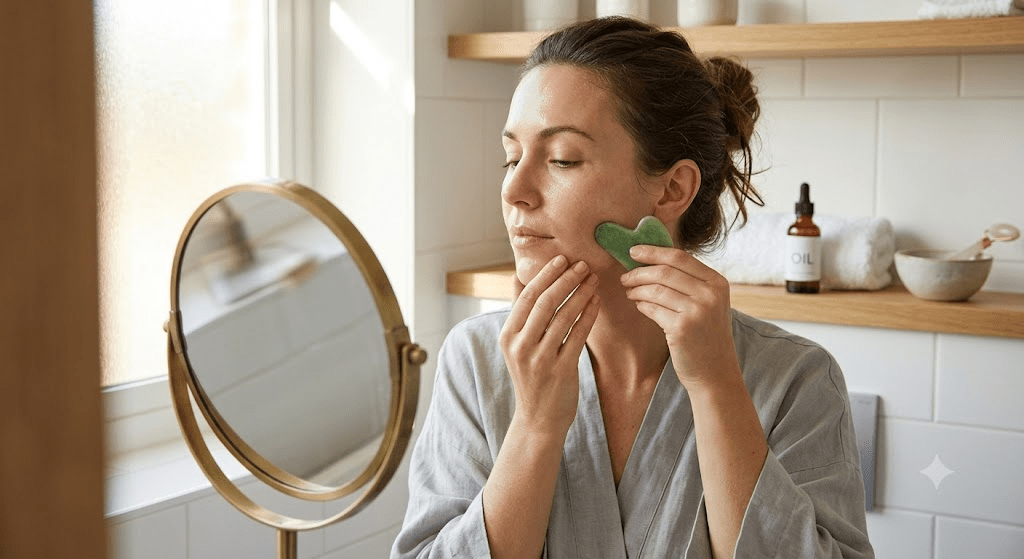
Fingertips give you the most control. You feel exactly where the tension sits, and you can adjust pressure on the fly — no tool does that as well as your own hands. Jade and quartz rollers are a nice entry point if you’re new to this; the cool stone feels great and glides evenly over flat planes like the cheeks. Gua Sha stones are the ones I reach for when I want real definition along the jaw and cheekbones. Contoured edges hug the bone in a way a roller just can’t.
Key Points to Remember
Light pressure. That’s the one rule people mess up most. Lymphatic vessels sit right under the skin, and if you press hard thinking you’re doing more good, you’re actually just squashing the very channels you’re trying to open. Always move outward and downward — toward the hairline, toward the neck. Drink water straight away; your kidneys need to clean out everything you have just gotten rid of. Also, if you have active acne or open wounds, stay away from that spot completely. Touching the infected part will just spread bacteria everywhere.
Conclusion
Five to ten minutes. That’s the task. In return you get less puffiness, sharper contours, and skin that actually looks like it’s had some sleep — even on the days it hasn’t. Whether you’re using bare fingertips or a Gua Sha stone doesn’t matter nearly as much as showing up for it daily. Consistency is the whole game here when practicing lymphatic massage
Frequently Asked Questions
How often should I do facial massage?
Daily is fine, and mornings work best — you’re clearing out whatever fluid settled overnight before it has a chance to set the tone for your whole day.
Can I perform this massage dry?
Don’t. Dry skin plus friction equals micro-tears you won’t notice until later. Oil, serum, rich moisturizer — pick one, just don’t skip it.
How quickly will I see results?
Fast. Under-eye puffiness and jaw tightness often visibly ease up after a single five-minute session.