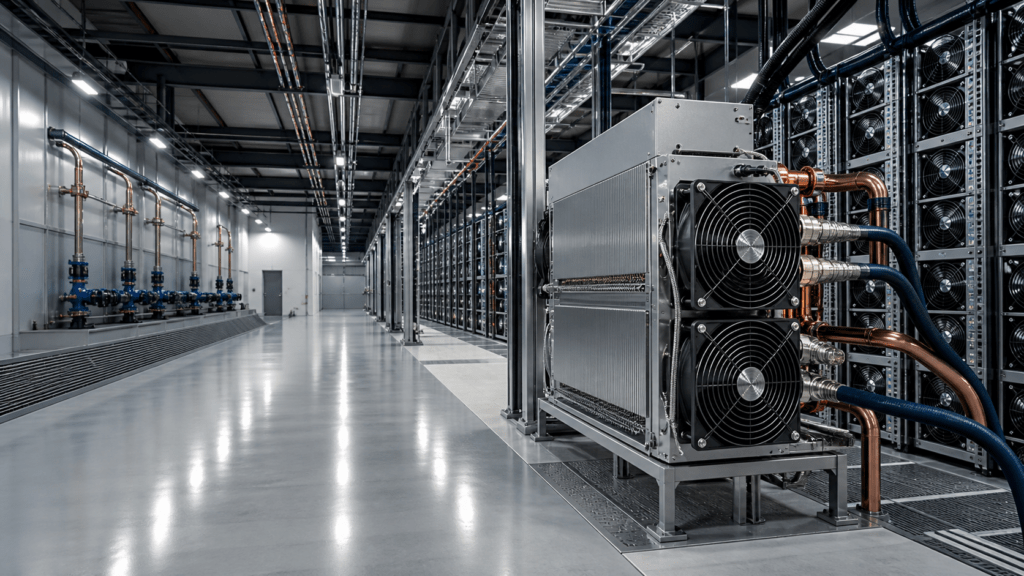
The End of the Hashrate Race: Why Bitcoin Mining Is Becoming an Infrastructure Business
For much of Bitcoin mining’s history, hardware discussions have revolved around one headline number: hashrate. A new machine arrived, delivered more terahashes per second than the previous generation, and immediately became the center of attention.
That way of thinking is becoming outdated.
Hashrate still matters, but modern mining economics are increasingly determined by the system surrounding the machine. Electricity contracts, cooling architecture, power density, uptime, firmware, maintenance access, curtailment agreements, and even heat-reuse opportunities can influence profitability as much as the ASIC itself.
Bitcoin mining is no longer merely a contest to own the fastest boxes. It is becoming a discipline of coordinated infrastructure design.
A Miner Is Only One Part of the System
An ASIC miner converts electricity into computational work and heat. The process sounds simple until hundreds or thousands of units must operate continuously in the same facility.
Every machine needs stable power, network access, cooling, monitoring, and physical space. It also needs to remain productive despite dust, temperature changes, voltage fluctuations, fan failures, firmware issues, and occasional network interruptions.
This is why comparing machines by hashrate alone is misleading. A high-performance model can become a poor investment if the facility cannot cool it efficiently or if its electrical requirements force expensive upgrades. Conversely, a slightly less powerful machine may produce better financial results when it fits existing racks, transformers, and ventilation systems.
Hardware selection therefore begins with infrastructure compatibility, not a leaderboard.
Manufacturers such as Bitmain have developed multiple ASIC configurations across different performance and cooling categories. That variety reflects a broader reality: there is no universally superior miner. The right choice depends on the energy source, climate, building design, operational strategy, and risk tolerance of the buyer.
Efficiency Is a Facility-Level Metric
ASIC efficiency is usually expressed as joules per terahash. A lower number means the machine requires less energy to perform the same amount of SHA-256 computation. This is one of the most important specifications in mining, particularly after block-reward reductions or increases in network difficulty.
However, machine efficiency is not the same as facility efficiency.
A miner may consume a certain amount of power at the wall, but the site also uses electricity for ventilation fans, pumps, cooling towers, lighting, networking, and auxiliary equipment. Engineers often evaluate the complete operation through metrics similar to power usage effectiveness, comparing total facility consumption with the electricity used directly by computing equipment.
If inefficient airflow adds ten percent to the site’s power demand, the advantage of newer ASICs can be partly lost. Poor rack spacing, recirculated hot air, undersized ducts, and dirty filters can all increase temperatures and force fans to work harder.
The next efficiency breakthrough may therefore come not from a chip, but from a better-designed building.
Air, Water, or Dielectric Fluid?
Cooling architecture has become one of the industry’s most consequential decisions.
Air cooling remains familiar and relatively straightforward. Fans move air through heat sinks and carry thermal energy away from the chips. It can work well in dry, cool environments where filtered outside air is abundant. The disadvantages include noise, dust exposure, fan maintenance, and limits on power density.
Hydro cooling transfers heat through a liquid circuit. This can support denser deployments and more predictable chip temperatures, but it requires pumps, heat exchangers, piping, water-quality management, and leak-prevention procedures. Operators must develop skills closer to those used in industrial mechanical systems.
Immersion cooling places mining hardware in a non-conductive dielectric fluid. Heat moves from the electronics into the liquid and then through a secondary cooling loop. Immersion can reduce acoustic noise and eliminate conventional miner fans, although tank design, fluid compatibility, component servicing, and capital expense introduce different challenges.
The best option depends on local conditions. A desert site, a hydroelectric region, and an urban heat-recovery project may arrive at completely different answers even when they run similar hardware.
Power Density Changes the Building
As machines become more powerful, mining facilities must accommodate more electricity and heat within the same physical footprint.
This affects transformers, switchgear, cables, breakers, busways, racks, ducts, pumps, and emergency systems. A building designed for an earlier hardware generation may not safely or economically support newer high-density equipment without renovation.
Operators evaluating an antminer should therefore examine more than its purchase price and projected daily revenue. They need to calculate how many units can be supported by the existing electrical system, whether the cooling design can remove the resulting heat, and how much capital is required before the machines can begin hashing.
This is where total cost of ownership becomes more useful than hardware cost. Shipping, tariffs, installation, infrastructure upgrades, spare parts, labor, pool fees, cooling overhead, and downtime all belong in the calculation.
A machine that appears inexpensive may become costly after installation. A more efficient model with a higher purchase price may reduce electrical and cooling expenses throughout its service life.
Uptime Beats Theoretical Performance
Mining economics are unforgiving of idle hardware. A machine generates no revenue while waiting for a replacement fan, network repair, or overloaded circuit to be restored.
For that reason, professional operators focus heavily on uptime. They monitor hashrate, chip temperatures, power consumption, fan speed, pool connectivity, and rejected shares. Automated alerts identify abnormal behavior before a complete shutdown occurs.
The physical layout also matters. Technicians need safe access to machines without interrupting an entire row. Cables should be labeled. Spare parts should be inventoried. Repair workflows should distinguish between faults that can be solved on site and units that require specialized service.
A slightly more efficient machine is not automatically more valuable if it is difficult to maintain or poorly supported. Reliability, firmware stability, parts availability, and service procedures affect real-world output.
In this sense, mining resembles aviation or industrial manufacturing: performance depends on disciplined operations, not merely advanced equipment.
Flexible Loads Meet Modern Energy Markets
One of Bitcoin mining’s unusual characteristics is that it can be interrupted. A factory may lose products if it stops suddenly, while a miner can usually power down and resume later without destroying work in progress.
That flexibility is increasingly valuable in electricity markets.
Facilities can schedule operation around time-of-use rates, reduce consumption during grid emergencies, or absorb energy that would otherwise be curtailed. Sites connected to wind or solar generation may increase mining activity when production is strong and reduce it when energy becomes scarce or more valuable elsewhere.
This does not automatically make mining beneficial to every grid. Outcomes depend on market rules, generation sources, transmission constraints, and operator behavior. Still, controllability gives mining a feature that many industrial loads do not possess.
The most sophisticated operations are beginning to treat electricity as a dynamic input rather than a fixed monthly bill. Software can compare mining revenue with power prices and determine when running, throttling, or shutting down creates the best result.
The facility becomes not only a computing site, but also an active participant in the energy market.
Heat Could Become a Second Product
Every watt used by mining hardware eventually becomes heat. Traditionally, operators have treated that heat as waste and paid to remove it.
A different model asks whether the thermal output can be sold or reused.
Mining heat can potentially support greenhouses, warehouses, drying processes, district-heating loops, or industrial water preheating. Liquid-based cooling makes this opportunity especially interesting because heat captured in a fluid is often easier to transport than warm exhaust air.
The economics remain highly location-specific. Heat has limited value when there is no nearby customer, and seasonal demand can complicate year-round planning. Additional pumps, pipes, heat exchangers, and backup systems also require investment.
Nevertheless, combining computation with a genuine thermal demand can improve total energy utilization. The mining site of the future may be planned around both an inexpensive power source and a valuable destination for heat.
Designing for Uncertainty
No infrastructure plan can remove cryptocurrency-market risk. Bitcoin prices change, network difficulty evolves, transaction-fee revenue fluctuates, and more efficient hardware eventually enters the market.
Good facility design cannot predict those variables, but it can create resilience.
Modular electrical systems make upgrades easier. Flexible racks accommodate new machine dimensions. Cooling equipment with appropriate capacity reduces the need for repeated reconstruction. Monitoring helps operators identify underperforming units, while access to multiple power strategies can protect margins during difficult periods.
Financial models should also include several scenarios instead of one optimistic payback date. Operators need to know what happens if revenue falls, power prices rise, delivery is delayed, or network difficulty increases faster than expected.
The strongest projects are not those that assume ideal conditions. They are those that can survive ordinary disappointment.
The New Competitive Advantage
ASIC development will continue, and improvements in chip efficiency will remain important. Yet hardware advantages inevitably narrow as competitors release new generations and network difficulty adjusts.
Infrastructure capabilities can be more durable.
A well-designed site can host several generations of equipment. A strong energy agreement can remain valuable after machines are replaced. Effective cooling, maintenance processes, automation, and trained personnel create operational advantages that cannot be copied simply by ordering the same hardware.
That is the central shift taking place in Bitcoin mining. The machine is still essential, but it is no longer the complete strategy.
The next winners will combine efficient hardware with intelligent power procurement, carefully engineered cooling, high uptime, flexible operation, and realistic financial planning. They will understand that hashrate is produced not by an isolated metal box, but by an entire physical and economic system working together.
Bitcoin mining’s future may still be measured in terahashes. Its competitive advantage, however, will increasingly be built in transformers, pipes, airflow, software, maintenance bays, and energy contracts.