The Compact Machine That Shows Up on Every Job Site — And Why Nobody Talks About It
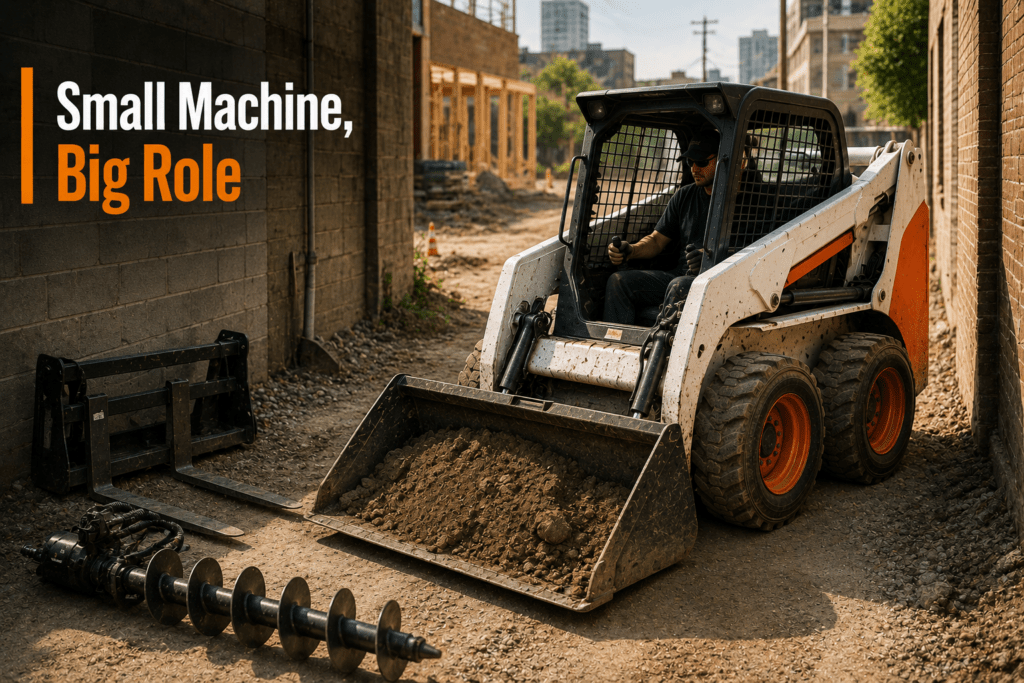
You’ve seen it. Parked on the edge of a construction site, tucked into a corner of a landscaping yard, or working along a narrow urban alleyway where nothing larger could fit. It’s small, it’s orange and white, and it moves with a kind of purposeful efficiency that’s oddly satisfying to watch. It can spin almost entirely within its own footprint, swap attachments in minutes, and operate in spaces that would stop a full-size machine cold.
Most people who see it every week couldn’t tell you what it’s called. The answer is a skid steer loader — and if you work in construction, agriculture, landscaping, or a dozen other industries, it’s one of the most useful machines ever built.
What a Skid Steer Loader Actually Does — and Why Job Sites Can’t Function Without One
The name comes from how it steers. Unlike a conventional wheeled vehicle that turns by pointing its front wheels in a new direction, a skid steer changes direction by driving one side faster than the other — or running one side in reverse — causing the machine to skid and pivot. It’s the same principle that makes a tank able to spin in place, applied to a compact construction machine that weighs a few tonnes rather than the many dozens a tank carries.
That steering system makes skid steers extraordinarily maneuverable. They can turn within a circle roughly equal to their own length, which means they can work effectively in spaces that would be inaccessible to larger equipment. A full-size excavator or wheel loader needs room to operate. A skid steer can work in a basement, inside a barn, along a narrow trench, or right up against a wall.
What makes them even more useful is the attachment system. The front of a skid steer accepts a wide variety of tools — buckets, forks, augers, trenchers, grapples, brush cutters, snow blowers — all of which connect to a standardized mounting plate and can typically be swapped in a matter of minutes. The machine itself is the power unit. The attachment determines what job it’s doing today.
Why Bobcat Became the Name That Defined an Entire Category of Machine
Bobcat didn’t invent the skid steer concept, but they were among the earliest manufacturers to commercialize it at scale — and more importantly, they spent decades making it ubiquitous. The company launched its first skid steer in the 1960s, at a time when the concept was still being proven, and methodically refined the design through the following decades. By the time competitors arrived in force, Bobcat had established the kind of brand recognition that turns a product name into a category descriptor.
Today, many people in the industry refer to any skid steer as a “Bobcat” the way people call any facial tissue a Kleenex. The actual Bobcat lineup covers a wide range of compact equipment — skid steers, compact track loaders, compact excavators — but the orange skid steer remains the machine most closely associated with the name.
That dominance wasn’t accidental. Bobcat built machines that held up under sustained, demanding use across a huge variety of applications. They were designed to be serviced by operators and mechanics without specialized training. Bobcat also invested early in parts distribution, so finding what you needed to keep a machine running wasn’t a hunt — it was a phone call. The combination of mechanical simplicity and supply availability added up to a brand that contractors trusted with real work.
The Engine That Powered a Generation of Bobcat Machines — and Still Does
Behind the Bobcat nameplate, the actual power often came from a different manufacturer entirely. Many classic Bobcat models used Kubota diesel engines — a partnership that made practical sense. Kubota had built a strong reputation for small, reliable, low-maintenance diesels in agricultural and light industrial applications. Bobcat needed a proven power unit that its customers’ mechanics could work on without specialist training. The Kubota V1702 became one of the defining engines of the Bobcat lineup, and the 743 is the model that best illustrates why that combination worked.

Built from the mid-1980s through the early 1990s, the 743’s four-cylinder, liquid-cooled V1702 produces around 36 horsepower, uses mechanical fuel injection rather than electronic systems, and was deliberately designed to be maintained without specialist equipment. Decades after production ended, a significant number of 743s are still earning their keep on job sites and farms — which says something real about how well the design held up. Anyone currently running one, or thinking about picking one up, will find the specifications and maintenance insights for the Bobcat 743 engine useful — it covers the Kubota V1702 in detail, from core specs and maintenance intervals through to troubleshooting common issues and deciding whether a rebuild or a replacement engine makes more sense.
The V1702 is also notable for its cross-brand presence. The same engine appeared in equipment from CASE, Gehl, Mustang, and New Holland — which means parts supply and remanufactured engine availability has stayed healthy long after the 743’s production run ended.
What Keeps a Bobcat Running When Parts Wear Out
A skid steer operates under real stress. It lifts, pushes, and pulls repeatedly across long shifts, often in dusty or debris-heavy environments. The components that take the most punishment — fuel injectors, hydraulic seals, filters, solenoid valves, oil coolers, belt tensioners — wear at predictable rates, and keeping a machine running means staying ahead of that wear rather than responding to it after something fails.
The practical challenge for operators and repair shops is sourcing the right replacement parts without long lead times or excessive cost. OEM parts through a dealer are often the slowest and most expensive option. The aftermarket has expanded significantly over the past decade, with suppliers stocking engine components, hydraulic parts, and filter kits for a wide range of Bobcat models. Fab Heavy Parts is one such supplier — their bobcat parts collection covers engine components, hydraulic parts, filter kits, and service items for both classic models like the 743 and current S and T-series loaders, available for fast dispatch.
Why the Compact Machine in the Corner of Every Job Site Deserves More Credit Than It Gets
There’s something almost paradoxical about the skid steer’s position in the construction world. It’s one of the most versatile, widely deployed, and genuinely irreplaceable pieces of equipment in the industry. It shows up on practically every job site of any meaningful scale. And yet it’s one of the least discussed and least celebrated machines in the public consciousness.
The excavator gets the dramatic footage. The crane gets the wow factor. The skid steer gets the job done — quietly, efficiently, in the corner, without attracting much attention. For the contractors who depend on them, that’s exactly the point. A machine that works reliably, accepts whatever attachment the job needs, and fits wherever the work is happening doesn’t need to be impressive. It just needs to show up every morning and run.