
Singapore Emerges as Southeast Asia’s Video Production Hub: Regional Campaign Spending Surges 55%
Something noticeable is happening in Southeast Asian marketing. Brands that used to run separate video productions for Indonesia, Malaysia, Thailand, and the Philippines are now doing it all from one place: Singapore.
Regional campaign spending through Singapore-based video production grew 55% between 2023 and 2025. That’s not a small uptick. That’s brands making a deliberate decision to consolidate.
And the reasons come down to three things:
- Singapore’s regulations are stable,
- its talent is genuinely world-class,
- and its infrastructure is simply better than anywhere else in the region.
Industry estimates suggest that a substantial share of cross-border production activity now flows through Singapore, as companies prioritise consistency, efficiency, and scalability across regional campaigns.
Why Singapore Wins Regional Production
The honest answer is that Singapore makes regional production less complicated. Singapore has become a natural choice for video production in Southeast Asia because everything works smoothly and clearly.
Regulatory Stability
When financial services brands run campaigns across five ASEAN markets, compliance can delay timelines, but Singapore reduces that risk through –
- trusted guidelines from the Monetary Authority of Singapore,
- healthcare standards set by the Health Sciences Authority,
- and globally respected content rules from the Infocomm Media Development Authority.
Strong IP protection also ensures creative work stays secure, giving Singapore a level of regulatory confidence that no other Southeast Asian city can match in one place.
Technical Infrastructure
Singapore’s internet access is very strong, with about 98% of households connected, according to the Infocomm Media Development Authority, which helps production teams quickly transfer large video files from cities like Jakarta or Bangkok.
It also has high-quality studios, easy access to RED and ARRI cameras, and strong post-production services like colour grading, VFX, and animation that match global standards.
Talent Pool
Singapore topped the IMD World Digital Competitiveness Ranking in 2024, placing first among 67 global economies. It ranked first specifically in Talent, Regulatory Framework, Business Agility, and IT Integration. Those are not abstract categories. They are exactly what a regional production operation depends on every day.
And the talent is multilingual in a way that matters. Singapore crews work across English, Mandarin, Malay, and Tamil as a baseline, with many also covering Bahasa Indonesia, Thai, or Tagalog. That’s not just useful for regional campaigns, it’s essential.
Logistical Efficiency
With Changi Airport, travel is easy. Teams can move quickly across ASEAN countries, making regional production faster.
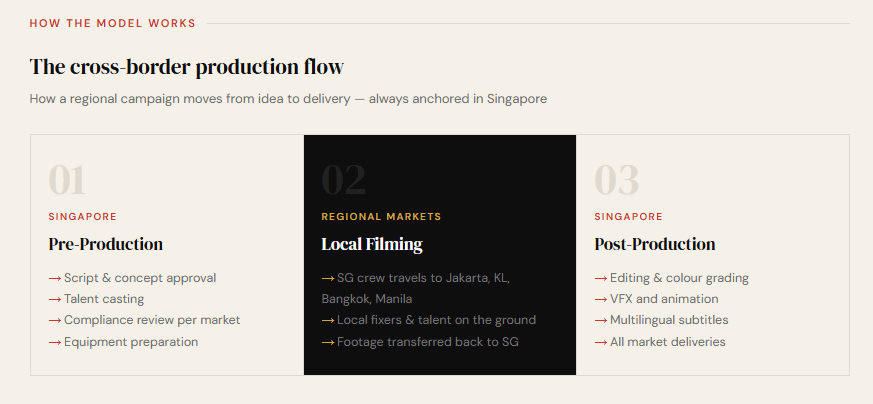
How a Regional Campaign Actually Works From Singapore
The video production workflow across Southeast Asia is now more structured. The model is straightforward once you see it. Here is the typical workflow for cross-border campaigns:
Pre-Production in Singapore
Everything strategic stays in Singapore. The script gets written here. Creative concepts go through approval here. Compliance gets reviewed here for every market the campaign will run in. Casting happens here, equipment gets prepped here, and the production schedule gets locked here.
Regional Filming
Then the crew travels. A Singapore-based director of photography leads the shoot in Jakarta. A local fixer in Bangkok sources the supporting cast. A production coordinator manages logistics in Manila.
Post-Production Centralized
Footage comes back to Singapore for post-production: one editing suite, one colour grade, one VFX pipeline, delivering multiple formats, multilingual subtitles, and market-specific versions all at once.
According to Moving Image, a video production company in Singapore that works across Singapore and Malaysia, 45% of our 2025 projects involved cross-border filming, up from 28% in 2023. Brands choose this approach because centralised pre- and post-production protects quality while local filming keeps each market’s version feeling authentic.
Which Industries are Leading This Shift
Three industries account for most of the regional production work flowing through Singapore right now.
| Industry | Share of Regional Campaigns | What They Need Most |
| Financial Services | ~35% | Regulatory compliance + brand consistency |
| Technology | ~25% | Technical accuracy + localisation |
| FMCG / Consumer Brands | ~20% | Cultural adaptation + cost efficiency |
| Healthcare, Education, Automotive | ~20% | Specialist compliance + audience targeting |
Here are the details.
Financial Services
Financial services lead regional campaigns, making up about 35%, as banks, fintech firms, and insurers need video production partners who understand strict compliance rules. If a campaign passes review by the Monetary Authority of Singapore, it is usually well-positioned for other Southeast Asian markets.
The region’s advertising market reached USD 28.34 billion in 2025 and is expected to grow at 14.52% annually through 2031, with financial services remaining one of the top-spending sectors.
Technology
Technology companies, such as SaaS platforms, e-commerce players like Shopee and Lazada, and telecom providers, make up roughly 25% of regional campaigns.
These brands need content that is both technically accurate and culturally adapted for different markets. Singapore’s video production teams have strong experience in handling both requirements, which makes them a reliable choice for regional campaigns.
FMCG
Fast-moving consumer goods (FMCG) dominated Southeast Asian advertising with a 28.74% share in 2025. FMCG brands also make up about 20% of the regional campaigns produced in Singapore.
How Centralised Production Cuts Regional Campaign Costs by 30–40%
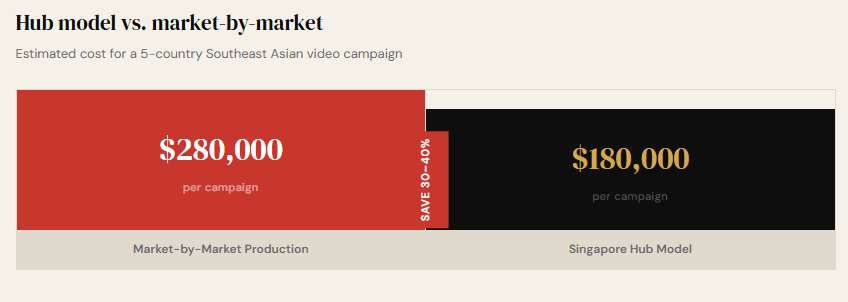
The hub model is popular mainly because it saves money. Instead of repeating planning in each country, brands do it once in Singapore. A five-country Southeast Asian campaign costs around USD 180,000 using the Singapore hub model.
The same campaign produced market-by-market costs of roughly USD 280,000. That’s a saving of 30–40%, and the quality is higher because one team controls the whole thing.
Where does the saving come from? Pre-production runs once instead of five times. Script development, storyboarding, legal review, and creative approvals all happen in a single process.
Post-production centralises in one facility. A Singapore crew travelling to each market costs less than building independent local production teams in five countries.
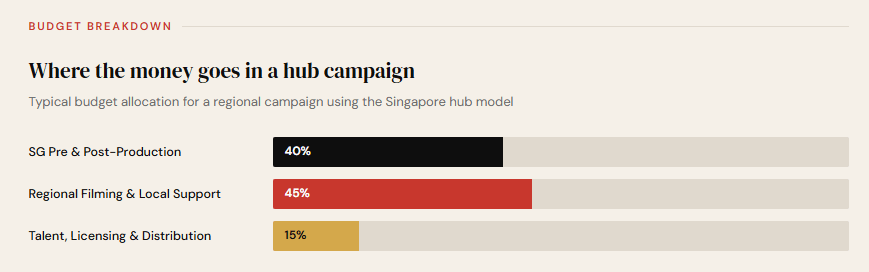
A typical budget splits like this:
- 40% – Singapore pre-production and post-production
- 45% – Regional filming and local production support
- 15% – Talent fees, licensing, and distribution
The One Challenge Worth Talking About
The hub model has strong benefits, but it also brings one key challenge. A Singapore-based event video production and campaign approach can sometimes feel slightly Singapore-centric, especially for audiences in places like Jakarta or Chiang Mai. For example, a script may be correct in Bahasa Indonesia but still sound unnatural to local viewers, so local consultants and native speakers must be involved from the start, not only at the final stage.
Another challenge is the different regulations across Southeast Asia. Each country has its own rules for financial ads, healthcare claims, and content standards, so strong teams use country-specific compliance checklists and legal reviews before release.
Market Forecast: Regional Consolidation Trend Accelerates Through 2027
Regional production is growing quickly, and more brands are choosing one central hub instead of managing each country separately. Singapore is becoming the top choice because it offers better control, quality, and efficiency across markets.
- The Asia-Pacific video production market is expected to grow at 41.1% CAGR (2024–2030), according to Grand View Research, with Singapore at the centre.
- Support from Infocomm Media Development Authority and co-funded productions is strengthening its position, while its share of regional hub production may reach 60% by 2027.
- At the same time, Southeast Asia’s advertising market hit USD 29.6 billion in 2024 and is projected to grow around 12% annually through 2033, based on UnivDatos
The Bottom Line
Singapore is clearly becoming the centre of video production in Southeast Asia. More brands are choosing to manage regional campaigns from one place because it saves money, improves quality, and speeds up delivery.
This analysis is based on Moving Image’s cross-border Singapore production projects 2023–2025, including client surveys, budget analysis, and industry interviews. Market data sourced from IMDA, IMD World Competitiveness Centre, Mordor Intelligence, and Grand View Research.