Social Media Risks: How Location Check-ins Can Damage Your Premises Claim
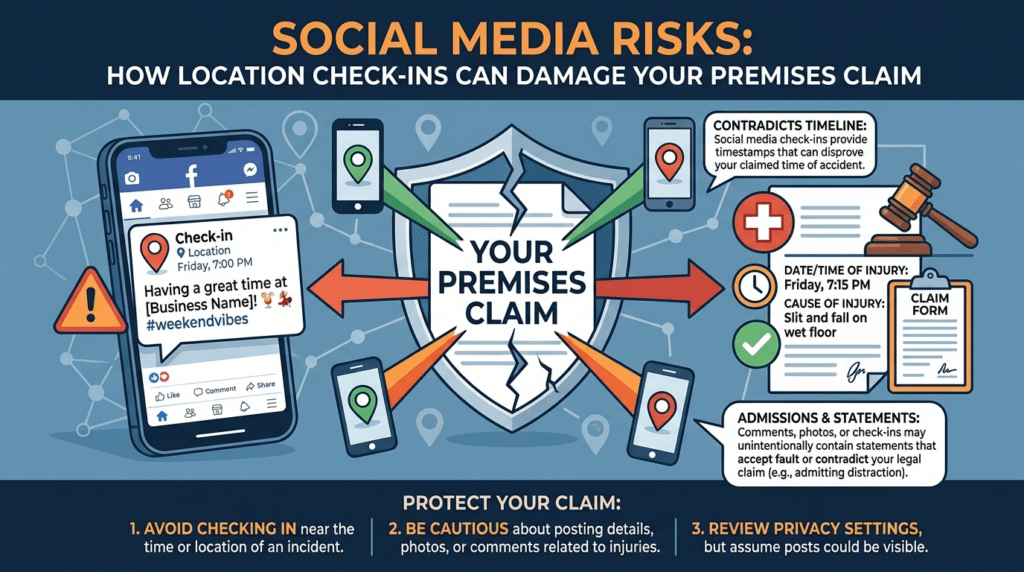
Many people treat social media like a personal diary. They share where they are, what they are doing, and how they feel without much thought. However, if you have a premises liability claim, each post, tag, and check-in can be used against you by the insurance company. What seems like a harmless update to friends can look very different in court.
Location check-ins can pose a significant risk in a personal injury case. A single tag at a restaurant, gym, or friend’s house can contradict your injury claims in ways that are hard to explain. Insurance adjusters keep an eye on claimants’ social media and can take posts out of context. Knowing this can help you better protect your claim.
Why Insurance Companies Monitor Your Social Media
Insurance companies have entire teams dedicated to investigating claimants online. Their job is to find anything that contradicts what you told them about your injuries and limitations. Social media makes that job remarkably easy because most people post publicly without realizing who might be watching. A single scroll through your profile can give an adjuster everything they need to challenge your claim.
This monitoring starts the moment your claim is filed. Adjusters search for your name across every major platform, including Facebook, Instagram, TikTok, and even LinkedIn. A premises liability attorney in Tulsa will tell you that screenshots, saved videos, and documented check-ins are captured before you ever have a chance to delete them. Knowing this changes how you should approach social media from the very first day after your accident.
What a Location Check-in Actually Tells an Insurer
When you check in at a location, it shows more than where you were; it can indicate your physical ability at that time. For instance, if you check into a mall after claiming a knee injury, it suggests you were mobile. The insurer won’t know if you used a wheelchair; they only see the location and make judgments.
Check-ins also reveal patterns. Frequent visits to restaurants or social outings create an image of an active lifestyle that insurers might use to challenge your claimed limitations. This can lead to lower settlement offers, as each check-in adds to the story they build against you.
The Most Damaging Types of Location Tags
Not all check-ins carry the same risk. Some places can harm your premises liability claim. Knowing which locations to avoid can help you prevent giving insurers an easy argument. A premises liability attorney often advises clients to stop location sharing right after filing a claim for this reason.
Here are the location types that cause the most damage to injury claims:
- Gyms and fitness centers, because any check-in at a workout facility directly contradicts claims of physical limitation or chronic pain.
- Amusement parks and sporting events, because these environments require significant physical activity and stamina that insurers will argue is inconsistent with serious injury.
- Bars and nightclubs, because late-night social outings suggest a level of energy and mobility that undermines claims of ongoing suffering.
- Travel locations, including airports, hotels, and tourist attractions, because travel implies the physical capacity to endure long periods of standing, walking, and carrying luggage.
- Outdoor recreational areas like hiking trails, beaches, and parks because these settings visually suggest physical activity even when you are simply sitting or resting there.
How Deleted Posts Can Still Hurt You
Many people think that deleting a post or check-in after an accident will fix the issue. It won’t. Insurance companies often save social media content quickly, even before someone realizes they need to delete it. Screenshots taken before a post is removed can also be used as proof in court or during settlement talks.
Removing posts after filing a claim can lead to another legal issue. Courts may see this as spoliation, which means purposely destroying evidence. This can hurt your credibility and give the other party a reason to argue that you are hiding something. The best choice is to stop posting instead of trying to erase what is already online.
Friends and Family Can Hurt Your Claim Too
You might carefully control your own posts, but friends and family can still share information without realizing it. Tags in photos, comments with your location, or public videos can all be found by insurers. So, it’s important to talk to your close circle.
Let them know about your situation early. Ask them not to tag you in photos or videos, mention your location, or share anything publicly that includes you. A quick conversation can prevent accidental sharing that could complicate things later. Your lawyer can help you assess if any existing content may harm your claim.
What to Do With Your Social Media Accounts Right Now
If you have a premises liability claim, focus on your social media accounts now. Your actions in the next few days can protect your case or cause difficult problems. Acting quickly and carefully is essential for your claim.
Here is what to do with your accounts right away:
- Stop all location check-ins immediately on every platform including Facebook, Instagram, Snapchat, and any app that tracks or shares your location automatically.
- Review your privacy settings on all accounts and restrict public access as much as possible while understanding this is not a complete solution.
- Audit your existing posts and discuss anything potentially sensitive with your attorney before deciding whether to leave it or address it.
- Talk to friends and family and ask them not to tag you, mention your location, or share any content involving you until your case is resolved.
- Turn off automatic location sharing in your phone settings and within individual apps that may be posting your location without you actively choosing to share it.
- Document everything about the accident scene, your injuries, and your medical treatment separately and securely in a way that is not connected to any public platform.
Privacy Settings Are Not a Complete Shield
Setting your social media accounts to private after filing a claim may seem protective, but it’s not foolproof. Courts can still order you to disclose private content if it’s relevant to the case. A private account doesn’t shield your posts from legal scrutiny.
Additionally, mutual connections can share sensitive information unknowingly. Insurance investigators can create fake profiles or use indirect links to access your restricted content. Experts advise keeping social media activity to a minimum during open claims to avoid risks.