Peptide Recovery Claims in Sport: A Better Way to Read the Evidence
Recovery stories move quickly in sport. A molecule is discussed in a laboratory paper, the finding becomes a headline, and the headline becomes a promise. By the time the claim reaches an athlete or coach, the original experiment may be almost unrecognizable.
Peptide research is especially vulnerable to this compression. The word “peptide” covers approved medicines, naturally occurring signaling molecules, experimental compounds and products sold only for laboratory work. Treating those categories as interchangeable produces bad science communication and poor decisions.
Start by defining what “recovery” means
Recovery is not one measurable outcome. It can refer to soreness, range of motion, tissue remodeling, inflammation markers, sleep, return-to-play time or subjective readiness. A study that changes one laboratory marker has not automatically demonstrated faster healing or better athletic performance.
The first useful question is therefore simple: what exactly improved, in whom, and over what period? Precise outcomes make it harder for marketing language to borrow certainty from a result that was narrow by design.
Use an evidence ladder, not a yes-or-no verdict
Mechanistic studies can show that a pathway is biologically plausible. Cell experiments can isolate that pathway. Animal models can test a controlled injury or inflammatory condition. Human studies can then ask whether the effect translates under real biological variability. Each stage matters, but each answers a different question.
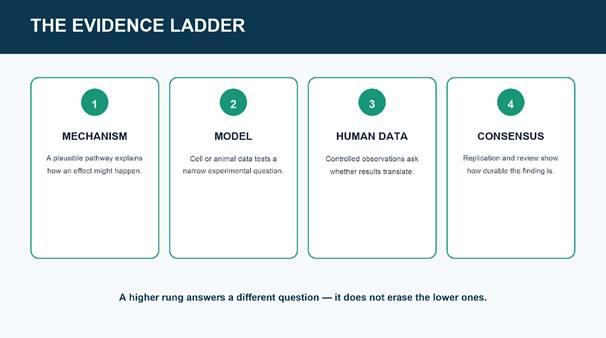
The common mistake is jumping from the first or second rung directly to a practical sports claim. A signaling change in cultured cells does not establish a recovery benefit in athletes. An animal model can justify further study without establishing an appropriate product, route, dose or outcome for people. Responsible reporting preserves those boundaries instead of treating them as fine print.
Separate three questions that headlines often blend
- Does the compound have an interesting biological mechanism?
- Has a meaningful benefit been demonstrated in controlled human research?
- Is the substance approved, lawful under the relevant rules and permitted in sport?
A “yes” to one does not answer the others. A compound may have a credible mechanism and still lack clinical evidence. An approved medicine may be prohibited in competition. An experimental research compound may appear in scientific databases while remaining unapproved for human use.
Anti-doping status is its own evidence check
The World Anti-Doping Agency updates its Prohibited List annually. The 2026 list includes broad categories as well as named examples. Section S0 covers non-approved substances, while S2 covers peptide hormones, growth factors, related substances and mimetics. BPC-157 is explicitly identified under the non-approved-substance framework.
That structure matters because absence from a social-media list is not proof that a compound is permitted. Athletes and support personnel should consult the current official list and their governing organization rather than relying on a product page, forum post or old screenshot. Anti-doping rules are compliance documents, not popularity rankings.
A certificate of analysis proves less than many readers assume
A laboratory report can help establish identity, purity or measured content for a particular sample. It does not prove that a compound improves recovery, that every unit sold matches the tested sample, or that the substance is approved for use. Those are separate claims requiring separate evidence.
The document itself must also be read carefully. The compound name, lot number, testing date, laboratory identity and method should align. “Third-party tested” without a traceable report is a slogan, not a result. Even a legitimate purity value should not be stretched into a statement about sterility, safety or performance.
Read the source before reading the summary
A useful evidence review begins with the original paper or regulatory document. Check the study population, comparison group, sample size, measured endpoints and limitations. Then compare those details with the headline. If the summary adds athletes, injuries, faster healing or practical outcomes that the study never measured, the claim has outgrown its source.
Independent research directories can help organize compounds, supplier documentation and current research boundaries. One starting point is https://peptidestack.io/, but the linked information should still be checked against the original study, the current testing record and the applicable rules.
A six-question claim check
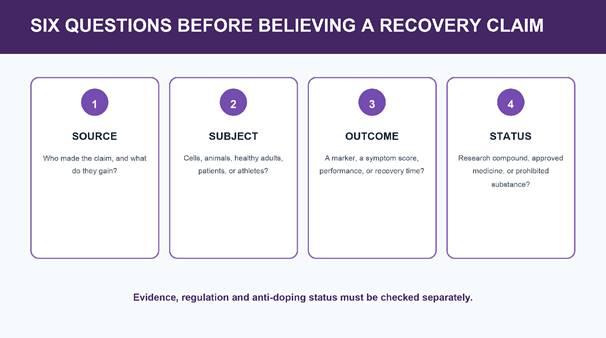
- What is the original source: a paper, press release, product page or testimonial?
- What was studied: cells, animals, patients, healthy adults or trained athletes?
- What outcome changed, and was that outcome directly relevant to recovery?
- Was the result replicated or supported by more than one research group?
- What is the compound’s regulatory and anti-doping status today?
- Does the product documentation match the exact lot being discussed?
What responsible sports coverage looks like
Good reporting can discuss promising research without turning uncertainty into a sales pitch. It names the model, describes the actual endpoint, distinguishes association from causation and says when human evidence is missing. It also separates scientific interest from permission to use a substance.
This standard is not anti-innovation. It protects innovation from being judged by claims the evidence was never designed to support. When a compound eventually earns stronger evidence, the progression from mechanism to replicated human outcomes will be visible rather than implied.
Why personal stories cannot close the evidence gap
Recovery anecdotes are persuasive because they are concrete: a person describes an injury, a change and an outcome. What the story cannot isolate is the cause. Training load, rehabilitation, sleep, time, concurrent treatment and expectations can all change together. Without a comparison group, the improvement cannot be assigned confidently to one compound.
That does not make the person dishonest or the experience meaningless. It means the story is a signal that may justify a research question, not a substitute for controlled evidence. Responsible coverage can quote an experience while labeling it accurately and refusing to convert it into a general result.
A checklist for editors, coaches and readers
Before sharing a claim, preserve the study population, model and outcome in the first sentence. State whether the compound is investigational or approved. Check the current anti-doping list rather than an older summary. If the article discusses a commercial product, separate its batch documentation from claims about biological effects. Finally, make uncertainty visible in the headline—not only in the last paragraph.
The practical takeaway
Peptide recovery claims should be treated as a chain of evidence, not a single dramatic headline. Define the outcome, identify the research stage, verify the original source, read product testing narrowly and check current sport rules independently. If any link in that chain is missing, the honest conclusion is not “proven” or “disproven.” It is “not established yet.”
This article is for research and educational purposes only. It does not provide medical advice, product-use instructions or anti-doping legal advice.