AI Baby Generator and the New “What If” Workflow for Curious Creators
A Faster Way to Test an Idea
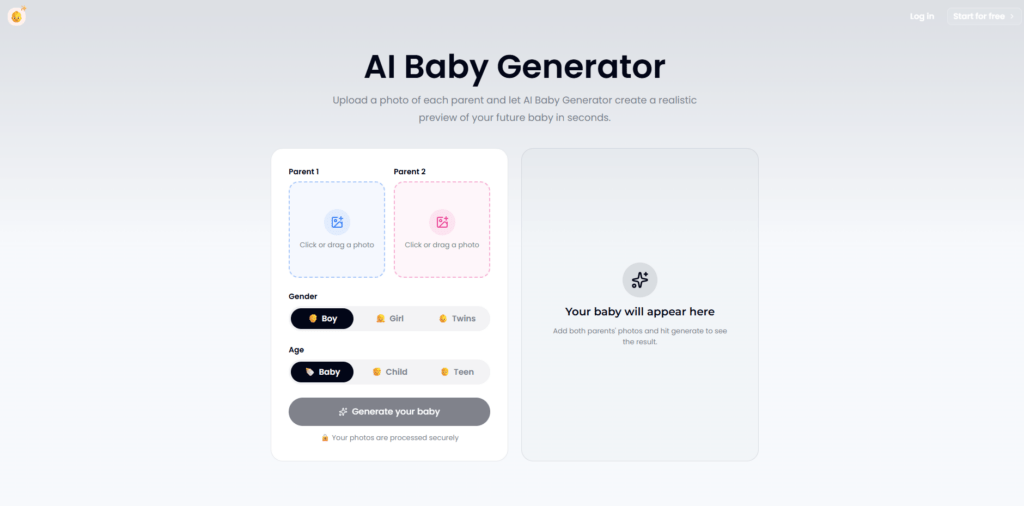
When I first looked at Baby Generator, I did not treat it like a magic trick. I treated it like a fast way to answer a simple question: what happens when a playful idea needs a visual result in seconds? For creators, that matters because the cost of “just trying one more version” is often time, not money. In that sense, AI Baby Generator is less about prediction and more about quick visual exploration.
That is also why this kind of tool fits the current wave of generative AI adoption. McKinsey reports that 88 percent of organizations say they use AI in at least one business function, but most are still in experimentation or piloting mode, which shows how common “test first, scale later” has become. Baby-focused image tools sit in that same mindset: low commitment, fast feedback, and easy comparison.
Why People Keep Trying It
The appeal is not hard to understand. People are naturally curious about identity, family, and future possibilities, and AI gives that curiosity a visible shape. For content creators, that makes the tool useful in a different way: it becomes a small but highly shareable concept for social posts, reaction content, and casual audience engagement.
It also fits a broader trend in how people use AI. McKinsey notes that generative AI is increasingly used in marketing, content support, and workflow redesign, not just for heavy technical tasks. So while the output here is playful, the behavior behind it is real: users want a quick, visual answer before they decide whether a bigger creative effort is worth it.
What the Tool Actually Does
At a basic level, the product takes parent photos and blends facial cues into a baby-style portrait. That means it is closer to an image synthesis workflow than a scientific prediction engine. From a user’s point of view, the value is speed and convenience, not medical accuracy.
This is where the difference between traditional methods and AI becomes obvious. In a normal workflow, a creator would need a designer, a photo editor, and a lot of time to create a similar “what if” visual. With AI, the process collapses into a few uploads and a short wait. That shift is exactly what makes AI Baby Generator interesting: it compresses a playful concept into something people can actually test right away.
Why It Works for Content People
For creators, the tool is most useful when the goal is not precision but reaction. A thumbnail idea, a short-form joke, a family-themed post, or a curiosity-driven prompt all benefit from fast visual output. The real win is that you can move from idea to image without opening a full design workflow.
I also think this matters because users rarely read digital content in a deep, linear way. Nielsen Norman Group has long shown that people scan pages rather than read every line, which is why a strong visual hook matters so much in social and creator-led content. A baby-style AI image fits that behavior well because it delivers an instant visual answer with almost no explanation needed.
Where the Limits Show Up
The weak point is that the result can feel more like an interpretation than a real forecast. That is not a flaw unique to this tool; it is a general limitation of generative media. If the source photos are awkward, low quality, or too different in style, the output can look inconsistent.
There is also a privacy question any user should notice. Some review coverage of AI baby tools mentions photo deletion policies and GDPR-related handling, which makes sense because these apps depend on personal images. For users, that means the experience is not just about the picture; it is also about whether the platform handles sensitive uploads responsibly.
How I’d Use It
I would use a tool like this for curiosity, content concepts, or lightweight social experiments. I would not use it as a serious decision-making tool, and I would not read too much into one generated result. That line matters because the product is strongest when it stays in the playful lane.
From a workflow angle, it is best seen as a fast prototype layer. You upload, check the result, compare a few outputs, and decide whether the idea is worth expanding. That makes the tool feel closer to a creative draft system than a finished product.
Final Take
What makes Baby Generator worth noticing is not that it promises certainty. It is that it gives people a quick, visual answer to a question they were already asking. That is a simple product idea, but it fits the way people now explore AI: fast, visual, and low-friction.
For creators, that is the real story. Tools like this are not replacing deeper creative work. They are reducing the time it takes to decide whether an idea has legs. And in a crowded content workflow, that is often enough to matter.