The Complete Guide to Naomi Osaka: Career, Life & Legacy
Why Naomi Osaka Matters Beyond Tennis
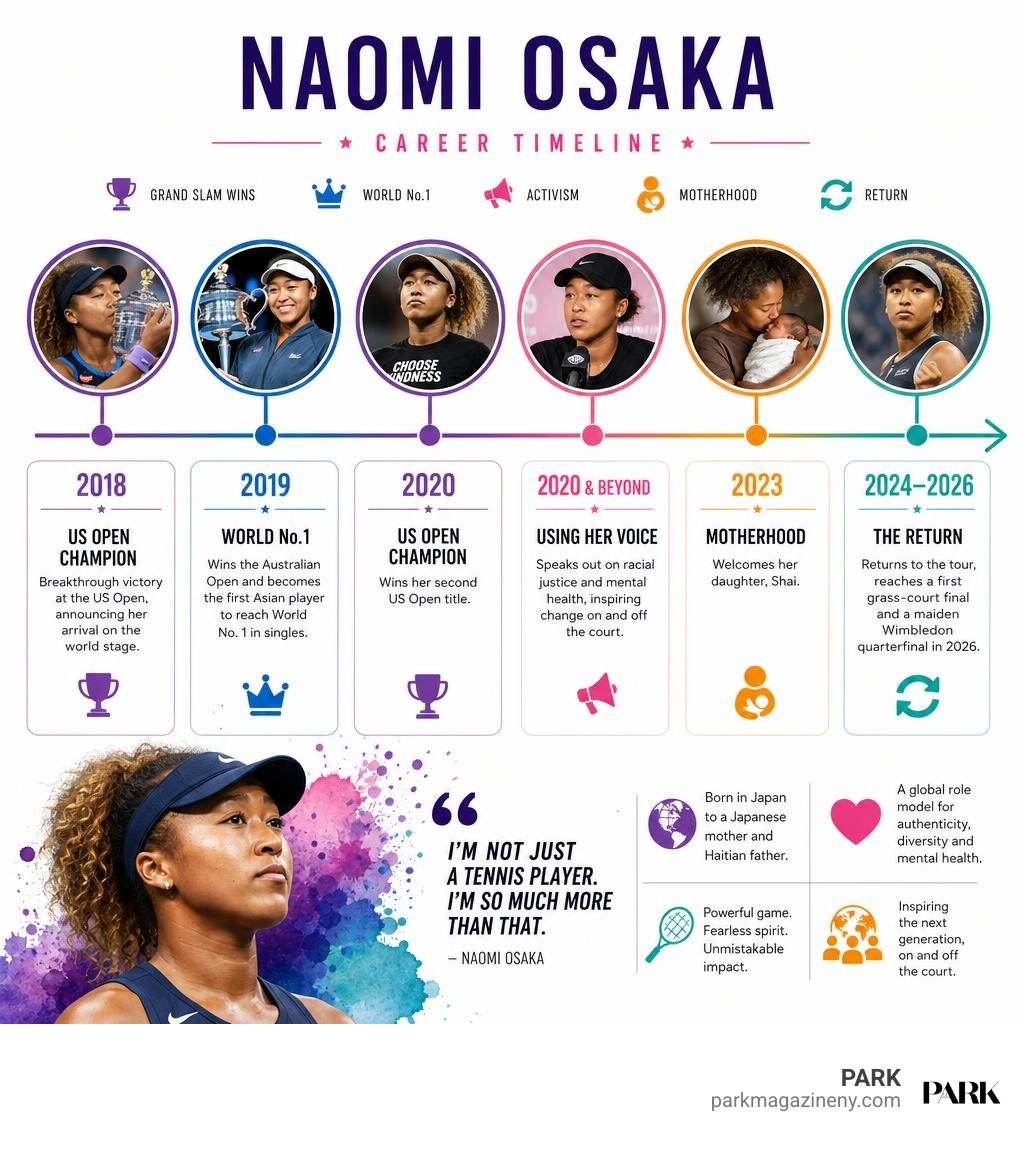
Naomi Osaka is a four-time Grand Slam champion, the first Asian player to reach world No. 1 in singles, and one of the most influential athletes of her generation. She has won the US Open twice and the Australian Open twice, while using her global platform to speak openly about racial justice, mental health, motherhood, and multicultural identity.
Her career changed tennis history in 2019, when she rose to No. 1 after winning the Australian Open. But Osaka’s legacy is wider than rankings and trophies. Born in Japan to a Japanese mother and Haitian father, and raised in the United States, she represents a more global and more candid model of modern sport.
From her breakthrough win over Serena Williams at the 2018 US Open to her return after giving birth to her daughter Shai in 2023, Osaka has combined elite power tennis with unusual honesty about the pressure behind it. Her 2026 season, including a first grass-court final and maiden Wimbledon quarterfinal, suggests that a new chapter is still unfolding.
I am W.A. Muller, and this guide explores the career, character, business reach, and lasting impact of Naomi Osaka.
Quick naomi osaka terms:
The Rise of Naomi Osaka: Early Life and Major Breakthroughs
The story of how Osaka reached the pinnacle of international tennis is one of unconventional development, immense family sacrifice, and unwavering self-belief. Born in Osaka, Japan, to Tamaki Osaka and Leonard François, she moved with her family to the United States at the age of three, settling in Elmont, Long Island, New York. It was there, on local public park courts across New York, that her relationship with the sport began.
Her father, inspired by watching the Williams sisters dominate the 1999 French Open on television, saw a viable path forward. Despite possessing no prior tennis background, François studied the training methods Richard Williams used to coach Venus and Serena. He established a rigorous training program for Naomi and her older sister, Mari, focused on heavy repetition, athletic agility, and aggressive baseline hitting.
Rather than follow the conventional American junior tennis pathway, the family made a deliberate choice to bypass the ITF Junior Circuit almost entirely. Instead, Osaka honed her game in private training sessions and local matches before transitioning directly into professional ITF Women’s Circuit qualifying tournaments on her 14th birthday.
Her breakthrough into global awareness arrived at the 2014 Bank of the West Classic in Stanford. At just 16 years old and ranked No. 406 in the world, she qualified for the main draw and defeated former US Open champion Samantha Stosur in a thrilling three-set match after saving a match point. That display of explosive hitting and composure signaled the arrival of a rare talent. By 2016, she was officially voted the WTA Newcomer of the Year. For a deeper look at her tournament records, you can review the Official WTA career profile and milestones.
| Tournament | Year | Surface | Opponent in Final | Final Score |
|---|---|---|---|---|
| US Open | 2018 | Hard | Serena Williams | 6–2, 6–4 |
| Australian Open | 2019 | Hard | Petra Kvitová | 7–6(2), 5–7, 6–4 |
| US Open | 2020 | Hard | Victoria Azarenka | 1–6, 6–3, 6–3 |
| Australian Open | 2021 | Hard | Jennifer Brady | 6–4, 6–3 |
Multicultural Roots and Early Training Blueprint
Osaka’s multicultural identity—shaped by her Haitian father, Japanese mother, and American upbringing—has guided her personal journey and public voice. When her family relocated to Florida to gain access to year-round outdoor training facilities, her mother, Tamaki, worked extensive overtime hours in New York’s import and export business to support the family’s tennis ambitions. Naomi practiced during the day and completed her schoolwork at night alongside Mari, driven by a deep desire to ease the financial burdens placed on her parents.
The decision for Naomi and Mari to represent Japan in international competition was made early by their parents. It reflected their deep connection to Japanese heritage and maternal family culture, as well as an initial lack of developmental interest from traditional domestic tennis associations. That cultural blend gave Osaka a unique perspective on identity and global representation, which we often explore across our celebrity biography coverage.
Historic US Open and Australian Open Triumphs
Osaka’s transition from a promising prospect to a dominant force occurred with remarkable speed. At the 2018 US Open in New York, she charged through the draw with devastating baseline power to reach her first major final against her childhood idol, Serena Williams. Osaka displayed supreme poise under immense pressure, capturing her first major title in straight sets, 6–2, 6–4.
She followed that victory by winning the 2019 Australian Open in Melbourne, outlasting Petra Kvitová in a grueling three-set final. In doing so, Osaka became the first player since Jennifer Capriati in 2001 to win her first two Grand Slam singles titles back-to-back. The victory propelled her to the WTA World No. 1 ranking on January 28, 2019, making her the first Asian singles player—male or female—to achieve the world’s top ranking.
Her dominance on hard courts continued over the subsequent two seasons. At the 2020 US Open, held in New York during the height of the COVID-19 pandemic, she rallied from a set and a break down to overcome Victoria Azarenka, demonstrating expanded tactical patience and mental fortitude. Months later, she secured her fourth major title at the 2021 Australian Open by defeating Jennifer Brady in straight sets. Winning each of her first four Grand Slam finals placed her alongside Roger Federer and Monica Seles as one of the few players in Open Era history to accomplish that milestone.
Evolution of Playing Style, Coaching, and the 2026 Resurgence

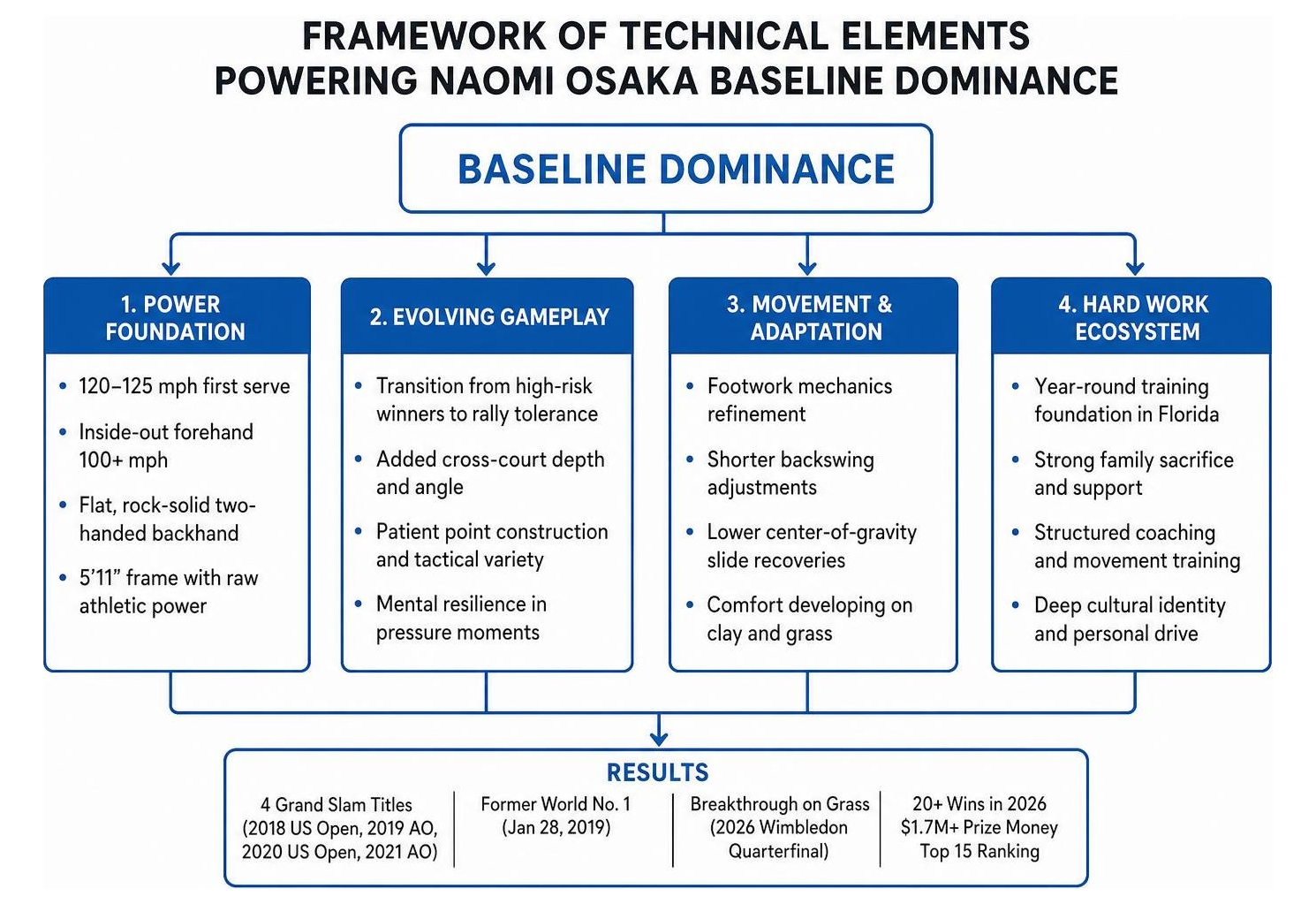
Osaka is one of the most formidable aggressive baseliners the sport has produced. Standing 5’11”, she pairs raw athletic power with smooth, fluid movement across the back of the court. Her primary offensive weapon is her first serve, which consistently clocks over 120 mph and has reached up to 125 mph (201 km/h), placing her among the ten fastest servers in WTA history.
Complementing her serve is a lethal inside-out forehand, recorded at speeds over 100 mph (160 km/h) since her teenage years, and a rock-solid, flat two-handed backhand. While her early career relied primarily on overpowering opponents with high-risk winners, her game has evolved to incorporate rally tolerance, angled cross-court depth, and patient point construction.
Technical Mastery and Surface Adaptations
Historically, Osaka’s flatter groundstrokes and high bounce preferences yielded her greatest triumphs on hard courts. Developing comfort on natural surfaces, specifically red clay and grass, represented her major developmental hurdle. Under structured movement training, she adjusted her footwork mechanics, learned to shorten her backswing, and incorporated lower center-of-gravity slide recoveries.
These adjustments produced undeniable dividends throughout the 2026 season. After reaching the fourth round at the French Open, Osaka enjoyed a breakthrough grass-court swing. She advanced to her first career grass-court final and produced an exceptional run at Wimbledon, stunning world No. 1 Aryna Sabalenka in straight sets (6–2, 7–6) en route to her first Wimbledon quarterfinal. That resurgence carried her win total past 20 victories for the year, raised her 2026 prize money over $1.7 million, and propelled her back into the WTA Top 15.
Coaching Milestones: From Sascha Bajin to Tomasz Wiktorowski
Key coaching partnerships have played an important role in sharpening Osaka’s tactical execution:
- Sascha Bajin (2017–2019): Built on-court consistency, positivity, and point-building endurance, guiding Osaka to her maiden titles at Indian Wells, the 2018 US Open, and the 2019 Australian Open.
- Wim Fissette (2020–2022, 2023–2024): Refined her return-of-serve positioning, match strategy, and rally patience, resulting in victories at the 2020 US Open and 2021 Australian Open.
- Patrick Mouratoglou (2024–2025): Provided tactical reinvention during her post-maternity tour return, focusing on forward court movement and transition volleys.
- Tomasz Wiktorowski (2025–Present): Instilled disciplined baseline footwork, grass-court point construction, and emotional clarity, unlocking her deep runs in the 2026 Grand Slam season.
Cultural Impact, Mental Health Advocacy, and Identity
Osaka’s cultural footprint extends far beyond tournament scorelines. In 2021, she was chosen to light the Olympic cauldron during the Opening Ceremony of the Tokyo 2020 Olympic Games, symbolizing modern, multicultural Japan on the world stage. That same year, she served as a co-chair for the Met Gala in New York, celebrating American fashion and her own diverse heritage.
We continually celebrate how sports icons drive culture forward, regularly documenting notable charitable events and impact initiatives shaping the cultural landscape. To understand her foundational worldview, readers can reference Naomi Osaka’s official background for additional insights into her journey.
Naomi Osaka and the Power of Athlete Activism
At the 2020 US Open in New York, Osaka brought international attention to the fight for civil rights and racial justice. Across the seven rounds of the tournament, she entered Arthur Ashe Stadium wearing seven individual black face masks, each bearing the name of an African American victim of violence, including Breonna Taylor, Trayvon Martin, and George Floyd. When asked after winning the final what message she hoped to send, she calmly replied: “The point is to make people start talking.”
In 2021, Osaka shifted the global conversation around athlete well-being when she withdrew from mandatory press conferences at the French Open, citing the severe impact on her mental health, anxiety, and periods of depression. After facing fines and public scrutiny from tournament organizers, she chose to withdraw from the tournament entirely to rest and regroup.
Her vulnerability prompted a complete re-evaluation of media obligations, athlete psychological care, and working conditions across professional sports leagues worldwide. By openly stating that winning matches no longer brought her unconditional happiness if her peace of mind was compromised, Osaka normalized setting boundaries in elite sports.
Redefining Representation and Global Fashion
As a Japanese-Haitian-American woman, Osaka has reimagined modern athletic representation. She served as the inspiration for the manga character Unrivaled Naomi Tenkaichi in the popular Japanese publication Nakayoshi, and debuted runway-ready fashion capsules at New York Fashion Week with designer ADEAM.
Her creative collaborations with global luxury fashion houses illustrate how athletes influence high-end design, much like cultural fashion icons like Margot Robbie. Osaka has consistently leveraged apparel, hair styling, and accessories to celebrate Black and Japanese heritage on the world’s most visible sporting stages.
Entrepreneurial Legacy and Personal Evolution

Osaka has transformed the business model for modern female athletes. In 2020, Forbes reported that she earned $37.4 million in a single calendar year—including $34 million from global endorsement deals—making her the highest-paid female athlete in sports history over a 12-month span. By mid-2026, her career prize money surpassed $25.7 million, placing her 17th on the all-time WTA earnings list.
Rather than remaining a traditional endorser, Osaka transitioned into an equity builder and team owner. She became a co-owner of the North Carolina Courage in the National Women’s Soccer League (NWSL), invested in professional pickleball franchises, and founded Hana Kuma, an independent media production company dedicated to telling culturally diverse and uplifting stories.
Inside the Business Empire of Naomi Osaka
In 2022, Osaka took full control of her commercial enterprise by parting ways with legacy agency IMG to co-found Evolve, a boutique sports and talent agency alongside her longtime agent, Stuart Duguid. Evolve was designed to offer elite representation while allowing athletes to retain substantial equity in their brands and ventures.
The agency quickly expanded its roster, signing other generation-defining talents, echoing the rising market influence of elite female athletes like Angel Reese.
Beyond athlete management, her business portfolio includes:
- KINLÒ: A skincare and sun-protection brand formulated specifically for melanated skin tones.
- Boba x Ice Cream: An early equity investment and ambassadorship in the super-premium, 100% lactose-free dessert brand celebrating AAPI flavors.
- Global Brand Partnerships: Long-term design and ambassador relationships spanning luxury timepieces, apparel, and consumer technology.
Motherhood, Balance, and Long-Term Vision
In early 2023, Osaka announced her pregnancy, taking a 15-month hiatus from the WTA Tour. Alongside her partner, Grammy-nominated recording artist Cordae, she welcomed their daughter, Shai, in July 2023.
Her return to competitive tennis in 2024 reflected a transformed mindset. Rather than measuring her worth purely by match victories and tournament hardware, Osaka has spoken openly about wanting her daughter to see what hard work, resilience, and personal joy look like in real time.
With her deep run at Wimbledon in 2026 and her return to the world’s top tier, Osaka has shown that female athletes can step away to build a family and return to the highest level of professional competition on their own terms.
Frequently Asked Questions
How many Grand Slam singles titles has she won?
Naomi Osaka has won four Grand Slam singles titles: the US Open in 2018 and 2020, and the Australian Open in 2019 and 2021. She is one of only three players in Open Era tennis history to win each of her first four major finals, and was the first Asian player to hold the world No. 1 singles ranking.
What makes her 2026 season historically significant?
The 2026 season marked Osaka’s technical breakthrough on natural surfaces. She reached her first career WTA grass-court final and advanced to the quarterfinals of Wimbledon for the first time in her career, highlighted by a straight-sets upset over world No. 1 Aryna Sabalenka. The run solidified her post-maternity return to the WTA Top 15.
Why did she choose to represent Japan?
Osaka’s parents decided early in her childhood that she and her sister Mari would represent Japan in international competition. The decision honored their mother’s cultural heritage and upbringing, paired with an initial lack of developmental support from American tennis organizations during her early junior training years.
Conclusion
Naomi Osaka has redefined what it means to be a global sports icon in the 21st century. Through her four Grand Slam championships, historic ascension to world No. 1, and pioneering advocacy for mental health transparency and civil justice, she has built a legacy that extends far beyond the baseline.
From her early days practicing on New York public courts to lighting the Olympic cauldron and managing an international business empire, Osaka proves that vulnerability and world-class athletic power can coexist. As she continues her journey post-motherhood and deep into her late 20s, Osaka remains a guiding force for the next generation of athletes, cultural leaders, and entrepreneurs.
For readers looking to expand their personal portfolios and explore enduring wealth-building assets, explore our curated guide to luxury investments worth considering.