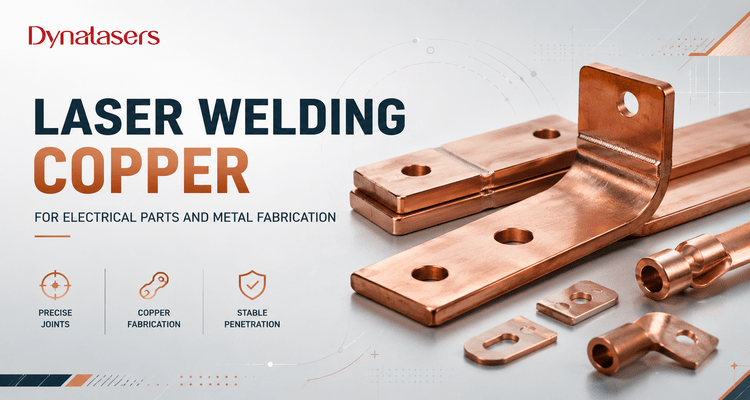
Laser Welding Copper for Electrical Parts and Metal Fabrication
Laser welding copper is possible, but copper demands tighter process control than steel. Higher-power Dynalasers M and D systems can handle suitable copper parts alongside stainless steel, aluminum, and brass, with selected 1800W models rated for copper melting depths up to about 2.5 mm. For dedicated high-volume copper joining, however, green or blue laser systems may offer a wider process window. The right approach depends on thickness, joint design, required penetration, and production consistency.
Can Copper Be Laser Welded?
Yes. Copper laser welding is used for electrical contacts, busbars, power electronics, battery components, thin sheet, and other conductive parts. The difficulty comes from how copper interacts with the laser before a stable weld pool has formed.
At room temperature, pure copper can absorb less than 5% of near-infrared laser energy, while its high thermal conductivity rapidly carries heat away from the joint. Research shows that shorter green wavelengths can raise room-temperature absorption into roughly the 40–50% range, making initial energy coupling much more predictable.
There is an important practical point here: copper does not stay equally reflective throughout the weld. Once melting and a keyhole begin, multiple internal reflections increase energy absorption. The challenge is therefore not simply “getting enough power.” It is moving from a cold reflective surface into a stable melt condition without creating excessive spatter, pores, or an unstable keyhole.
This also explains why Dynalasers publishes much lower copper depth figures than steel figures for the same machines. For example, the M70 is listed at about 7 mm for stainless steel but approximately 2.5 mm for copper under its stated test conditions.
Why Laser Welding Copper Is Difficult
Several problems occur at the same time during laser welding copper.
| Challenge | What Happens at the Weld | Practical Response |
| Low cold-state IR absorption | Melt initiation can be inconsistent | Correct focus and sufficient local power density |
| High thermal conductivity | Heat leaves the joint quickly, reducing penetration | Balance power with travel speed |
| Rapid change in absorption | Energy coupling can change suddenly after melting | Stabilize the process with controlled beam movement |
| Unstable keyhole | Spatter, pores, or inconsistent depth may appear | Avoid excessive energy and tune speed/power together |
| Surface contamination | Oxides, oil, and gases can increase defects | Clean and dry the joint before welding |
| Poor fit-up | Narrow laser welds may fail to bridge changing gaps | Maintain consistent joint geometry or use filler wire |
Copper’s thermal and optical properties make the process window narrower than it is for common steels. Research using in-situ X-ray imaging has also shown that keyhole geometry and pore formation change significantly with wavelength, power, and travel speed.
That is why copying stainless-steel settings to copper usually fails. Power, focus, wobble, speed, shielding, and joint condition need to be established specifically for the copper part.
Infrared Fiber Laser vs Green and Blue Laser for Copper
A common question is whether an ordinary fiber laser or a specialized green or blue laser is better for copper.
Green laser light is absorbed much more efficiently by copper. TRUMPF reports room-temperature green-light absorption around eight times higher than infrared, which helps create more stable welds with less spatter and more consistent penetration. Blue wavelengths offer the same general advantage of improved absorption in highly reflective metals, which is why shorter-wavelength systems are increasingly used in precision copper processing.
That does not make infrared fiber lasers unsuitable. The choice depends on the job.
A dedicated electrical or battery production line making thousands of precision copper connections may justify a specialized short-wavelength system. A fabrication shop working with stainless steel, carbon steel, aluminum, brass, and occasional copper has different priorities. In that environment, an infrared handheld system such as Dynalasers can provide greater multi-material flexibility without requiring a copper-only production platform. Dynalasers portable welders typically operate in the near-infrared fiber-laser range used for general metal processing.
What Controls Laser Weld Penetration in Copper?
Laser weld penetration should not be judged from wattage alone.
Increasing power can improve penetration, but only while the melt pool remains stable. Too little energy can cause incomplete fusion. Too much energy can drive an unstable keyhole, increase spatter, or trap porosity. Travel speed changes how long the laser interacts with each point, while focus and beam movement change the actual power density delivered into the joint.
Joint fit-up matters as well. A narrow laser beam has less natural gap-bridging ability than processes that deposit large amounts of filler metal. Beam wobble can widen the effective processing zone, while filler wire may help when gaps or bead profile require additional material.
Another distinction matters when reading machine specifications:
Melting depth is not automatically the same as guaranteed production welding thickness.
Dynalasers publishes single-sided melting depths as application references. The M70 and D70 are listed at approximately 2.5 mm for copper, but actual usable joint thickness depends on copper grade, geometry, travel speed, focus, shielding, and acceptance criteria.
For critical parts, cross-sections should be used to verify penetration. If the joint carries electrical current, mechanical strength alone is not enough; electrical resistance or conductivity should also be checked.
Is Laser Welding Copper Strong?
So, is laser welding strong enough for copper components?
It can be. Properly controlled copper laser welding can produce high-strength and highly conductive joints. Industrial laser welding is already used for copper connections in electronics and e-mobility applications where repeatability and conductivity matter.
But bead appearance is a poor substitute for testing. A smooth top surface may hide incomplete penetration or internal porosity. Strength depends on penetration, fusion area, joint design, copper grade, defects, and service conditions.
For structural parts, destructive testing may be needed. For electrical parts, contact resistance can be just as important as tensile or shear strength.
Laser Welding Copper to Aluminum
Laser welding copper to aluminum introduces another problem: the two materials can form brittle intermetallic compounds when excessive mixing occurs.
Research on Cu-Al laser joining shows that greater heat input and uncontrolled mixing can increase intermetallic formation, cracks, and electrical resistance. Beam position, penetration depth, oscillation, and energy input therefore need particularly careful control.
This makes copper-to-aluminum welding very different from simply changing from one copper sheet to another. Battery and electrical applications often use carefully controlled lap joints, beam shaping, or oscillation to limit how much of each material mixes into the weld pool. Recent research has shown that controlling this mixing can improve both mechanical performance and electrical resistance.
For handheld fabrication, Cu-Al joints should always be proven on representative samples before production.
Dynalasers Options for Copper Welding
Dynalasers divides its handheld welding systems into S, M, and D Series. All use air-cooled designs, but their copper capability differs significantly with power.
| Series | Power Range | Published Copper Capability | Best Fit |
| M Series | 800W–1800W | M50 ≈1 mm; M70 ≈2.5 mm | Mixed fabrication and regular copper jobs |
| D Series | 1200W–1800W | D50 ≈1 mm; D60 ≈1.5 mm; D70 ≈2.5 mm | Higher-output workshop and repair work |
| S Series | 700W–900W | No published pure-copper rating | Portable work on other common metals |
Figures refer to Dynalasers’ published single-sided melting-depth data and should be confirmed on the actual workpiece.
M Series for Mixed-Metal Fabrication
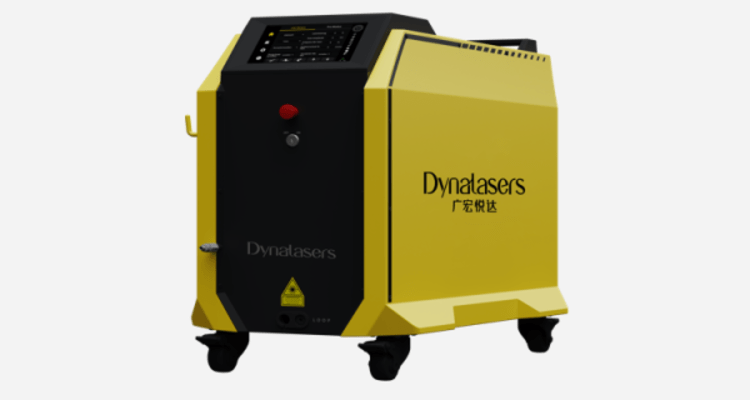
The M30, M50, and M70 cover approximately 800W, 1200W, and 1800W. The M Series is useful when copper is part of a broader workload that also includes stainless steel, carbon steel, aluminum, and brass.
For copper specifically, the M50 is listed around 1 mm and the 1800W M70 around 2.5 mm. The M70 also uses air cooling and a handheld welding gun below 0.48 kg, keeping the system relatively compact for its output.
Best for: General fabrication shops needing copper capability without buying a copper-only system.
D Series for Stronger Copper Welding
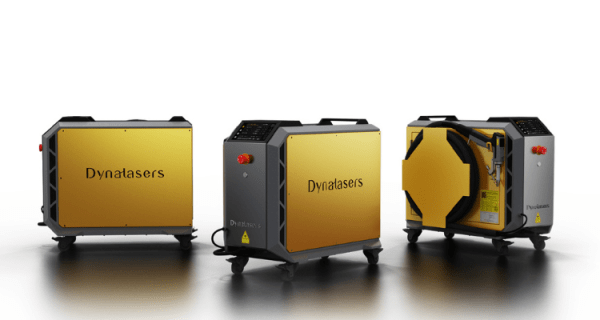
The D Series covers 1200W, 1500W, and 1800W configurations. Its published copper figures increase from about 1 mm on the D50 to 1.5 mm on the D60 and 2.5 mm on the D70.
The series combines higher welding capability with air cooling and multi-process workshop use, making it the more suitable Dynalasers family when copper appears regularly in repair or fabrication work.
Best for: Higher-output mixed-metal welding where copper capability matters more frequently.
S Series Is About Portability, Not Copper
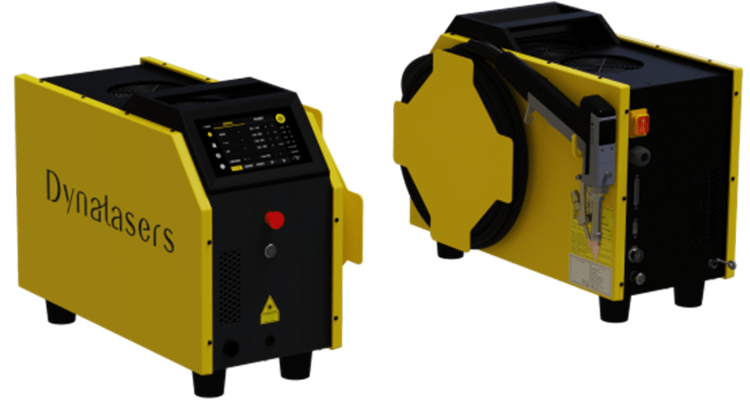
The S Series takes a different position. Its strength is low weight and mobility rather than pure-copper penetration.
Dynalasers does not publish a pure-copper depth for the S30 or S40 in its current penetration table. That makes the higher-power M and D models the better starting point when copper is a defined production requirement.
This distinction is important because choosing the smallest portable machine simply because it is convenient can leave too little process margin for reflective copper.
Preparing Copper Before Laser Welding
Copper should be clean, dry, and consistently fitted before welding. Oil, oxide, moisture, adhesive residue, and unstable gaps all reduce the usable process window.
Run sample joints before production and check more than the surface bead. Confirm penetration with a cross-section when necessary, monitor spatter and porosity, and test mechanical or electrical performance according to the final part requirement.
For copper, a repeatable parameter window is more valuable than achieving one impressive weld on a single sample.
FAQs
Can copper be laser welded?
Yes. Infrared, green, and blue lasers can all weld copper, although shorter wavelengths generally provide better cold-state absorption and easier process stability.
Why is copper difficult to laser weld?
Copper reflects most near-infrared energy when cold and conducts heat away very quickly. This makes melt initiation and stable penetration harder than with steel.
What is the thickest copper a Dynalasers welder can handle?
Dynalasers currently publishes up to about 2.5 mm single-sided copper melting depth for selected 1800W M70 and D70 models. Actual welding capability should be verified on the specific joint.
Can you weld brass with a laser welder?
Yes. Fiber lasers can weld brass under suitable conditions, although zinc content, fumes, surface condition, and parameters require attention.
Conclusion
Laser welding copper works best when the process is treated differently from steel welding. Reflectivity, rapid heat conduction, changing absorption, penetration, and joint fit-up all need tighter control.
Green and blue lasers offer clear advantages for dedicated precision copper production. For workshops processing several metals, Dynalasers M and D Series provide a more flexible fiber-laser option, with selected 1800W models reaching published copper melting depths around 2.5 mm. The final decision should come from real-part testing, because a stable and verified weld matters more than the power number alone.