The Definitive Guide to Jason Momoa
Why Jason Momoa Remains a Defining Hollywood Star
Jason Momoa is a Hawaiian-born actor, producer, musician, and environmental advocate best known for playing Khal Drogo in Game of Thrones, Aquaman in DC films, Duncan Idaho in Dune, and Dante Reyes in Fast X. As of September 2026, he is 47 and has built a career that reaches from early television work to global franchises, independent filmmaking, and Native Hawaiian storytelling.
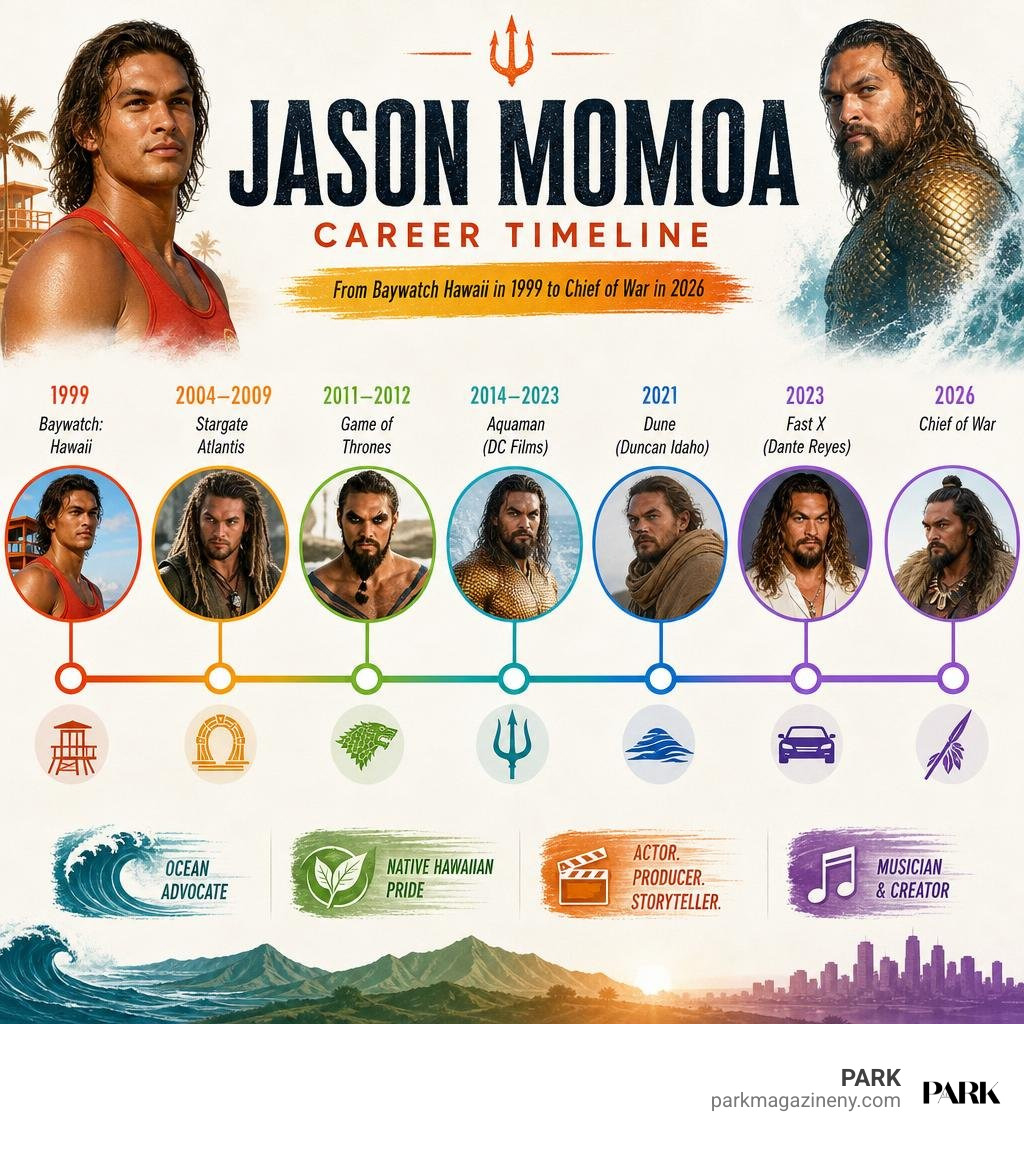
His path is unusually broad. Momoa began on Baywatch: Hawaii, earned wider attention on Stargate Atlantis, and changed his career trajectory after performing a haka in his Game of Thrones audition. His role as Aquaman then made him a blockbuster leading man; Aquaman earned more than $1.1 billion worldwide.
Away from the screen, Momoa has used his public reach – including 16.8 million Instagram followers at @prideofgypsies – to speak about ocean protection, coral reefs, and Native Hawaiian rights. He also continues to expand as a creator through projects such as Chief of War and his 2024 power trio, ÖOF TATATÁ.
This guide looks beyond the familiar trident and action roles to explain the experiences, culture, creative work, and advocacy that shape Momoa’s public life. I am W.A. Muller, and we will begin with the roots behind the career.
Jason momoa word roundup:
Early Life, Cultural Identity, and Early Career Milestones
Joseph Jason Namakaeha Momoa was born on August 1, 1979, in Honolulu, Hawaii. Raised primarily in Norwalk, Iowa, by his mother, an artist and photographer, he experienced a dual upbringing that bridged the rolling plains of the American Midwest with frequent visits to the coastal landscapes of Oahu. This dynamic geographic and cultural foundation deeply informed his worldview, artistic temperament, and creative ambitions.
Before ever stepping onto a Hollywood soundstage, Momoa explored painting pastels in Paris, studied marine biology, and immersed himself in outdoor pursuits like rock climbing. Returning to Hawaii as a young man, he was discovered by international designer Takeo Kobayashi, launching a modeling career that earned him Hawaii’s Model of the Year in 1999. That sudden visibility quickly opened doors to screen auditions, setting the stage for a decades-long career.
Jason Momoa Heritage and Formative Years
Momoa’s heritage represents a rich multicultural tapestry. On his father’s side, he carries Native Hawaiian and Samoan ancestry; on his mother’s side, his lineage includes German, Irish, and Pawnee Native American roots. Rather than viewing these distinct backgrounds as disparate elements, he has consistently credited his diverse heritage with shaping his grounded perspective and storytelling instincts.
Throughout his career, Jason Momoa has honored his Polynesian roots openly. His left forearm bears a prominent half-sleeve tattoo representing his family’s ʻaumakua (ancestral guardian spirit), depicted as shark teeth (manō). By integrating indigenous cultural practices, language, and perspectives into mainstream entertainment, he has redefined the modern action hero, proving that global commercial appeal and profound cultural authenticity can thrive simultaneously on screen.
Television Beginnings: Baywatch Hawaii, Stargate, and the 2008 Scar
Momoa made his screen acting debut in 1999 on Baywatch: Hawaii, beating out thousands of contenders to secure the role of Jason Ioane across 38 episodes. While the show introduced him to international audiences, breaking out of the sun-drenched lifeguard mold required deliberate artistic reinvention.
He found his next major proving ground in science fiction television, starring as the fierce warrior Ronon Dex on Stargate Atlantis across 73 episodes from 2005 to 2009. The role required intensive martial arts training, tactical weapon choreography, and an imposing physical presence. Momoa famously wore signature heavy dreadlocks for the part, eventually cutting them after four seasons due to the sheer physical strain and headaches they caused during complex stunt sequences.
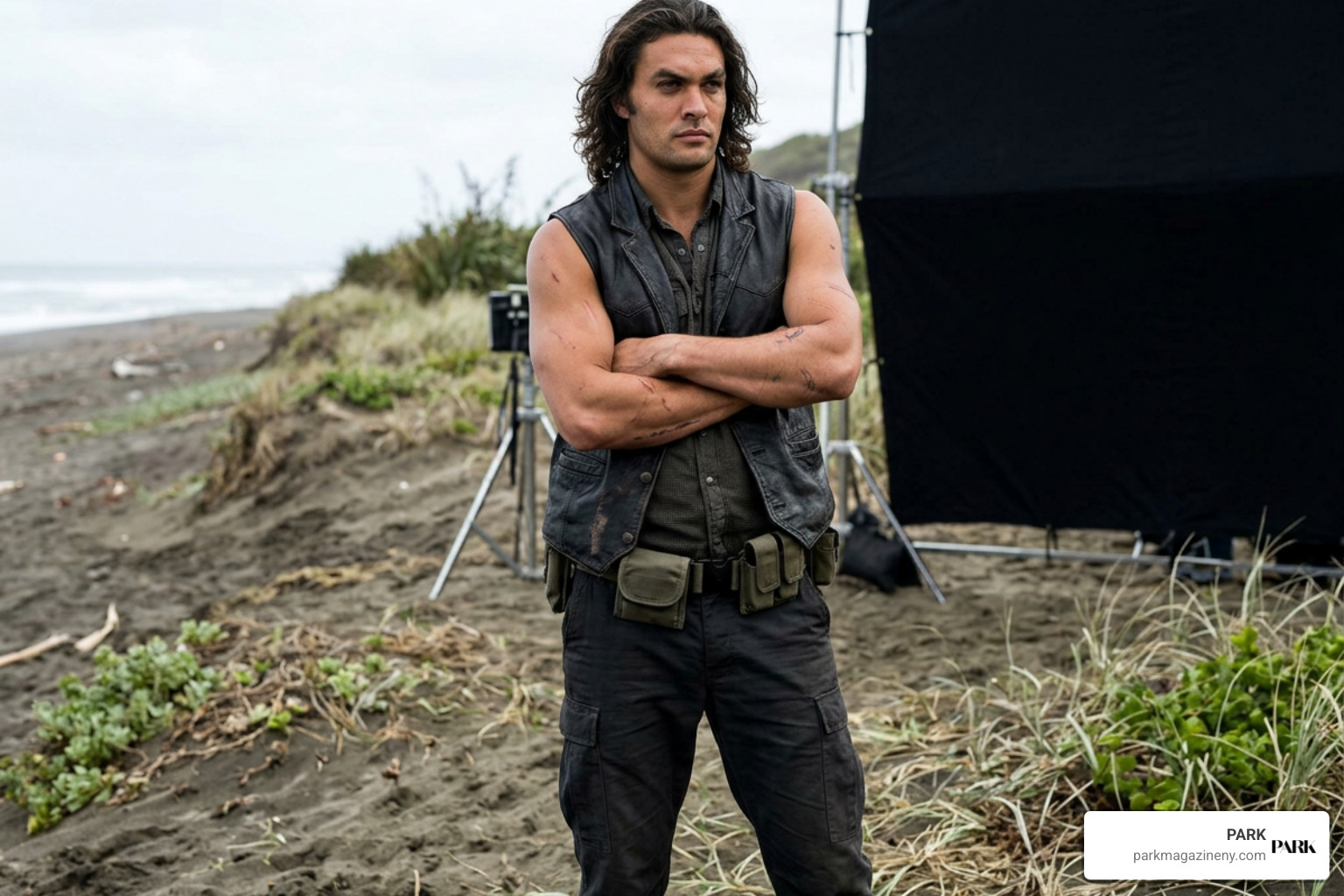
In November 2008, an unexpected and violent altercation altered his appearance permanently. While at a café in Los Angeles, Momoa was assaulted with a shattered beer glass. The incident resulted in approximately 140 stitches and reconstructive facial surgery, leaving a prominent scar slashing through his left eyebrow. Rather than derailing his leading-man aspirations, the scar became an unmistakable signature feature—adding rugged authenticity and edge to the memorable warrior characters he would soon embody.
The Career Trajectory of Jason Momoa: From Breakout Roles to Blockbuster Franchises
Transitioning from episodic television to high-stakes Hollywood cinema requires rare versatility and market magnetism. Momoa leveraged his distinctive physical presence, humor, and depth to conquer diverse cinematic spaces. From historical dramas and gritty epics to billion-dollar comic book franchises, his commercial journey reflects an astute balance between blockbuster crowd-pleasers and auteur-driven projects.
| Franchise / Project | Role | Primary Character Archetype | Global Box Office / Platform Impact |
|---|---|---|---|
| Game of Thrones | Khal Drogo | Formidable Dothraki Warlord | Global HBO Cultural Phenomenon |
| Aquaman (2018) | Arthur Curry | Reluctant King & Ocean Protector | $1.15 Billion Global Box Office |
| Dune (2021) | Duncan Idaho | Legendary Ginaz Swordmaster | $407 Million / Multi-Oscar Winner |
| Fast X (2023) | Dante Reyes | Flamboyant, Psychopathic Antagonist | $714 Million Global Box Office |
| See (2019–2022) | Baba Voss | Fierce Blind Tribal Chieftain | Flagship Apple TV+ Original Hit |
| Chief of War (2025–2026) | Kaʻiana | Visionary Hawaiian Warrior-Chief | Emmy & Spirit Award Winner |
Game of Thrones Breakthrough and the Iconic Haka Audition
While Momoa took on the mantle of Robert E. Howard’s legendary warrior in the 2011 reboot Conan the Barbarian, his true global breakthrough arrived that same year on HBO’s groundbreaking fantasy series Game of Thrones.
To secure the role of the fierce Dothraki warlord Khal Drogo, Momoa walked into the casting room and delivered a ferocious, commanding performance of the traditional Māori Ka Mate Haka. The raw power and emotional intensity stunned showrunners David Benioff and D.B. Weiss, instantly landing him the part.
Across his appearances in the first two seasons, Momoa imbued Drogo with genuine vulnerability beneath an impenetrable exterior. Even though his character spoke primarily in the fictional Dothraki language, Momoa’s performance earned widespread critical acclaim, establishing him as one of the series’ most unforgettable figures. Fans tracking his filmography can explore the full critical breakdown on the Jason Momoa Movies & TV Shows List | Rotten Tomatoes, where his diverse body of work—spanning television milestones and independent projects—is documented in detail.

Blockbuster Stardom: Aquaman, Dune, Fast X, and Future Releases
Momoa entered premier superhero cinema through an unconventional path: he originally auditioned for the role of Batman for director Zack Snyder. Snyder recognized a different potential in Momoa, ultimately casting him as Arthur Curry in the DC Extended Universe.
Following a brief cameo in Batman v Superman: Dawn of Justice (2016) and a central ensemble role in Justice League (2017), Momoa headlined James Wan’s Aquaman in 2018. The film shattered box office expectations, grossing over $1.15 billion worldwide to become the highest-earning DC film in history. Momoa reinvented the comic book icon—traditionally portrayed as a clean-cut hero—into an engaging, tattooed, rock-and-roll protector of the seven seas.
His cinematic range expanded further when director Denis Villeneuve cast him as Duncan Idaho in the Academy Award-winning sci-fi epic Dune (2021). Momoa brought warmth, loyalty, and unmatched martial prowess to the beloved swordmaster, earning praise from critics and fans alike. In 2023, he delivered an outrageously entertaining, scene-stealing performance as the flamboyant villain Dante Reyes in Fast X, followed by Aquaman and the Lost Kingdom.
His credits cataloged on Jason Momoa — The Movie Database (TMDB) showcase an artist continuously pushing boundaries across formats. Looking ahead through 2026 and beyond, Momoa continues to headline high-profile properties, including starring alongside Jack Black in the live-action A Minecraft Movie and reprising Duncan Idaho in Denis Villeneuve’s eagerly anticipated Dune: Part Three.
Behind the Screen: Creative Ventures, Personal Life, and Advocacy
Momoa’s creative expression extends well beyond studio franchises. Through his production company, Pride of Gypsies, he has developed, directed, and produced personal projects that reflect his varied interests. In 2014, he co-wrote, directed, and starred in the road drama Road to Paloma, establishing his capabilities behind the lens. He later brought his passion for bouldering to television by creating and executive producing the high-stakes climbing competition The Climb for HBO Max.
Jason Momoa Environmental Advocacy and Native Hawaiian Rights
A committed environmentalist, Momoa utilizes his global platform to champion sustainability and ocean health. Appointed as an Advocate for Life Below Water by the United Nations Environment Programme (UNEP), he has spoken before the UN on single-use plastics, ocean acidification, and coral reef restoration. He also founded Mananalu, a mission-driven pure water company packaged in infinitely recyclable aluminum bottles designed to eliminate plastic waste.
In addition to ecological advocacy, Momoa is an outspoken defender of indigenous sovereignty and cultural preservation. In 2019, he stood on the front lines alongside native Hawaiian elders and community protectors on the sacred mountain of Mauna Kea to protest the construction of the Thirty Meter Telescope (TMT). His visible support amplified international awareness of Native Hawaiian land rights and sacred cultural sites.
Music with ÖOF TATATÁ, Creative Directing, and Relationships
Music serves as one of Momoa’s primary creative outlets and character-building tools; he frequently constructs specific heavy metal playlists to tap into the emotional frequency of his roles. An accomplished multi-instrumentalist who plays bass, guitar, mandolin, and ukulele, Momoa co-founded the high-energy power trio ÖOF TATATÁ in 2024. Performing live rock and metal sets across venues from Nashville’s Cannery Hall to international stages, the group highlights his lifelong dedication to live music.

In his personal life, Momoa shares two children—daughter Lola Iolani (born 2007) and son Nakoa-Wolf Manakauapo Namakaeha (born 2008)—with actress Lisa Bonet. The couple married in October 2017 after more than a decade together; following a collaborative, amicable separation, their divorce was finalized in July 2024, with both remaining committed co-parents. In recent years, Momoa has found romantic happiness with actress Adria Arjona, with the pair frequently celebrating shared creative milestones and personal travels together.
Momoa achieved a career-defining artistic milestone with the Apple TV+ historical epic series Chief of War (2025–2026), which he co-created, executive produced, and starred in as the 18th-century warrior Kaʻiana. Told entirely from an indigenous Hawaiian perspective with extensive dialogue in ʻŌlelo Hawaiʻi, the groundbreaking series earned critical acclaim and won the Film Independent Spirit Award for Best Ensemble Cast in a New Scripted Series in 2026.
Frequently Asked Questions about the Hollywood Icon
How did the actor get his signature eyebrow scar?
In November 2008, Momoa was involved in an unprovoked altercation at the Birds Cafe in Hollywood, California, where he was attacked with a broken beer glass. The assault required emergency surgery and approximately 140 stitches across his face and forehead, leaving a distinct diagonal scar running through his left eyebrow. Rather than concealing the mark, he embraced it as a defining characteristic for his subsequent roles.
Which audition dance launched the Khal Drogo role?
When auditioning for the role of Khal Drogo in Game of Thrones, Momoa recognized that standard script dialogue could not fully capture the physical intimidation and spiritual authority of the character. Instead, he performed a traditional Māori Ka Mate Haka—a ceremonial war dance featuring rhythmic stomping, chest-slapping, and vocal chanting. The performance astonished casting directors David Benioff and D.B. Weiss, immediately earning him the iconic part.
What major awards did Chief of War win?
Chief of War, Momoa’s landmark historical series chronicling the unification of the Hawaiian Kingdom, received widespread industry praise for its cultural authenticity, indigenous casting, and technical excellence. In 2026, the series won the Film Independent Spirit Award for Best Ensemble Cast in a New Scripted Series, solidifying Momoa’s reputation as a top-tier executive producer and showrunner.
Conclusion
From his early days on the beaches of Oahu to commanding international box offices and producing award-winning indigenous epics, Jason Momoa has redefined what it means to be a modern Hollywood leading man. Often describing his creative ethos as a “sensitive alpha male,” he effortlessly balances immense physical power with artistic vulnerability, environmental stewardship, and deep reverence for his cultural heritage.
As we look at the evolution of modern media icons, balancing creative authenticity with lasting legacy remains paramount. Discerning collectors and cultural enthusiasts who value timeless value and heritage across lifestyle and entertainment can explore the ultimate luxury investments worth considering for an informed perspective on enduring value in a changing world.