How to Improve Your Home’s Indoor Air Quality
The Three Core Strategies for Improving Indoor Air Quality
Improving the air we breathe indoors can seem like a complex task, but it boils down to three fundamental strategies: source control, enhanced ventilation, and effective air filtration. Each plays a vital role, and often, the most significant improvements come from a balanced approach that considers all three. We aim to reduce the amount of pollutants entering our indoor spaces, dilute those that remain, and remove particles from the air. This layered strategy is not only effective for health but can also be implemented with an eye toward energy efficiency, making our homes healthier without dramatically increasing utility costs.
Source Elimination vs. Dilution
The most effective way to improve indoor air quality is by eliminating or reducing pollutant sources. Think of it as preventing a problem rather than constantly cleaning up after it. Pollutants originate from a myriad of sources within our homes, from building materials and furnishings to cooking activities and cleaning products. Understanding the emission rates of these sources allows us to make informed choices. For instance, new carpets or furniture can off-gas volatile organic compounds (VOCs) for weeks or months. Choosing low-VOC alternatives or allowing new items to air out in a well-ventilated space before bringing them indoors are preventative measures that significantly reduce initial pollutant loads. Managing the “building envelope”—the physical separator between the conditioned interior and the unconditioned exterior—is also crucial for preventing outdoor pollutants from infiltrating and for sealing in certain indoor pollutants. While some sources are unavoidable, proactive source control often proves more cost-efficient than continuously trying to dilute or filter out pollutants.
Improving Indoor Air Quality Through Whole-Home Ventilation
Once we’ve minimized pollutant sources, the next step is to ensure adequate fresh air exchange. Ventilation helps dilute any remaining pollutants, preventing them from accumulating to harmful levels. Natural ventilation, achieved by simply opening windows and doors to create cross-ventilation, can be a free and effective method when outdoor air quality is good. However, this isn’t always practical due to weather, outdoor allergens, or external pollution.
For consistent and controlled fresh air, mechanical ventilation systems are invaluable. These systems actively bring in outdoor air and exhaust indoor air. Heat Recovery Ventilators (HRVs) and Energy Recovery Ventilators (ERVs) are advanced mechanical airflow systems that provide balanced exchange while minimizing energy loss. HRVs transfer heat from the outgoing air to the incoming fresh air, ideal for colder climates. ERVs transfer both heat and moisture, making them suitable for mixed or humid climates. Both systems ensure a continuous supply of fresh air, helping to reduce indoor CO2, VOCs, and other airborne contaminants without compromising your home’s energy efficiency.
Controlling Indoor Pollution Sources and Allergens
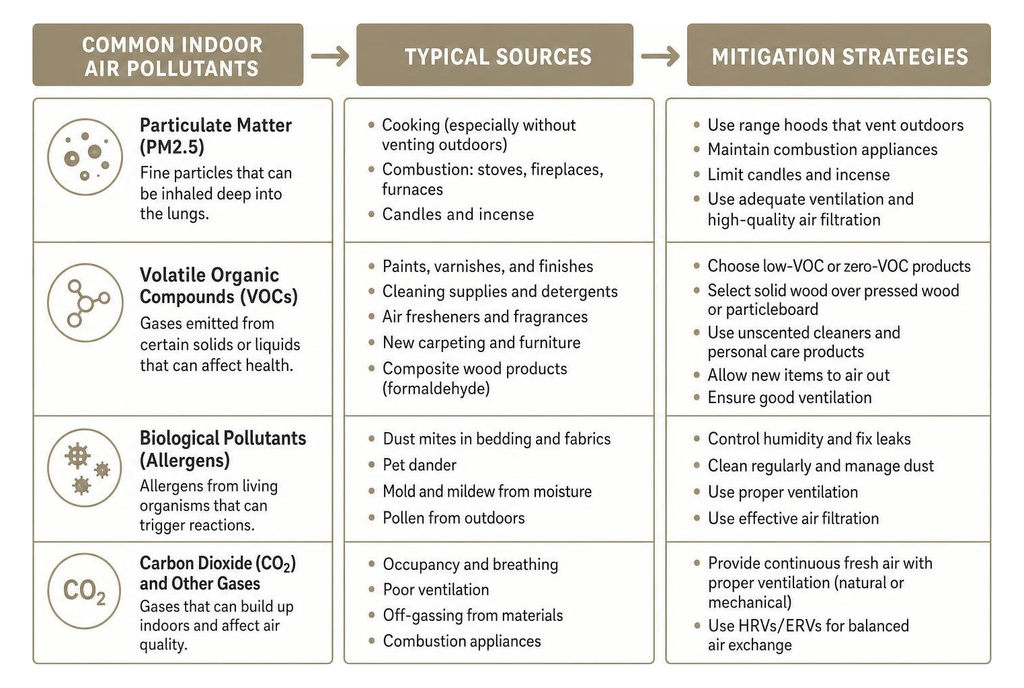
Many common household activities and items contribute to indoor air pollution. Combustion gases from stoves, fireplaces, and furnaces, off-gassing from materials like paints and furniture, and cooking emissions are among the primary culprits. Using a range hood that vents outdoors during cooking is particularly important, as cooking can generate significant amounts of particulate matter (PM2.5) and other pollutants.
Reducing Chemical Off-Gassing and VOCs
Volatile Organic Compounds (VOCs) are gases emitted from certain solids or liquids, many of which can have adverse health effects. Common sources include paints, varnishes, cleaning supplies, air fresheners, new carpeting, and composite wood products. To reduce your exposure, we recommend choosing low-VOC or zero-VOC paints and finishes for home improvement projects. When purchasing furniture, consider solid wood options over pressed wood or particleboard, which often contain formaldehyde—a known VOC. Opt for unscented cleaners, laundry detergents, and personal care products, as artificial fragrances can be a significant source of VOCs and other irritants. Even seemingly innocuous items like scented candles can release PM2.5 and VOCs, so limiting their use or ensuring robust ventilation when used is advisable.
Improving Indoor Air Quality by Controlling Household Allergens
Allergens like dust mites, pet dander, pollen, and mold spores are common indoor air pollutants that can trigger respiratory issues and allergic reactions. Effective allergen control involves a multi-pronged approach. Regular cleaning is paramount. We suggest vacuuming carpets and rugs weekly with a HEPA-filter vacuum to capture fine particles. For hard-surface flooring, frequent damp mopping is effective. Washing bedding, curtains, and pet beds in hot water (at least 130°F) helps to kill dust mites and remove dander. Using dust-mite-proof covers on mattresses and pillows can also make a significant difference. Keeping pets out of bedrooms and wiping them down after outdoor activities can reduce the amount of dander and pollen they bring inside. For a truly comprehensive approach to maintaining a pristine living environment and minimizing allergens, consider investing in professional residential deep cleaning services. Such services can reach areas often overlooked, ensuring a thorough removal of accumulated dust, dander, and other irritants, contributing to noticeably cleaner air.
Upgrading Home Ventilation and HVAC Filtration
Beyond managing sources, enhancing your home’s ventilation and filtration systems is crucial for maintaining good indoor air quality. Understanding airflow dynamics and ensuring adequate air changes per hour (ACH) helps to keep pollutants diluted. While opening windows offers natural ventilation, check the outdoor Air Quality Index (AQI) first, as bringing in polluted outdoor air (e.g., during wildfire season or high pollen counts) can worsen indoor conditions. Exhaust fans in bathrooms and kitchens are vital for removing moisture and cooking fumes directly at the source.
Choosing the Right MERV and HEPA Filters
The right filtration can make a substantial difference in removing airborne particles. For your home’s central heating and cooling system, upgrading your HVAC filter is one of the most impactful and cost-effective steps. We recommend using a MERV (Minimum Efficiency Reporting Value) 13 filter. MERV 13 filters are highly effective, capable of capturing over 90% of PM10 and over 85% of PM2.5 particles, including bacteria and some virus-carrying aerosols. Most HVAC systems built after 2010 can accommodate a MERV 13 filter, but it’s always wise to check your system’s manual or consult a professional to ensure compatibility and avoid restricting airflow.
For targeted air cleaning in specific rooms, portable air purifiers equipped with true HEPA (High-Efficiency Particulate Air) filters are excellent. True HEPA filters capture 99.97% of particles as small as 0.3 microns. When choosing a portable purifier, look for its CADR (Clean Air Delivery Rate) rating, which indicates how quickly it cleans a room of a specific size. Many also include activated carbon filters, which are effective at absorbing gaseous pollutants like VOCs and odors, complementing the particle removal of HEPA filters.
Maintaining Ductwork and Air Handler Systems
Your HVAC system is the lungs of your home, and its ductwork acts as the airways. Over time, ducts can accumulate dust, debris, allergens, and even mold, which can then be circulated throughout your home. Leaky ductwork can also pull in unfiltered air from attics, crawl spaces, or wall cavities, introducing additional pollutants. Therefore, maintaining your ductwork and air handler systems is critical.
Duct sealing is often more important than cleaning. Sealing leaks in your ductwork prevents conditioned air from escaping and unconditioned, potentially polluted air from entering the system. This not only improves air quality but also enhances energy efficiency by reducing static pressure and ensuring proper airflow. Regular maintenance of the air handler, including cleaning the evaporator coil, prevents mold growth and ensures the system operates efficiently. While routine duct cleaning is not always necessary, if you notice excessive dust, a musty odor, or visible mold growth within your ducts, or if you’ve recently completed a renovation, considering professional air duct cleaning can be a beneficial step to remove accumulated contaminants and improve overall system performance.
Managing Moisture, Mold, and Invisible Threats
Controlling indoor humidity is paramount for good indoor air quality, as excessive moisture creates an ideal environment for mold, mildew, and dust mites to thrive. These biological contaminants can trigger allergies, asthma, and other respiratory problems.
Balancing Indoor Humidity Levels
We aim for indoor relative humidity (RH) levels between 30% and 50%. This range is generally considered optimal for inhibiting the growth of mold and dust mites. A digital hygrometer can help you monitor humidity levels accurately. In humid climates or during certain seasons, a dehumidifier can be an invaluable tool, especially in basements, bathrooms, and other moisture-prone areas. Conversely, in very dry climates, a humidifier might be necessary to prevent issues like dry skin or respiratory irritation, but careful monitoring is needed to avoid over-humidification. Proper ventilation in bathrooms and kitchens, along with promptly fixing any leaks or water damage, are crucial moisture barriers to prevent mold proliferation.
Testing for Radon and Carbon Monoxide
Some of the most dangerous indoor pollutants are invisible and odorless, making regular testing essential. Radon is a naturally occurring radioactive gas that seeps into homes from the ground. It is the second leading cause of lung cancer in the United States, responsible for approximately 21,000 deaths annually. We strongly recommend radon testing for all homes. Low-cost DIY test kits are readily available, or you can hire a professional. If levels exceed the EPA’s action threshold of 4 pCi/L, mitigation, often through a sub-slab depressurization system, is necessary to safely vent the gas outside.
Carbon monoxide (CO) is another invisible, odorless, and potentially lethal gas produced by incomplete combustion in fuel-burning appliances like furnaces, water heaters, gas stoves, and fireplaces. We advise installing CO alarms on every level of your home, especially near sleeping areas, and checking their batteries annually. Regular professional inspections of all fuel-burning appliances ensure they are operating safely and efficiently, preventing CO leaks.
Frequently Asked Questions About Home Air Quality
We often encounter common questions when discussing indoor air quality. Here are some of the most frequent ones, along with our insights.
Are houseplants effective at purifying indoor air?
While houseplants are beautiful and can contribute to a pleasant indoor environment, their effectiveness at significantly purifying indoor air in a typical home setting is often overstated. Much of the research suggesting their air-cleaning capabilities was conducted in sealed chambers under laboratory conditions, which don’t reflect real-world ventilation rates in homes. In practice, you would need an impractically large number of plants (hundreds per room) to achieve the same pollutant reduction as a good air purifier or adequate ventilation. Furthermore, the soil in potted plants can sometimes harbor mold spores, potentially adding to indoor allergens. While they offer aesthetic and mental health benefits, we do not consider them a primary strategy for improving indoor air quality.
How often should HVAC filters be replaced?
The frequency of HVAC filter replacement depends on several factors, including the filter’s thickness and MERV rating, whether you have pets, and the overall air quality in your home. As a general guideline, we recommend checking your filter monthly and replacing it every 1 to 3 months for standard 1-inch filters, especially if you have pets or allergies. Higher MERV-rated filters (like MERV 13) or thicker filters (4-inch or 5-inch) can often last 3 to 6 months, or even up to a year, because they have more surface area to capture particles. However, it’s crucial to monitor for signs of a clogged filter, such as reduced airflow or an increase in static pressure, as a dirty filter can restrict airflow and strain your HVAC system. Setting a calendar reminder is a simple way to ensure timely replacement.
What is the most cost-effective way to improve air quality immediately?
For most homes, the single most cost-effective way to improve indoor air quality immediately involves a combination of source elimination, natural ventilation, and a simple filter upgrade. Consistently using your vented range hood while cooking is a free action that addresses one of the largest sources of indoor particulate matter. Opening windows for cross-ventilation when outdoor air quality is good can rapidly dilute indoor pollutants. Beyond these free actions, upgrading your HVAC filter to a MERV 13 is a highly cost-effective step, providing significant particle reduction for a relatively low recurring cost. These measures offer a substantial return on investment in terms of health benefits.
Conclusion
Improving indoor air quality is a continuous journey that significantly impacts our health and well-being. By adopting a layered strategy that prioritizes source control, enhances ventilation, and utilizes effective filtration, we can create healthier, more comfortable living spaces. Developing an action plan that includes routine maintenance, such as regular cleaning, filter replacement, and humidity management, is key to long-term success. From testing for invisible threats like radon and carbon monoxide to making informed choices about the products we bring into our homes, every step contributes to a cleaner air environment. Investing in your home’s air quality is an investment in your family’s long-term wellness.