Here is What Makes Stake Originals Variety the Best Online Mines Game
Online games do not always need complicated mechanics to become memorable. Sometimes, the strongest ideas are the ones that can be understood almost instantly. Pick a square, flip a card, spin a wheel, or make one more move, and suddenly a straightforward interaction becomes an industry leading mechanic. It is the complete opposite of what many fans believe it takes to develop and publish a hit.
Digital gaming has become particularly good at creating these tiny moments of suspense, especially when it takes concepts that might once have belonged to a real life game, a desktop computer, an arcade, a board game, or a casino table and turns them into experiences that work just as naturally on a smartphone. Fans love straightforward concepts, which is why a fine combo of wide accessibility and different levels of tension is the reason simple casino games can be so engaging. There is something inherently compelling about being given a choice and not knowing exactly what the next decision will produce.
Stake Originals Mines builds its entire experience around that feeling. Its interface is uncomplicated, its rules can be learned quickly, and yet every revealed tile changes the calculation of whether to continue or collect. Simplicity, escalating multipliers, and player controlled risk are major parts of what has made the game one of the most recognizable titles in the collection. So, before you play the Stake Mines game, how about an explainer guide?
What Sets Stake Originals Apart?
Stake Originals are games developed specifically for Stake rather than licensed from an outside casino software provider. The collection covers a broad range of formats, bringing together different approaches to casino style entertainment under one in house catalogue. Mines sits alongside games such as Plinko, Crash and Hilo, each built around a distinctive central mechanic.
The significance of an in house collection is not simply exclusivity. It allows individual games to be designed around a particular interaction instead of attempting to reproduce a conventional casino experience. A familiar concept can be stripped down to its most important components and rebuilt as a fast digital game.
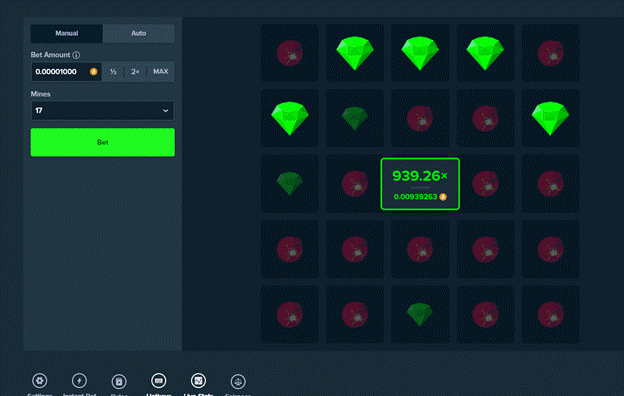
Mines demonstrates this particularly well. At first glance, there is little more than a grid of concealed tiles. Behind that simple presentation, however, are several variables that dramatically affect the way a round develops. The number of mines determines the level of danger. Every successful selection increases the potential multiplier, and the player controls the moment at which the current potential return is converted into a cash out.
Such an approach gives Mines a very different rhythm from a conventional slot or table game. There is no fixed sequence that every round has to follow. The player is constantly deciding whether the current opportunity is enough or whether another selection is worth the additional exposure.
Why the 5×5 Grid Works So Well
The basic Mines board contains 25 hidden tiles arranged in a 5×5 grid. Before beginning, the player selects a wager and chooses how many mines will be concealed on the board. The possible range runs from one mine to 24, meaning the same physical grid can accommodate dramatically different risk profiles.
Every tile that does not contain a mine is safe. When revealed, it appears as a gem. The objective is not to clear the entire board. Instead, the player is trying to reveal enough safe tiles to build a desirable multiplier before deciding to cash out.
This is where Mines gets much of its character. A successful reveal does not simply produce a result and finish the round. It increases the potential return and creates another decision. The player can take the current amount or continue, knowing that the next selection could increase the multiplier or end the round.
If a mine is revealed before cashing out, the round immediately ends, and the original wager is lost. If the player cashes out beforehand, the multiplier applicable at that point determines the potential return relative to the initial stake.
The structure creates a natural escalation. Early in a round, there may be plenty of safe tiles available and the multiplier is comparatively modest. After several successful selections, the potential return becomes more attractive, but continuing also means accepting another opportunity to hit a mine.
That push and pull is arguably the defining feature of Mines. The game never forces the player to chase the largest possible multiplier. It simply keeps presenting the same question of whether the current return is sufficient, or if the additional risk makes sense and is acceptable.
Risk Without Complicated Rules
With a single mine hidden among 25 tiles, 24 positions are safe. This makes successful selections considerably more common and allows a player to progress through the board with a lower immediate probability of encountering a mine. At the opposite extreme, selecting 24 mines leaves just one safe tile. The possibility of a successful progression is much narrower, but the potential multipliers can be substantially higher.
This means the mine count effectively functions as the game’s difficulty setting. A lower number generally creates more frequent successful selections and smaller potential multipliers, while a higher number creates a much more volatile experience in which successful selections can produce considerably larger multipliers.
It is important, however, not to confuse a different risk profile with a different house advantage. Mines still has a theoretical RTP of 99%, which in turn means a 1% house edge. Changing the number of mines changes how potential outcomes are distributed, but it does not remove the underlying mathematical advantage of the house. That always remains a constant, just like with every other casino game.
That distinction is central to understanding what makes Mines interesting. Players have meaningful control over the structure of their individual rounds, but they do not control the probabilities behind the game. Choosing an aggressive setting can produce the possibility of a large multiplier, but it also makes unsuccessful rounds more likely. Choosing a conservative configuration can produce more successful selections, but the potential rewards are correspondingly more modest.
The Player Controls Cashing Out
Another feature that separates Mines from many other casino formats is the importance of timing in your gameplay sessions. The game does not require the player to reach a particular tile count or to win a certain amount and go over a threshold before being able to cash out and walk away. There is no mandatory final stage where the board has to be completed. After a safe reveal, the player can simply collect the current potential return, even after a single tile, i.e., a few seconds of game time. Alternatively, another tile can be selected, and the process can continue.
Imagine starting with a modest wager and a relatively low mine count. The first selection reveals a gem, increasing the multiplier. At that point, the player has already created a possible return greater than the original wager. Cashing out ends the round with that applicable multiplier. Continuing creates the possibility of increasing the return further, but the next tile could also contain a mine.
This structure is what gives Mines its distinctive tempo. Some rounds can be extremely short. Others can involve a sequence of successful selections and rapidly increasing multipliers. The player does not know in advance which type of round is about to unfold.
The important limitation is that no particular stopping point guarantees a profit, nor can the previous selections reveal where the next mine must be located. A safe tile in one round does not become more or less likely to be safe in the next round, and a sequence of mines does not mean a safe result is somehow due. Everything resets and each time it plays differently, so make sure to understand it as such.
Manual Play and Automated Betting
Mines can be approached manually, with the player selecting each tile and deciding when to cash out, or through automated betting functionality that carries out rounds according to predefined settings. If you want a more hands off approach, there is one.
Manual play puts the decision making process at the centre of the experience. Every reveal creates a new opportunity to stop or continue, so the player remains directly involved in the progression of the round.
Autobet can make repeated play more convenient by handling predetermined actions automatically. It can reduce the amount of clicking involved, but it does not change the probabilities or mathematical structure of Mines. Automation is therefore a convenience feature rather than a mechanism for improving the underlying odds.
What “Provably Fair” Means in Mines
Another important element that players should remember when they play online Stake Originals games is the provably fair system used to generate outcomes. This is particularly relevant for a game in which the locations of hidden mines determine the outcome.
Stake’s provably fair mechanism is a cryptographic process that involves server seeds, client seeds, and hashes. Before an outcome is generated, the server seed is committed in hashed form. Other inputs are incorporated into the process used to determine the result. Once the relevant server seed is subsequently revealed, it can be compared with the earlier cryptographic commitment.
For Mines specifically, Stake’s game events documentation describes the use of three incremental numbers per game to generate the possible bomb locations. Randomly generated values are then translated into the game specific outcome, including where the mines appear on the board. The system provides a method through which an outcome can be checked against the published generation process rather than requiring the player simply to trust that the result was produced correctly.
Provably fair should never be interpreted as meaning winnable or profitable, because it concerns the verifiability of the outcome generation process. It does not remove randomness, change the house edge, or make future selections predictable. After several safe selections, it can be tempting to believe that certain areas of the board are becoming dangerous, or that a mine is somehow less likely to appear after a string of unsuccessful rounds. Random outcomes do not operate according to those assumptions.
Why Mines is a Standout Stake Original
The strength of Stake Originals Mines, similarly to some of their other hit titles, is ultimately its ability to make several casino mechanics feel like one very simple decision making loop. The board is immediately understandable, the risk level can be adjusted, multipliers rise as successful selections accumulate, and cashing out is always available.
There is also a useful balance between familiarity and uncertainty. The grid recalls a classic computer game, while the multiplier system gives the experience a distinctly casino oriented structure. Players who recognize Minesweeper can understand the visual language immediately, but they quickly discover that this is not a logic puzzle.
Flexibility is another defining characteristic. One player can choose a low mine count and focus on shorter, more frequent successful sequences, while another can select a much higher mine count and pursue the possibility of larger multipliers. Neither approach changes the underlying house edge, but the difference in volatility makes the experience feel substantially different. The rules are compact enough to fit comfortably into a modern digital interface, yet the interaction between mine count, multiplier progression, and cash out decisions creates enough variation to keep each round feeling like a fresh decision.
A sensible way to approach the game is to treat it as entertainment spending rather than money that needs to be recovered or a way to earn on the side. Setting a session budget before playing, keeping individual wagers proportionate to that budget, establishing spending and/or time limits, and deciding on a personal win target can help keep individual results from dictating subsequent decisions. Increasing stakes after losses does not change the game’s mathematical edge, and a rising multiplier should never be mistaken for a guarantee that the next tile will be safe.
Ultimately, Mines stands out not because it hides complicated mechanics beneath a sophisticated interface, but because it does almost the opposite. It takes one of the simplest possible gaming structures, places meaningful decisions around it, and creates suspense from the space between one tile and the next. Its relationship with Minesweeper gives it a familiar visual foundation, while Stake Originals’ approach to multipliers, risk settings, cashing out, and provably fair outcome generation turns that old idea into something perfectly suited to modern online casino gaming.