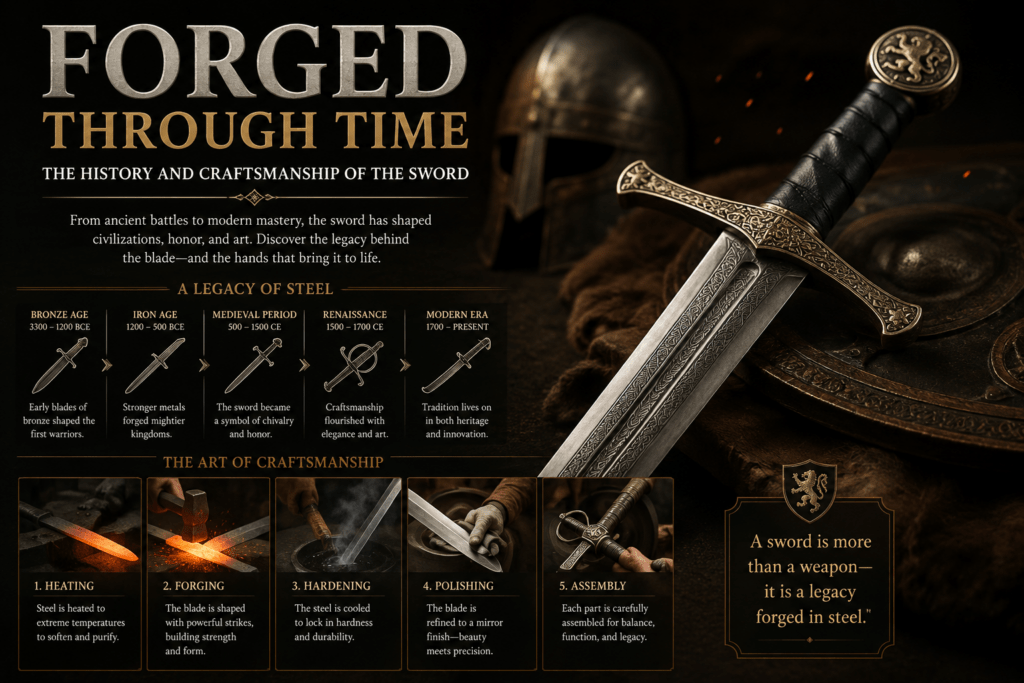
Forged Through Time: The History and Craftsmanship of the Sword
What Makes the Sword Special
Few objects have shaped human history. The sword stands above other tools. You recognize it from ancient battlefields to royal courts. Bronze-age warriors carried swords. Renaissance duelists mastered them. Throughout history, swords represented more than weapons. They showed a civilization’s knowledge of metal. They revealed artistic vision. They reflected warrior culture.
The longsword holds a special place in this history. You find the longsword represents the pinnacle of Western sword design. Master craftspeople created these longswords across centuries. They spent lifetimes perfecting their skills. You can trace the sword’s evolution across thousands of years. Each era produced smiths who transformed raw ore into objects of beauty and lethal power.
The Bronze Age: Where It All Began
Around 3000 BCE, the first true swords appeared. Civilizations in the Mediterranean and Near East had mastered a crucial skill. They learned to combine copper and tin. Bronze emerged from their forges. The smiths of Sumeria and Egypt led this revolution.
Early bronze swords remained short. Most measured less than 60 centimeters. You would recognize their simple design. The blade attached to the hilt. Rivets held the pieces together. These early weapons served double duty. Soldiers used them in battle. Nobles displayed them as status symbols.
The Egyptians created a distinctive curved sword. They called it the khopesh. You can see how this design combined advantages. A curved blade slashed with power. The point allowed thrusting attacks. One weapon could do both jobs.
The Iron Age: Everything Changed
Around 1200 BCE, a major shift occurred. Civilizations began to work with iron. You might assume iron was simply better than bronze. It is much harder to work. Making it into a weapon required new knowledge.
The real breakthrough came later. Smiths discovered steel. Steel contains iron mixed with carbon. You control the amount of carbon carefully. The result is stronger than iron alone. It keeps an edge much sharper than bronze. This discovery transformed weapon-making.
Different regions developed their own sword styles. Each culture created distinct traditions.
Greece: Balance and Elegance
Greek warriors favored the xiphos. The blade is straight. Both edges are sharp. Soldiers could slash or thrust. Greek design reflected their values. Elegance mattered. Practical effectiveness mattered more. Greek smiths developed advanced techniques. They learned to forge-weld iron. The blade became consistent throughout. Quality did not vary from spot to spot.
Rome: Industrial Scale
Romans transformed sword production. They manufactured swords at unprecedented levels. The gladius hispaniensis (Iberian sword) became standard. These swords endured constant use.
You judge this temperature color alone. Then you plunge it into water or oil. The cooling process is crucial. The edge becomes extremely hard. The spine stays slightly flexible. A hard edge holds sharpness. A flexible spine resists breaking.
Medieval Europe: The Golden Age of the Longsword
The High and Late Medieval periods produced the finest European swords. You can date this era from the 11th to 16th centuries. The longsword represents the peak of Western sword design. You recognize the longsword as the most sophisticated sword ever created in the West. Mastering the longsword took years of training. Warriors spent decades perfecting their technique. The longsword demanded skill and dedication.
How the Medieval Longsword Was Engineered
Medieval smiths understood engineering principles. They did not study physics formally. Instead, they learned through centuries of trial and error. You can see their knowledge in every detail of the longsword.
The blade’s shape mattered enormously. Master smiths never created a flat, uniform piece. Both the width and thickness tapered toward the point. You hold a great medieval longsword and feel perfect balance. The center of gravity sits just in front of the crossguard. This placement allowed rapid directional changes. Combat demanded instant control. The longsword blade delivered it.
The fuller proved crucial to the longsword. You see this distinctive groove running down the center. Many people think it is purely decorative. Actually, it solved an engineering problem. The groove removed weight. The longsword blade lost mass yet kept its strength. Centuries later, aircraft designers would rediscover this principle. They used it to make airplane wings strong yet light. The longsword design anticipated modern engineering.
The longsword’s cross-section reveals planning. Examine a quality medieval longsword blade under magnification. The edge sharpens to a fine angle. The spine maintains substantial thickness. The forces of combat pressed on both. The edge must take and hold sharpness. The spine must resist the shearing forces of combat. The transition between these zones was gradual. Medieval smiths controlled this transition precisely in every longsword they created.
Creating a Medieval Longsword: The Process
You needed to master many steps to create a true longsword. Each step demanded attention and skill. The longsword required more precision than shorter blades. The length and balance of the longsword demanded expert craftsmanship.
First, prepare the stock: The smith started materials from iron bloom. Bloomery furnaces produced this spongy iron ore. You could not use it directly. It required reheating. Hammer strikes consolidated it gradually. Repeated reheating created a usable billet.
Next, draw out the metal: Heat returned the billet to the forge. The smith began a long, patient process. Hammer strikes gradually increased its length. You maintained the thickness. You refined the shape constantly. This process could take weeks.
Some smiths employed a pattern: the ancient technique created extraordinary blades. The smith sandwiched different iron and steel types together. These layers were heated. Hammer strikes bonded them. Then the smith folded the metal repeatedly. Sometimes this folding happened ten or more times. The result was a blade strong and flexible. Beautiful patterns emerged on the surface. You could see the folded layers. Prestige came from these visible patterns.
Shaping required precision: As the blade took form, the smith forged the fuller. You carefully tapered the blade. The point took shape. Every hammer strike mattered. Mistakes could not be repaired easily. The smith had to see the final form in his mind before striking.
Heat treatment separated masters from amateurs: Artistry and science merged at this stage. The smith heated the blade to a precise temperature. He judged the color alone. No thermometer existed. Experience taught him to read the colors. Red became orange became yellow in the heat. Each color meant a different temperature. Then the blade went into water or oil. The quenching determined everything. A blade that was too hard would shatter. A blade that was too soft would bend. The master smith sought perfect balance.
Grinding and polishing came next: The smith used progressively finer stones. The blade took its final shape. Polish revealed the truth. Internal flaws appeared as lines or discolorations. Quality became visible. Only then could you see the true quality of the work.
Finally, edge the blade: Whetstones and stropping brought it to razor sharpness. The finest medieval swords could cut through hair. You could shave your arm clean. Stories claim the best blades could split a hair floating down a stream.
The Master Smiths and Their Legacy
You know the names Ulfberht and other legendary smiths. They etched their names into Viking-age blades. These represent some of history’s first branded products. Medieval Europe had many legendary smiths who created longswords. Most remained anonymous. Their work survives. Guild records documented the craft.
Master longsword makers required 7 to 10 years of apprenticeship. Only then could they produce their own longswords. The guild system protected secrets carefully. Techniques passed down through families. Rivals guarded their methods. The journeyman’s masterpiece proved final competence. Such a longsword could take months to complete. It demonstrated all accumulated skill. Creating a longsword was the highest achievement.
Eastern Traditions: Different Paths to Perfection
Far Eastern craftspeople developed equally sophisticated traditions. Their approach differed from European methods. Philosophy shaped their technique. Spirit mattered as much as skill.
The Japanese Katana: Philosophy and Steel
The katana represents perhaps the most sophisticated sword ever created. You find both philosophical and practical achievement. Development took centuries. The katana reflected military needs. It reflected spiritual values. Samurai culture shaped every aspect.
The craftsmanship proceeded through distinct stages. You heat steel repeatedly. You did not assemble different pieces together. The blade curved naturally. Differential heat treatment created this curve. The technique was so refined that each blade’s curve was unique. Polish revealed the hada (grain pattern). You could see all the folding. This grain pattern became an art form itself. Distinctive hamon (temper lines) appeared. These lines showed exactly where hardness changed. You could read the blade’s heat treatment in the hamon pattern.
The Chinese Tradition: Ancient and Refined
Chinese sword-making traditions stretch back 3,000 years. You find sophisticated techniques for many blade styles. They created blades at deliberately varied hardness. The spine remained soft for flexibility. The edge remained hard for sharpness. One blade achieved both properties.
The Decline: When Swords Became History
Firearms changed everything gradually. By the 18th century in Europe, the sword lost military importance. Asia followed a similar path somewhat later. Swords became status symbols. Then they became historical artifacts. The knowledge could have vanished forever.
Something remarkable happened instead. Japan preserved sword-making as cultural treasure. The government recognized an essential truth. This craft represented irreplaceable knowledge. The nation designated master smiths as “holders of important cultural properties.” You could not let this knowledge disappear. The living tradition continued.
Europe’s tradition broke apart. Museums preserved some techniques. Academic study kept some knowledge alive. The living tradition nearly vanished. Contemporary smiths began to rediscover methods. Experimental archaeology became crucial. They studied historical swords. They read period texts. Gradually, lost techniques returned.
Today: The Craft Continues
A global community of sword smiths continues this work. Traditional masters and contemporary practitioners both contribute. Modern makers take different approaches.
Reconstructionists: study history intensely. You examine historical examples. You read period texts. You attempt to recreate medieval and ancient techniques. Accuracy matters deeply. These smiths often test their work. You measure how closely you matched historical performance.
Traditional practitioners: maintain unbroken lineages. Japan and China never lost their traditions completely. The craft continued despite pressure to abandon it. You serve years learning. Knowledge passes directly from master to student.
Contemporary innovators: blend two worlds. You study historical knowledge carefully. Modern metallurgical science provides new understanding. You create blades combining traditional aesthetics. Modern techniques enhance them. The result respects tradition. Modern science improves performance.
All these approaches share common ground. You recognize that sword-making represents something profound. Practical knowledge and artistic sensibility converge. Human dedication creates the result.
What This Means Today
The sword’s journey spans centuries. You trace it from simple bronze blades to sophisticated instruments. Each culture created distinct traditions. European, Japanese, Chinese, and Islamic smiths all contributed. Each responded to fundamental challenges. Transform raw material into a tool. Make it lethal. Make it beautiful. Make it reliable. All three matter.
The craftsmanship required cannot be overstated. You need technical knowledge to create a masterwork sword. You need years of practice. You need innate understanding of materials. You need a willingness to spend months perfecting a single object. Master sword smiths earned legendary status.
In our modern age, you live surrounded by mass production. Digital design dominates manufacturing. Something profound appears in true craftsmanship. A medieval longsword shows what skill can achieve. The longsword demonstrates human possibility. A Japanese katana demonstrates dedication. A Chinese saber reveals centuries of knowledge. Each blade represents human skill applied completely.
The longsword ultimately tells a human story. It shows what humans can accomplish. You master your tools. You apply full attention to your craft. You create something that endures. You connect across centuries to other craftspeople. You join a tradition reaching back to ancient times. The longsword’s story is your story. It is all our stories.