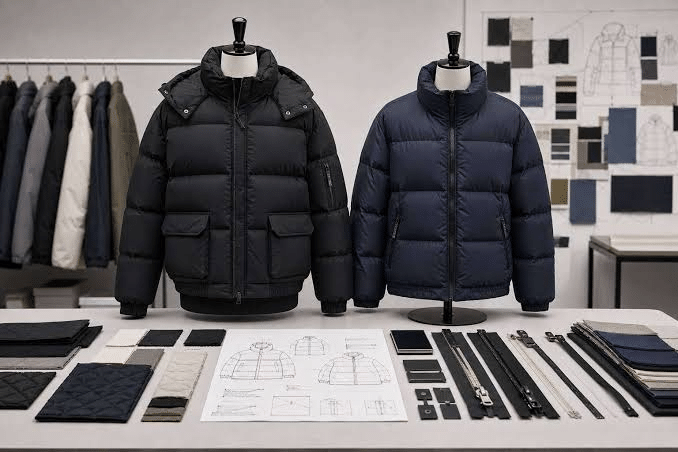
Developing an Outerwear Collection from Concept to Bulk Production
On paper, the winter jacket is almost finished. The wearer hasn’t yet tried the collar over a scarf, and the pattern cutter still has to allow for a sweater under the filling. For the brand, choosing a manufacturer means choosing who does this work. The discussion cannot end at the designer’s desk, either: somebody has to get the agreed construction into the factory’s instructions.
3S Apparel is one candidate for that conversation. Its ODM offer for outdoor and lifestyle brands includes insulated outerwear. Rather than opening with an entire collection, a prospective buyer could take one winter jacket sketch into the first meeting. The review should end with a proposed route through sampling and approval, including the paperwork production will receive.
Start with the collection architecture
Begin with what each jacket is for. Describe a working day in the garment. If the customer wears it over office clothing, that belongs in the fit brief. If it will spend much of a trip inside a bag, give packability a place in the discussion. Calling either garment winter outerwear doesn’t tell the developer enough about how it will be used.
For a hypothetical collection of a city parka and a short insulated jacket, write two fit briefs even if the colours and branding are shared. Compare the pocket access on the two lengths. Would the same opening work in both positions? Which garment needs more space for layers? Common components can be considered once those questions have answers.
Give the developer a short account of the range before moving into individual measurements. Include the intended wearer, use, silhouette, retail position and launch window. Flag the features that carry the brand identity. A note such as “retain collar proportions; pocket construction open to proposals” is useful here. It tells the developer where a manufacturing suggestion would be welcome and where to come back to the brand first.
An ODM relationship also needs a clear division of work. Who proposes materials? Who owns the fit block? Is the manufacturer’s designer expected to develop the initial idea, or resolve an already detailed design? 3S Apparel’s outerwear development solutions cover several product categories; a brand should narrow that broad scope into responsibilities for its own collection. The service label is only the beginning of the agreement.
Turn a sketch into a product brief
Work through the sketch with the person who will develop it. At the hood, establish whether the adjustment has been decided. At a quilted panel, establish whether the fill has been selected or just the visible stitch pattern. These are ordinary open design questions; passing the drawing into production without identifying them is where confusion becomes likely.
Write the open decisions beside the drawing. Add measurements and the proposed fabric and trim references as they become available. A conspicuous blank against the lining is more honest, and more useful, than a complete-looking brief that nobody has actually agreed.
Define the winter jacket before choosing its fill
Use the intended inner layer for the fitting and record it on the review sheet. Otherwise, one reviewer might accept the jacket over a shirt while another rejects it over a sweater. Check reach and arm movement with the garment fastened, including the collar and hood. Matching the outside measurements is only part of that review.
3S Apparel lists down, synthetic and hybrid insulation directions in its public insulated range. That gives a brand several routes to investigate, not a ready-made answer about warmth. The proposed fill, its distribution and the garment construction need to suit the use. A temperature rating cannot be read from a sketch or inferred from the word “down.” Any such claim needs an appropriate basis and clearly stated conditions.
At this point, a winter coat factory should be able to explain what the first sample will establish. It may resolve shape and construction while leaving final material selection open. The plan should say that plainly. Nobody should be waiting for a fully approved production reference when the developer is still testing the shape.
Use samples to settle different questions
Put a purpose against each sample request. For example, the first garment could be needed to review proportions, with a later version reserved for checking the selected fabric. The supplier may use different names for those stages; explain the intended review in writing alongside the sample name.
A first prototype might answer whether the proportions work. That approval can coexist with an open sleeve adjustment, especially while the final fabric is pending. Carry the adjustment forward to the next review instead of replacing the whole record with a general approval message.
Separate fit approval from material approval
“Fit accepted; shell fabric still pending” is a meaningful decision. For a sample containing substitutes, add the fabric and trim references to the review record. Keep photographs, but don’t rely on them to distinguish materials that happen to look alike. The next reviewer needs to know exactly what was in the garment.
A useful comment names the action that caused the problem. “Sleeve feels tight when reaching forward over the sweater” gives the pattern team something to reproduce; “improve comfort” leaves them to guess. Attach the requested change to an owner, then carry the comment into the next sample review until it has been resolved.
| Review stage | What the team examines | What gets recorded |
| First prototype | Shape and proposed construction | Changes needed and decisions still open |
| Fit and materials | Measurements, movement and material versions | Separate approvals for the accepted features |
| Pre-production | Final components and reference garment | The version authorised for manufacture |
This is a suggested sequence, not a fixed sample count or a promise about 3S Apparel’s timetable. The supplier and brand should agree their own review gates. A performance claim requires another kind of evidence. If the jacket is to be described as waterproof, decide with the relevant specialist how that claim will be evaluated; a visual review of the seams does not do that job.
Coordinate adult and child products deliberately
For a brand buying men’s, women’s and children’s outerwear, working with one development team has an obvious appeal: fewer separate conversations about the range. It still needs separate fit references. A common palette and logo can tie the collection together without making the garments identical.
The 3S Apparel development range includes adult and children’s outerwear. For a mixed range, the question to put to its team is how the work would be organised: which fit blocks would be used, which samples would be reviewed and who would keep the range consistent. A list of garment categories is less revealing than the proposed development route.
A children’s style needs more than a reduced adult pattern. Set aside a separate review with the brand’s qualified safety or compliance specialist, using the intended ages and sales markets. Features to put on that agenda include adjustments, fastenings and detachable parts. The result needs to relate to the children’s garment in front of the team, however familiar the supplier is with the adult range.
Even an apparently simple range decision can need several approvals. The same colour may look different on two fabrics. Accepting it on the adult parka shell doesn’t automatically approve its appearance on a child’s jacket in another material. Keeping the references distinct avoids an argument later about what “matching” was supposed to mean.
Make the approved sample usable in production
At handoff, put the sample’s identity beyond doubt. Is the reference the garment reviewed last week, or the one with the revised pocket? Which measurement sheet goes with it? Has the last pocket change reached the material list and construction notes? The production team needs one consistent answer.
The dated reference number on the garment should lead to the matching measurements, tolerances, colours, artwork, labels and trim list. If a note conflicts with the sample, return it to the person who approved the change. Measuring a reference garment will not tell the sewing team how much variation the brand has agreed to accept.
The handoff also needs people. Meet the development contact and the person responsible for production, and work through the style with both. Incoming material checks, early production comparisons and checks before delivery serve different purposes; Intertek’s textile inspection guidance describes these distinct stages. A brand can use that distinction to establish when a deviation would be found and who would resolve it.
There is one final commercial question. Are the bulk materials and production arrangements available for the intended order? A good sample doesn’t reserve either. Before closing the review with 3S Apparel or another candidate, list what remains open and name the person responsible for each item. Then the brand can see exactly what stands between its approved design and a production authorisation.