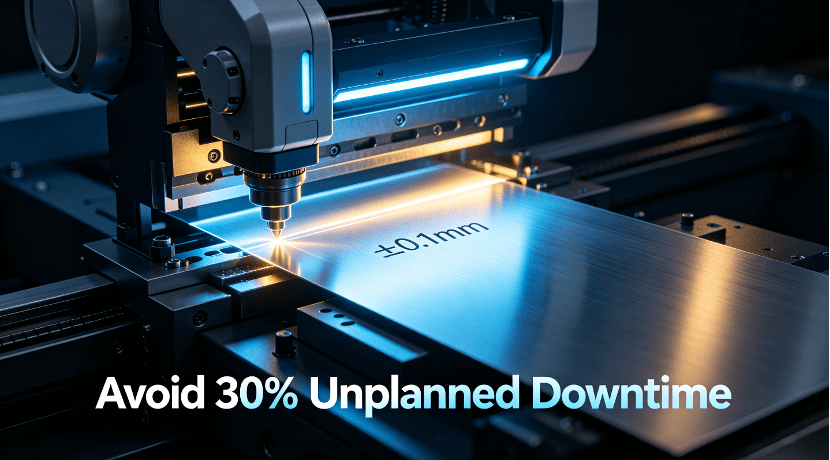
Avoid 30% Unplanned Downtime: How Precision Equipment Manufacturers Can Meet Stringent Tolerance Demands
Introduction
For semiconductors, aircraft, and advanced medical instruments, manufacturers depend on sheet metal components that require extreme flatness, fit, and sealing. Yet, variations as small as microns can lead to assembling problems, product malfunction, and expensive unplanned downtimes due to a disconnected process where cutting, bending, and welding are considered separate operations without an appropriate methodology to account for stresses, springback, and thermal distortion. It leads to inconsistent results, failing to meet the deterministic requirements of contemporary precision machinery.
The paper focuses on a data-driven approach to manufacturing sheet metal parts. Not only does it address the problem of using advanced machinery, but it also proposes a “deterministic manufacturing” process, including functional design and material-dependent processes leading to quality control. In the following paragraphs, the paper dissects each step to reach a reliable outcome.
How Does the Term “Functional Precision” Relate to Sheet Metal beyond Just Dimensional Tolerances?
Just because one hits each tolerance does not mean that the parts will fit together perfectly and function as desired. Precision is achieved at a system level, not at a feature level. This demands a manufacturing approach that goes beyond just tolerances to understand the true meaning of such standards as ASME Y14.5, where GD&T is defined. The key concept here is to differentiate between the static nature of dimensional tolerances (hole patterns) and dynamic geometric tolerances (flatness after welding) and reverse-engineer the intent behind the design, such as making sure there is no leakage or stress in the assembly.
- From Isolated Tolerances to Integrated Function: Checking the bend angle or the placement of a hole does not suffice. Even if the piece meets all these specifications, it might not seal or fit because the overall interaction of all the features was not controlled. Precision fabrication refers to the modeling of the way all the manufacturing dimensions will interact as an integrated whole when assembled. This systems approach differentiates conventional fabrication from high-end precision sheet metal fabrication services that offer sheet metal fabrication with tight tolerances.
- Balancing Static and Dynamic Dimensions: For static dimensions, such as the placement of mounting holes, absolute precision is needed. This is obtained using processes with very high repeatability, such as laser cutting with deterministic fixturing. The dynamic dimension is much more complicated because it is affected by process-induced stress. Controlling dynamic dimensions calls for prediction of the distortion through simulation and proprietary databases to modify the designs or the process to ensure that the result will relax into the desired form.
- Incorporating Design Intent into Process Control: Ultimately, the aim is to convert the design intent for functional requirements directly into manufacturing parameters. In the case of a part that needs a vacuum seal, the control criterion is then not only the sheet thickness but rather the flatness and stress profile of the mating surface at the flange. Such an approach entails a close interaction between design and manufacturing engineers, designing the manufacturing process backwards from the in-use requirements, making sure that every step leads to a functionally accurate part.
What Are the Key Control Points in an Integrated High-Precision Sheet Metal Fabrication Process?
A fragmented process cannot be expected to produce consistent results at a micron level. An integrated process, where each step is under control and drives the next step, is needed to make high-precision sheet metal fabrication into an exact science, overcoming the intrinsic issues of material springback and thermal distortion.
1. Blanking and Forming: Basis for Precision
We start with the accuracy of laser cutting where powerful fiber lasers ensure minimal Heat Affected Zone (HAZ) to maintain material integrity before bending. Springback compensation is the biggest obstacle when it comes to forming. High-precision sheet metal fabrication uses material databases with pre-programmed values that compensate for springback in particular materials, thicknesses, and bend angles. Data from databases powers CNC press brakes with in-process angle measurement and automatic springback compensation. In this way, bend angles are confined within ±0.5°, compensating for elastic deformation.
2. Joining and Stress Management: Distortion Control
One of the primary causes of deformation is welding. Among the methods for controlling welding distortion is regulating heat input. Methods that use little heat like laser welding are capable of generating 80% less heat than traditional TIG welding. For situations that either cannot be welded or where heat is not wanted, there are other alternatives like press-joining or adhesive bonding. Besides material properties, the initial and final states of the parts largely determine the forming processes that can be carried out and, as a result, the joining methods that are available and should be considered.
3. Systemic Error-Proofing Through Process Chain Control
The last measure of protection is process chain control, whereby the output measured during one stage of the process is used to set the input values for the next process stage. As an example, the measured angle of the bend and the hardness of the material in the bending stage determine the power and speed settings for welding. This results in an interconnected manufacturing process, which takes care of even the slightest deviations along the way. This is what characterizes a deterministic process, where dimensional drift is simply not possible.
Why Are Material-Specific Approaches the Core of High-Precision Fabrication?
There can be no single solution for high-precision custom sheet metal fabrication. Every material family has its own response to pressure, temperature, and deformation processes. The key to success lies in applying unique material-specific strategies in the fabrication process.
1. Taming Aluminum Alloys and Stainless Steels
The aluminum alloys that can be galled or marked during forming need exceptionally sharp tools as well as polyurethane die pads during bending. Austenitic stainless steel, such as 304, is difficult to work with because of its high springback and hardening nature; thus, bending should be done using incremental bending technique and following minimum bend radius rule (≥ material thickness). These fabrication methods ensure that no cracks form and that angles are consistent.
2. Navigating the Complexities of High-Performance Alloys
The precipitation-hardening stainless steels, including 17-4 PH, are challenging due to their machinability in solution-treated condition yet unpredictable distortion during age hardening. To solve this problem, all fabrication should be done after solution treatment while controlling distortions during aging. Special alloys such as Invar and titanium have to be processed in environments that maintain constant temperatures due to their thermal coefficient and reactivity.
3. The Protocol for De-Risking New Materials
The starting point for de-risking any new material or challenging design is the development phase in the materials lab. Empirical small-scale trials determine the optimal process window, i.e., the exact values of laser power, bend compensation, and weld parameters. This comprehensive front-end validation de-risks the entire production process, guaranteeing that ultra-precise sheet metal fabrication is based on robust empirical data, regardless of the material involved.
How Do Precision Sheet Metal Stamping and Laser Cutting Work Together for Economical but Super-Precise Results?
Many people think that doing a sheet metal stamping and doing laser cutting of the sheet metals are methods that cannot go together. The truth is that the combination of the two in one of the most cost-effective and efficient ways of producing high-quality results. The first one really gives great results when doing a large number of same type parts and the other one is great for making a lot of different types with flexibility in the designs at a lower volume.
1. Using Stamping for Quantity and Repeatability
In cases where a component is manufactured using features such as standard holes, louvers, or embossed elements in the thousands, there is no better method than precision sheet metal stamping. Progressive die stamping is able to provide incredible consistency at ±0.05mm tolerances, thus being the most economical way of manufacturing parts in bulk. The upfront investment in the die will be distributed over a larger quantity, resulting in a cheap per-piece price and very fast cycle times after perfecting the die.
2. Using Laser Cutting for Complex Design and Versatility
Where the design includes complicated shapes, internal cut-outs, or requires frequent design changes, laser cutting is the obvious choice. It is able to deliver small tolerances (±0.1mm) without requiring any tooling at all. Its non-contact process ensures that the part does not suffer from mechanical stress, an important feature when dealing with fragile or complicated geometries.
3. Leveraging Synergy through Hybrid Manufacturing
The most effective method involves the integration of both, forming a hybrid manufacturing cell. One machine could employ a laser for cutting intricate external shapes and internal features, followed by a punching process to form features such as louvres and tapped holes using one clamping operation. The resulting synergy would eliminate any secondary positioning errors while minimizing material handling. This hybrid approach represents an essential part of the sheet metal parts manufacturing process services.
What Do Advanced Metrology and Quality Systems Ensure Dimensional Precision Besides Certifications?
In close tolerance metal manufacturing, conformity cannot be presumed; it needs to be conclusively proven. Sheet metal advanced metrology goes beyond a mere go-no-go inspection to deliver constant, data-driven confirmation. This four-step process forms the digital thread of assurance required in fields where failure is not an option.
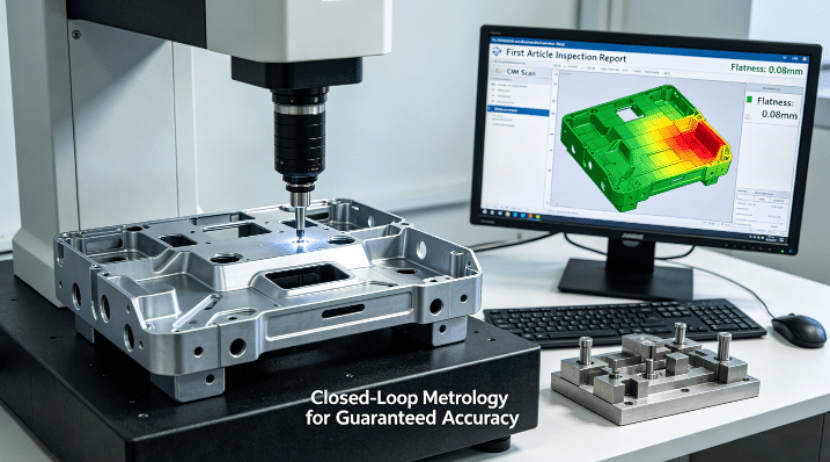
- First-Article and In-Process Verification: It starts with a thorough First-Article Inspection through CMM inspection for sheet metal parts to produce a complete 3D deviation map, not just random spot inspections. Then, during the production process, in-process verification steps in. Bend angle measurement in real time by laser sensors mounted in press brakes and seam positioning monitoring in real time through optical vision systems at welding stations become part of the process.
- Functional Validation and Digital Quality Archiving: Parts don’t just need to be shaped right – they have to work. Master fixtures simulate the final assembly environment, allowing the designer to see whether there’s any chance of fit problems or interference issues. Finally, all data related to the part’s measurements is collected together into a digital dossier associated with its serial number. This isn’t just documentation – it’s a complete set of data demonstrating compliance with every relevant requirement, ensuring traceability and supporting a closed-loop quality system.
- Quality Assurance and Smart Manufacturing: The data-enabled quality assurance framework discussed here is fundamental to the concept of smart manufacturing. Through its ability to make data from the manufacturing process meaningful, it allows for quality predictions and process optimization. Projects such as that by the National Institute of Standards and Technology (NIST) have been addressing the measurement and standards required for digital manufacturing processes. Establishing a digital quality archive would be one way to get closer to this goal.
Which Process Capability Metrics Actually Set Apart Great Suppliers from Average Ones?
In order to evaluate a sheet metal fabrication supplier with tight tolerances, one must look beyond mere machinery and examine its ability to run a well-oiled process. Capability is measured through statistics, responsiveness, and a strong quality culture. A proper supplier process capability assessment will thus target those metrics that prove rather than just talk about capability.
1. Demonstrating Control Using Statistical Process Control (SPC) Data
Present real data evidence: X-bar and R control charts and Cpk values for a key dimension like the height of the bend or the location of the hole. A Cpk value of 1. 33 or higher denotes a good level of capability whereas a Cpk value of 1. 67 or higher denotes a very good level of capability. The data confirm that the process is statistically controlled and capable to consistently deliver parts falling within the tolerance limits.
2. Assessing Response to Non-Conformance
Describe a hypothetical situation where non-conformance occurs: “What if the hardness of the material changes, leading to a 0.5° spring back change?” Assess their response process. This should encompass immediate containment of the issue, carrying out root cause analysis (for example, through 5 Why or Fishbone diagram approach), correction in the process, and prevention of the recurrence of the issue.
3. Evaluation of the Content of Management Systems
Check if the organization is accredited with the relevant certificates such as IATF 16949 for automotive industry manufacturing or AS9100D for aerospace manufacturing. Still, It is best to keep in mind that an audit should not focus solely on the certification. Is the management system fully and actively integrated into the business operations? Are risk-based thinking and corrective actions deeply ingrained into the corporate culture? For precision non-standard part fabrication services, this systematic approach is key to mitigating risk.
Conclusion
The attainment of tight tolerances on sheet metal parts is a systems engineering effort in itself. It involves the functional design intent, materials science, process compensation through prediction, and metrology validation in a closed-loop manner. The manufacturer must be one that is not only well-equipped technologically, but process-wise, as well, in order to convert knowledge into certainty. This approach is the only effective way to protect oneself from the expensive threat of unscheduled downtime.
FAQs
Q1: How much time would it take for us to prototype a tight-tolerance sheet metal assembly?
A: The prototyping lead time would normally take around 4-6 weeks after completion of the drawings. This will allow for proper DFM analysis, material procurement, and complete first article inspection.
Q2: How are such problems as burrs and sharp edges dealt with in order to guarantee both safety and premium finish?
A: Deburring is compulsory. Depending on the item, there are options such as vibratory finishing for deburring edges, magnetic polishing for obtaining a premium high-luster finish on complicated geometries, or sanding for large items. For the highest level of cleanliness, electropolishing eliminates any micro-burr and passivates the surface.
Q3: Is it possible to reach a flatness tolerance below 0.1 mm for large aluminum sheets welded together?
A: It is possible, but only through proactive distortion control. The steps include pre-tensioning of the sheet, pulse laser welding with low heat input, and post-weld vibrational stress relieving. This deterministic approach, validated by simulation, has been successful in obtaining parts with flatness within 0.08mm even after extreme thermal cycles.
Q4: What is the minimum order quantity (MOQ)? Do you offer prototype-scale manufacturing?
A: We offer prototype and pilot runs with MOQ as low as 1-10 pcs. This is important to validate the design and process before proceeding into production. The same process control approach is taken into account for prototypes as well.
Q5: What are the real benefits of getting certified with IATF 16949 and AS9100D standards for my project?
A: Securing such certifications means adopting a proactive and risk-based management system. In other words, there will be: 1) Proper advanced product quality planning to anticipating and avoiding problems, 2) Total traceability for each production lot, 3) Robust change management, and 4) An ongoing process of easy, data-driven improvement.