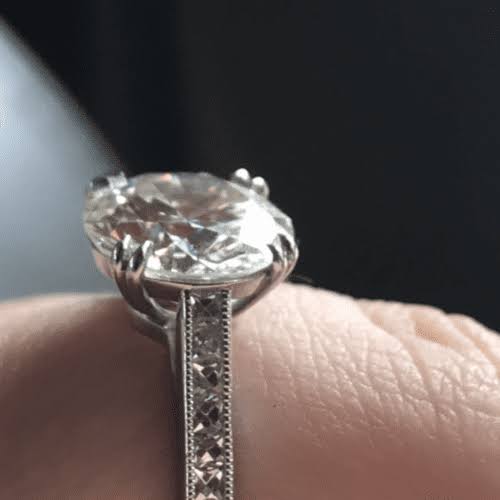
An Heirloom Diamond, Reset: Previewing a New Platinum Ring Before It Is Cast
There is a particular kind of diamond that turns up in jewelry boxes and safe-deposit drawers: round, slightly soft at the edges, with a face that glows in broad, petal-like flashes rather than tiny glitter. Often it is an old European cut, the style that dominated from roughly the 1890s into the 1930s, before modern brilliant proportions became standard. Inheriting one is a gift with a question attached. The stone deserves a ring someone will actually wear, yet it was cut by hand, for candlelight, and for the settings of another era. Moving it into new platinum is less about reinventing the stone than about introducing it to a different life, and seeing that life clearly before any metal is cast.
Start With the Stone, Not the Sketch
Before anyone draws a prong, the diamond needs an honest look. Old European cuts have a recognizable anatomy: a small table, a tall crown, and an open culet, the tiny flat facet at the bottom that often shows as a small circle when you look straight down. These are signatures, not flaws. A century of wear leaves its own marks, though. Ask a jeweler to examine the girdle, the thin outer edge, for chips hidden under old prongs, and to look under magnification for feathers or worn facet junctions. Those details affect how safely the stone can be unmounted and how much pressure new prongs should apply.
If the diamond has never been graded, consider sending it to an independent gemological laboratory once it is out of its old mounting. A loose stone can be weighed and measured precisely; a mounted one can only be estimated. That report becomes the baseline for everything that follows.
Keep the Story Intact
Provenance is easy to lose in the shuffle of a redesign. Photograph the original ring from several angles before it is taken apart, and write down what the family knows: whose it was, when it was given, and where it came from. Decide early what happens to the old mounting. Some families keep it whole; others ask for the metal back, or for one element, such as an engraved shank or a filigree gallery, to be saved or worked into the new piece. Put that decision on the intake paperwork rather than trusting anyone’s memory.
Proportion Is the Real Design Problem
Old European cuts are often deeper than modern rounds, so they tend to sit taller. A setting drawn around a contemporary brilliant can make an older stone look perched, while a heavy, low bezel can swallow the high crown that gives it character. Strong designs account for depth first: a gallery that lets the culet clear the finger, prongs placed to follow a hand-cut outline that may not be perfectly round, and a head height that balances presence with practicality.
Style follows from there. Slender prongs and a fine band tend to flatter an old cut’s warmth; a halo of modern brilliants can compete with its broad flashes rather than frame them. Platinum’s white color suits these stones, and its density makes it a dependable metal for prongs guarding a century-old edge. The guiding question is not what is fashionable this season but what lets this particular diamond look like itself.
To see how different ring profiles frame a center stone, browse Necker’s custom design possibilities before a consultation and note what you respond to.
Test Light, Fit, and Daily Life
A ring is judged on a hand, not in a tray. Think about where it will be worn most: an office under fluorescent panels, a kitchen, a garden, a commute in winter gloves. Old cuts are lovely in low, warm light and can look calmer under harsh overhead fixtures, so view the stone in several environments. Consider whether a wedding band needs to sit flush, whether a tall setting will snag knitwear, and whether the wearer works with their hands. Measure finger size more than once, at different times of day, since fingers swell with heat and activity.
Sketch, CAD, Wax, or Mockup: What Each Tells You
Each preview stage answers a different question. A hand sketch captures mood and proportion quickly and is the cheapest place to change direction. A CAD rendering adds precision, including millimeter dimensions, prong placement, and gallery detail, but on a screen everything can look larger and more dramatic than life, so ask for measurements alongside the images.
A wax or printed resin model is where scale becomes real. Because fine jewelry is commonly cast with the lost-wax method, a wax model shows the form that will become metal, and trying it on reveals height, band width, and how the ring sits beside a wedding band. It will not sparkle, and it is lighter than platinum, so judge shape rather than finish. Some studios also offer a simple mockup with a simulant stone to show face-up size on the hand.
Not every jeweler makes a wax preview for every commission, so ask whether one is available and whether it adds cost or time. Necker’s Jewelers, which has served customers from stores in DeWitt and Davenport, Iowa, for more than 130 years, notes in its custom process that a wax preview can be requested, a good reminder that this step is often something you ask for rather than something you assume.
Questions to Ask Before Casting
Once metal is poured, changes become expensive. Before approving the final model, confirm the finished ring size, the band’s width and thickness, and the exact height of the head. Ask how the culet will clear the finger, how many prongs there will be, what shape their tips will take, and whether a future wedding band will sit flush. Settle the platinum alloy, the surface finish, and any engraving text, font, and placement. Finally, ask what happens if the finished ring differs from the approved model.
Consent for Anything That Touches the Stone
Some decisions change the diamond itself, and they deserve explicit, written consent. Repolishing a chipped girdle or recutting an old stone toward modern proportions removes weight and, for many admirers of antique cuts, character; neither can be undone. Laser inscribing a report number is less invasive but still permanent. Ask how the jeweler handles setting a stone with surface-reaching feathers. If the diamond is shared family property, make sure everyone with a stake agrees before work begins.
Document and Insure the New Ring
Once the ring is finished, the paperwork should catch up. Request an updated written appraisal describing the diamond and mounting together, keep it with the lab report and before-and-after photographs, and send the new valuation to your insurer, since coverage written for the old ring may not reflect replacement value. Schedule periodic prong checks, especially during the first year of daily wear.
An inherited diamond already has a past. A thoughtful setting, previewed carefully, approved in stages, and documented well, gives it a future that fits the person wearing it.