The Ins and Outs of Michael Landon’s Life and Career
The Ins and Outs of Michael Landon’s Life and Career
Why Michael Landon Remains a Television Icon
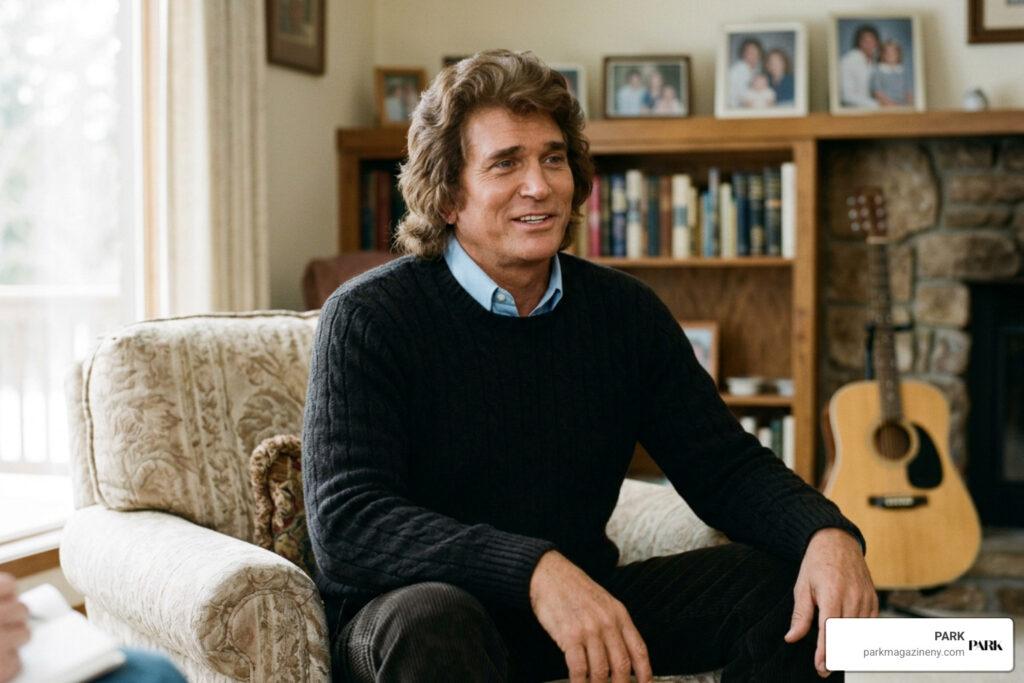
Michael Landon was an American actor, writer, director, and producer best known for three landmark TV roles: Little Joe Cartwright in Bonanza, Charles “Pa” Ingalls in Little House on the Prairie, and Jonathan Smith in Highway to Heaven. Born Eugene Maurice Orowitz in Forest Hills, Queens, he became one of network television’s most recognizable creative forces.
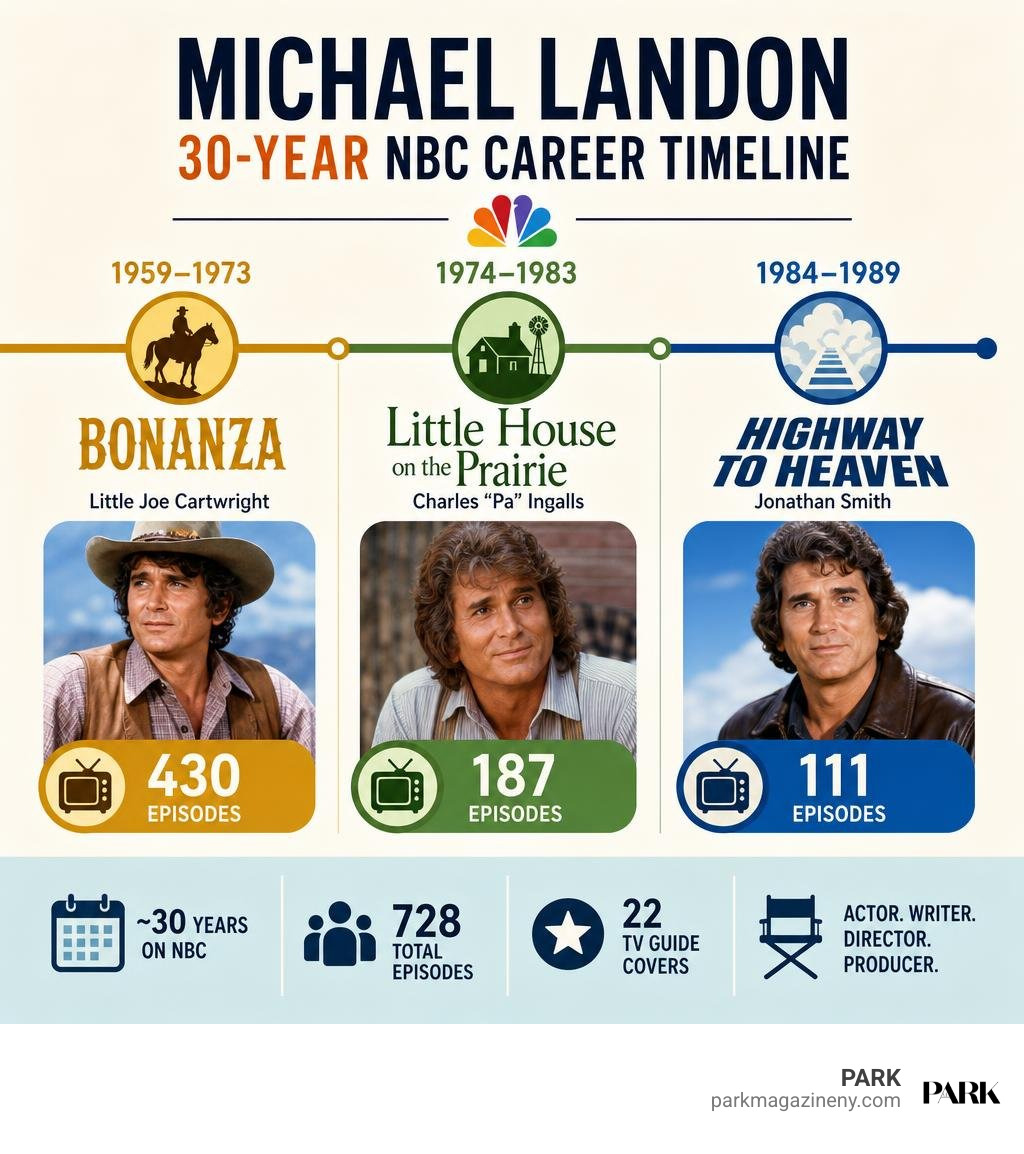
Across three consecutive hit series, Landon spent roughly 30 years on NBC. He starred in 430 episodes of Bonanza, 187 episodes of Little House on the Prairie, and 111 episodes of Highway to Heaven. His 22 TV Guide covers placed him second only to Lucille Ball.
More than a familiar face, Landon helped shape the stories behind the camera. He wrote, directed, and produced television centered on family, loss, faith, and compassion – themes that still connect with viewers decades after his death in 1991.
I am W.A. Muller, and this guide looks at the athlete, performer, filmmaker, and lasting cultural figure behind the name.
Michael landon terminology:
From Queens Athletics to Hollywood Breakthrough
Long before becoming a fixture of primetime television, Eugene Maurice Orowitz grew up with big athletic dreams. Born on October 31, 1936, in Forest Hills, Queens, New York City, he spent his earliest years surrounded by the hustle of the city before his family relocated to suburban Collingswood, New Jersey.
During his high school years at Collingswood High School, Eugene channeled his energy into track and field. He became a standout athlete, developing an extraordinary talent for the javelin throw. In 1954, he recorded a monumental toss of 193 feet 4 inches (58.93 meters), which stood as the longest javelin throw by any high schooler in the United States that year. His athletic prowess earned him an athletic scholarship to the University of Southern California (USC).
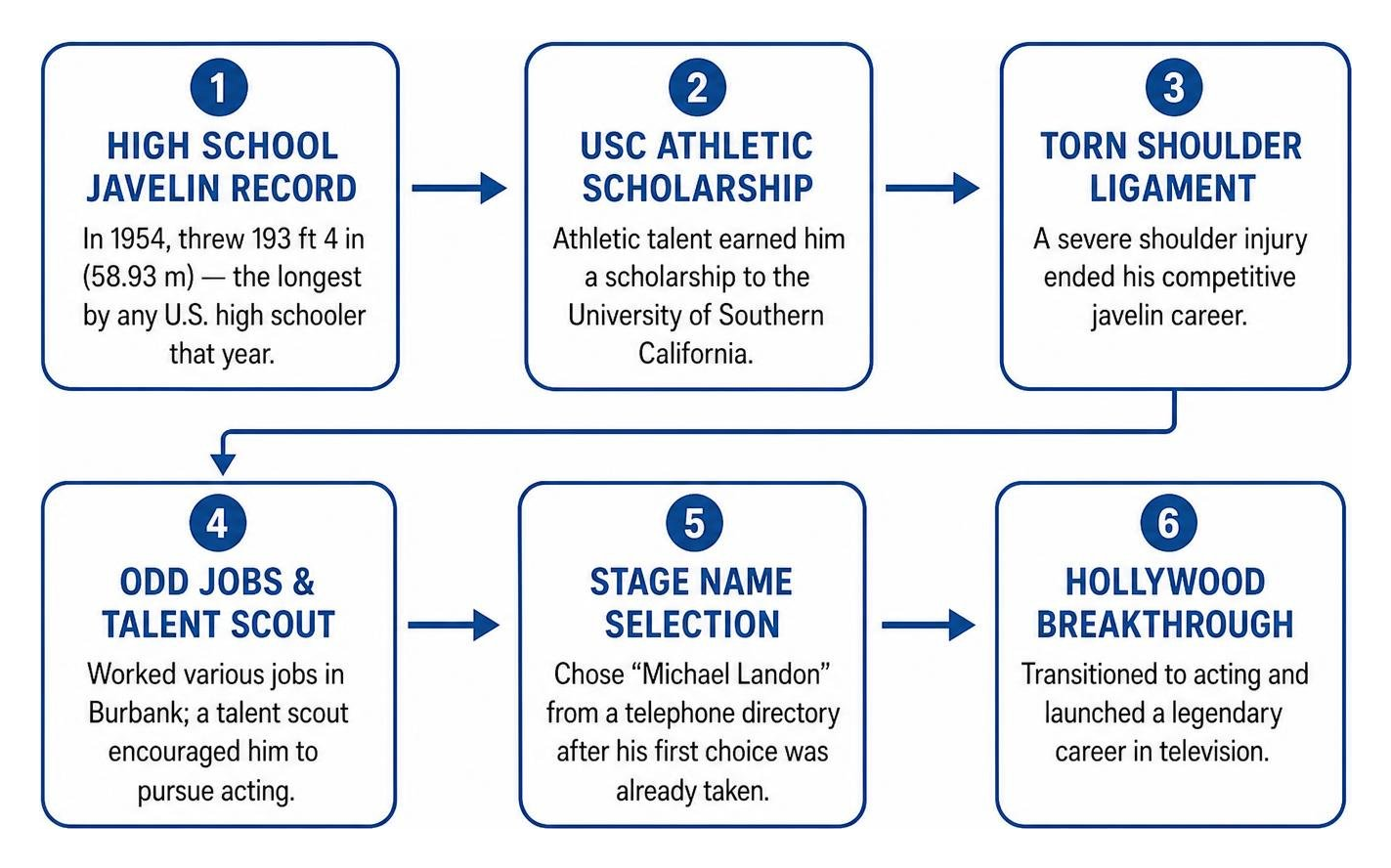
Landon’s collegiate athletic journey met an abrupt halt when he suffered a severe torn shoulder ligament, ending his competitive throwing career. After leaving USC, he worked a series of odd jobs—unloading freight cars, making ribbons, and working at a local gas station situated across from the Warner Bros. studios in Burbank. It was around this time that a talent scout noticed him, encouraging him to pursue acting. He chose the stage name “Michael Landon” by picking a surname out of a telephone directory after discovering his initial choice was already registered with the Screen Actors Guild. We often explore such inspiring stories of reinvention in our historical biography series.
Early Life: Eugene Orowitz to Michael Landon
Behind Landon’s athletic accomplishments lay a deeply challenging childhood marked by emotional adversity. He endured a tumultuous home environment, navigating his mother’s serious mental health struggles and repeated suicide attempts. During one beach outing, young Eugene—who did not yet know how to swim—leaped into the water to rescue his mother from drowning.
He also wrestled with chronic childhood bed-wetting. In an effort to shame him, his mother would hang his urine-stained sheets outside his bedroom window, forcing him to sprint home from school as fast as possible to tear them down before his classmates could notice. Rather than letting this trauma define him negatively, Landon later transformed this private pain into art, writing and directing the acclaimed 1976 semi-autobiographical teleplay The Loneliest Runner. The project served as a cathartic milestone, demonstrating his lifelong ability to turn personal pain into poignant storytelling.
First On-Screen Successes
Landon’s breakthrough into show business occurred rapidly in the late 1950s. He developed a remarkable auditioning skill: he could cry on command, an ability he discovered while helping a fellow actor prepare for a screen test by drawing upon his genuine childhood emotional reserves.
His early screen work quickly proved his versatility. In 1957, he earned leading acclaim starring as Tony Rivers in the cult-classic horror film I Was a Teenage Werewolf. He followed with notable performances in films like The Legend of Tom Dooley (1959) and released several teen idol musical singles through Candlelight and RCA Victor. As an undeniable rising star in Hollywood, his charisma and emotional range quickly captured the attention of network casting directors.
The Three Primetime Masterpieces That Defined Network TV

Over a span of three decades, Michael Landon achieved an unprecedented broadcasting footprint. His shows championed empathy, moral integrity, resilience, and family connection, providing audiences with comforting, character-driven television during eras of massive cultural change. Recognized as an extraordinary hollywood talent, Landon built a portfolio of primetime programming that remains iconic.
| Television Series | Broadcast Run | Seasons | Total Episodes | Core Creative Roles | Key Legacy & Themes |
|---|---|---|---|---|---|
| Bonanza | 1959–1973 | 14 | 430 | Actor, Writer, Director | Early full-color pioneer, western morality, sibling loyalty |
| Little House on the Prairie | 1974–1983 | 9 | 187 | Lead Actor, Director, Exec Producer, Writer | Frontier resilience, family values, youth mentorship |
| Highway to Heaven | 1984–1989 | 5 | 111 | Creator, Star, Director, Owner, Exec Producer | Spiritual redemption, disability representation, compassion |
Little Joe Cartwright on Bonanza
In 1959, at age 22, Landon was cast as the hot-headed, good-hearted youngest brother Little Joe Cartwright on NBC’s Bonanza. The show became one of the earliest primetime network programs broadcast in full color and developed into a global ratings juggernaut, running for 14 seasons across 430 episodes.
Not content with merely acting, Landon used his time on the Bonanza set to learn every aspect of filmmaking. He began pitching and penning scripts, eventually stepping into the director’s chair. This hands-on education transformed him into a seasoned industry creator and later earned him induction into the Western Performers Hall of Fame at the National Cowboy & Western Heritage Museum.
Charles “Pa” Ingalls and Little House on the Prairie
Following Bonanza, Landon took on the role of Charles “Pa” Ingalls in the television adaptation of Laura Ingalls Wilder’s classic books, Little House on the Prairie. Airing from 1974 to 1983 for nine seasons and 187 episodes, the series cemented Landon as America’s favorite television father.
As executive producer, frequent writer, and director of 85 episodes, Landon maintained strict creative standards. On set, he served as a nurturing mentor to young cast members, especially Melissa Gilbert, who played Laura Ingalls. Gilbert often spoke about how Landon treated the young cast like his own family, fostering an environment where young performers could learn professional filmmaking in a safe, supportive space.
Jonathan Smith in Highway to Heaven
In 1984, Landon launched Highway to Heaven, starring as Jonathan Smith, a probationary angel sent to Earth to help people in need alongside his mortal friend Mark Gordon, played by Victor French. The inspiration behind the show was deeply personal: Landon conceived the series to fulfill a spiritual vow to God after his daughter Cheryl survived a catastrophic car crash and emerged from a coma in 1973.
Highway to Heaven aired for five seasons and 111 episodes. Notably, it was the only television series throughout Landon’s career that he owned outright under Michael Landon Productions. Landon used this total creative independence to pioneer inclusive hiring practices across Hollywood, deliberately hiring disabled adults and real-life cancer patients as writers, actors, and crew members.
The Enduring Television Legacy of Michael Landon
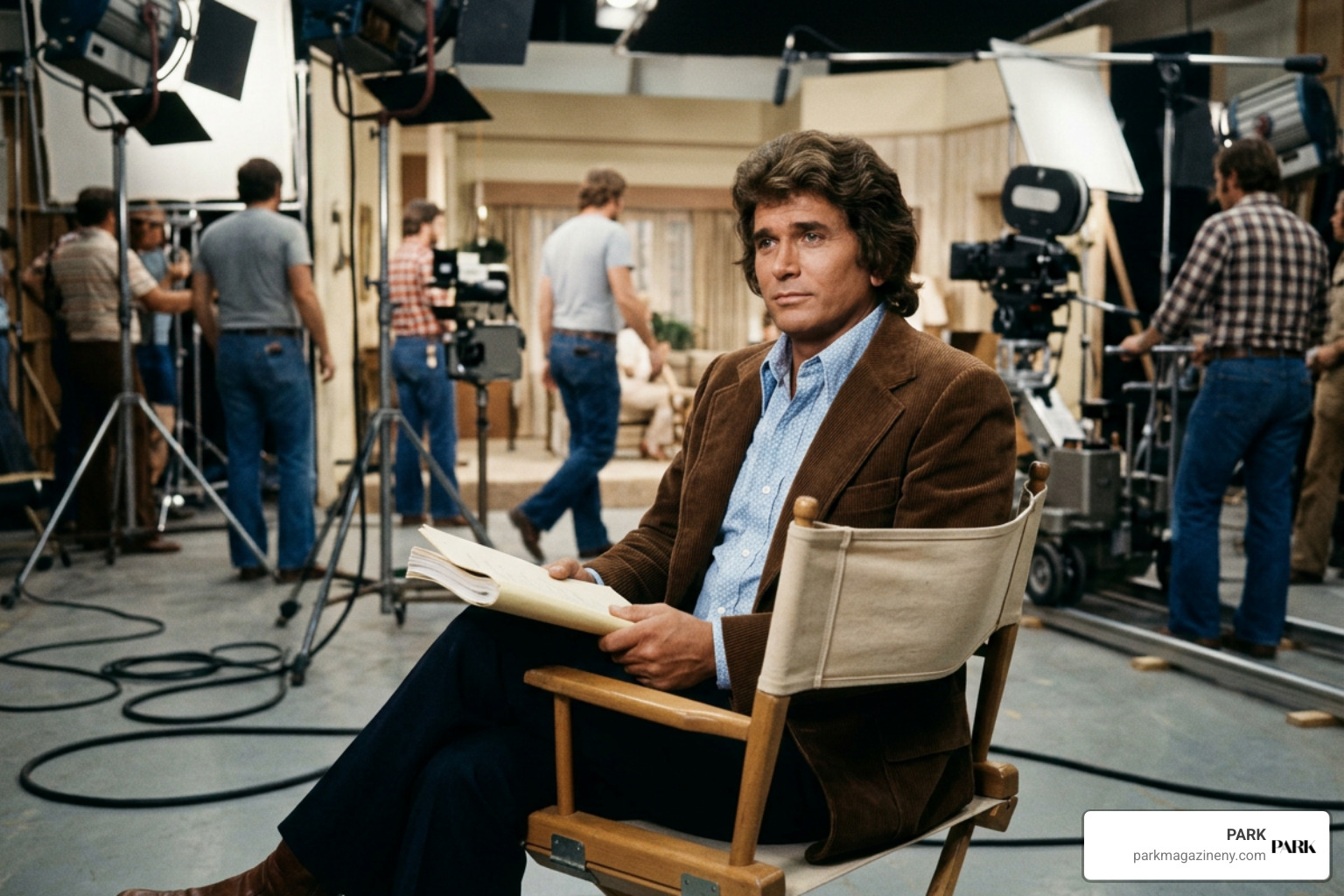
Landon’s legacy extends far beyond his handsome screen presence. He was an audacious industry pioneer who fearlessly negotiated with television network executives to protect his creative storytelling vision. His transition from an athletic Queens youth to an entertainment powerhouse marks a journey from luxury to legend. In 1984, he received a star on the Hollywood Walk of Fame, cementing his status among Hollywood greats.
The Multi-Hyphenate Auteur: Michael Landon as Writer and Director
Landon’s directorial efficiency was famous across the entertainment industry. He wrote scripts at blistering speed, frequently revising pages in his director’s chair while lighting crews set up shots. His crew loyalty was legendary; camera operators, sound technicians, and lighting professionals worked with him continuously across all three of his major television series.
In 1990, Landon wrote, directed, and starred in the critically acclaimed television film Where Pigeons Go to Die, earning two Emmy nominations. In 1991, he filmed the pilot episode for a proposed CBS series titled Us, which highlighted his continuous drive to innovate narrative television before his passing. He was posthumously inducted into the Television Hall of Fame in 1995.
Family Dynamics and Generational Impact
Throughout his life, Landon was married three times and was the father of nine children (including three adopted). His first marriage was to Dodie Levy-Fraser, followed by his marriage to Marjorie Lynn Noe, and later to Cindy Clerico, who worked on the set of Little House on the Prairie. Landon’s private world centered around his sprawling ranch in Malibu, California, where his large family routinely gathered.
His artistic legacy continues through his family. His son, Michael Landon Jr., became a successful director, writer, and producer, directing tributes such as Michael Landon: Memories with Laughter and Love (1991) and the dramatic teleplay Michael Landon, the Father I Knew (1999). For those interested in Hollywood financial dynasties, our coverage of celebrity net worth highlights how production ownership enables generational stability.
Pancreatic Cancer Diagnosis, Advocacy, and Final Days
In early 1991, while on a family ski trip in Park City, Utah, Landon began suffering from severe abdominal pain. After cutting the vacation short to undergo medical testing, he received a devastating diagnosis of inoperable pancreatic cancer on April 5, 1991, which had already metastasized to his liver.
Rather than hiding his condition, Landon held a candid press conference at his Malibu home to announce the news directly to the public. In May 1991, he appeared on The Tonight Show Starring Johnny Carson, displaying his characteristic humor and warmth while discussing his diagnosis, alternative holistic efforts, and the importance of public awareness.
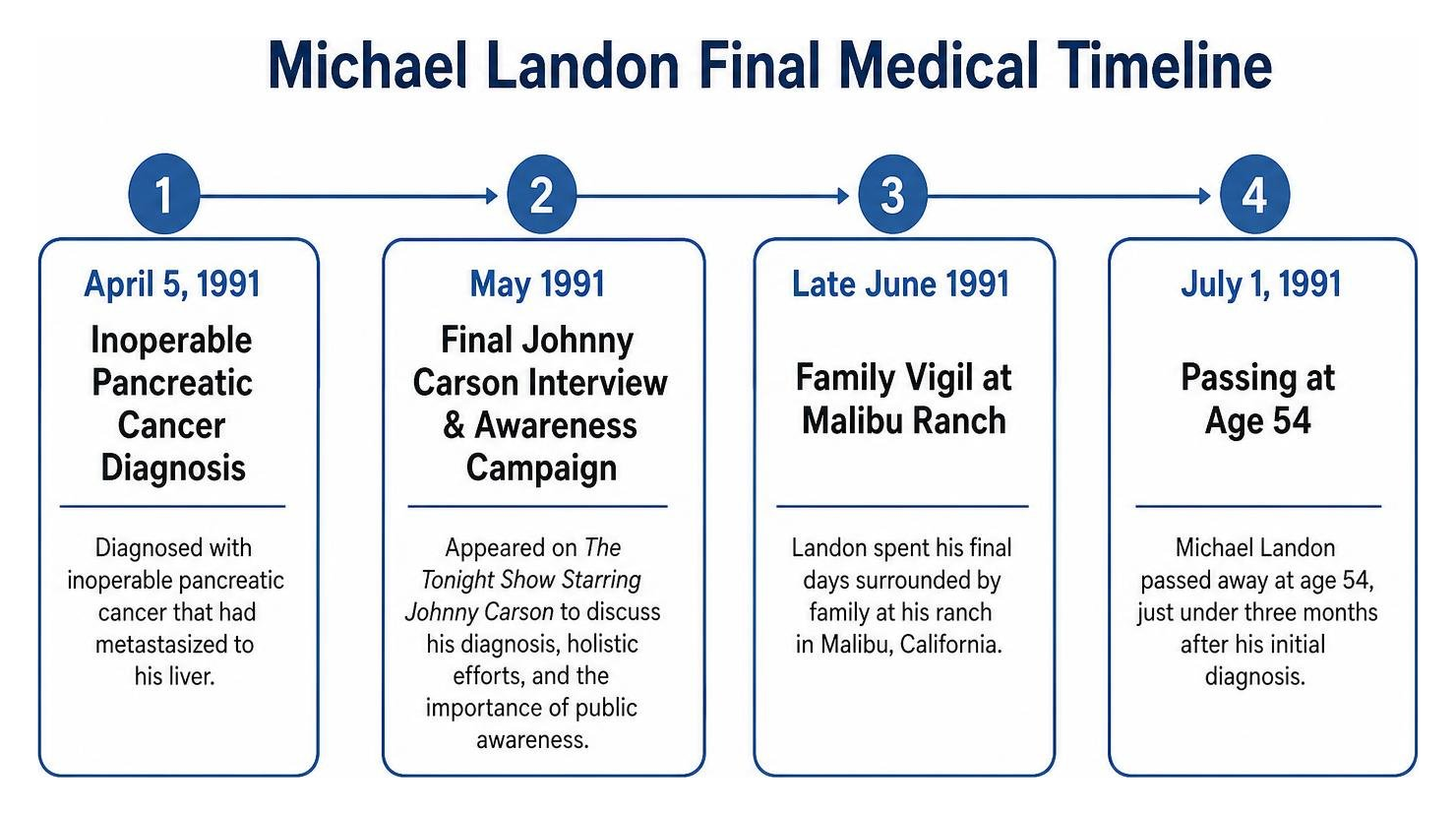
Landon passed away on July 1, 1991, at age 54, just under three months after his initial diagnosis. His candid discussions about pancreatic cancer ignited widespread public health conversations, prompting fans and viewers across the globe to recognize symptoms early and seek medical care.
Frequently Asked Questions about Michael Landon
What was Michael Landon’s birth name and where was he born?
Michael Landon was born Eugene Maurice Orowitz on October 31, 1936, in Forest Hills, Queens, New York City. His family relocated to Collingswood, New Jersey during his childhood. He adopted the stage name “Michael Landon” after picking it at random from a telephone directory. Further biographical archives are detailed on Britannica and Encyclopedia.com.
What were Michael Landon’s most famous television shows?
Landon starred in three classic television shows that aired for a combined 30 years on NBC:
- Bonanza (1959–1973) as Little Joe Cartwright (430 episodes)
- Little House on the Prairie (1974–1983) as Charles “Pa” Ingalls (187 episodes)
- Highway to Heaven (1984–1989) as Jonathan Smith (111 episodes)
His full credits can be explored on The Movie Database (TMDB) and Wikipedia.
What caused Michael Landon’s death and how did it impact cancer awareness?
Michael Landon passed away on July 1, 1991, from inoperable pancreatic cancer that had metastasized to his liver. At the time of his passing, five-year survival rates for pancreatic cancer were roughly 4%. His open discussion of his illness raised substantial global awareness for early detection and research support through organizations like the Pancreatic Cancer Action Network (PanCAN), as highlighted in his New York Times obituary.
Conclusion
Michael Landon left a lasting mark on television history. From his athletic youth in Queens to becoming a Hollywood auteur who wrote, directed, produced, and starred in three landmark television franchises, he used storytelling to champion human kindness, family solidarity, and moral courage.
Decades after his passing, his television series continue to find new audiences worldwide. For our team at PARK Ave Magazine, celebrating cultural figures who created enduring work reminds us of what makes timeless art so valuable. To explore more about building collections and legacies that stand the test of time, explore the ultimate luxury investments worth considering.