From Madonna to Prince: The 80s Style Icons You Need to Know
From Madonna to Prince: The 80s Style Icons You Need to Know
Why 80s Fashion Icons Still Matter
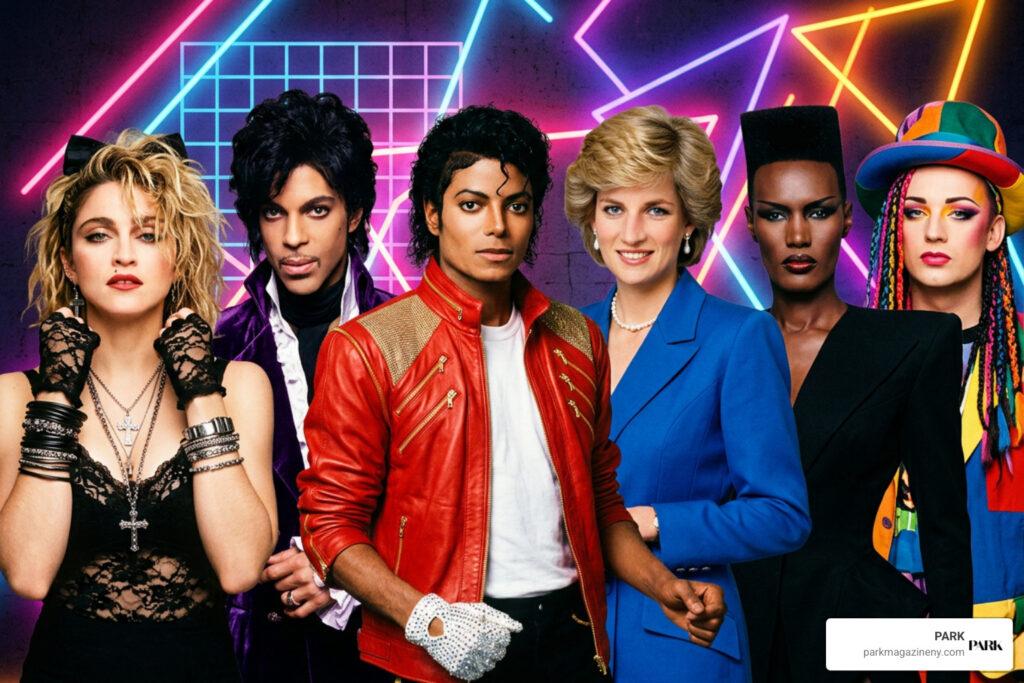
The most influential 80s fashion icons include Madonna, Prince, Michael Jackson, Princess Diana, Grace Jones, Boy George, Naomi Campbell, and Linda Evangelista. Their signature looks ranged from Madonna’s lace gloves and stacked bracelets to Prince’s ruffles and velvet, Diana’s polished power tailoring, and Grace Jones’s sharp, sculptural silhouettes.
The decade made fashion feel public, personal, and impossible to ignore. MTV turned music-video wardrobes into global trends. Dynasty made padded shoulders a symbol of power, while Flashdance brought leggings, leg warmers, and off-the-shoulder sweatshirts into everyday style.
Just as important, figures such as Prince, Boy George, and Grace Jones used clothes, makeup, and tailoring to challenge narrow ideas about gender. Their influence still shows up in modern runway collections, streetwear, and luxury dressing.
I am W.A. Muller, and this guide explores the people and cultural forces that made 1980s style endure.
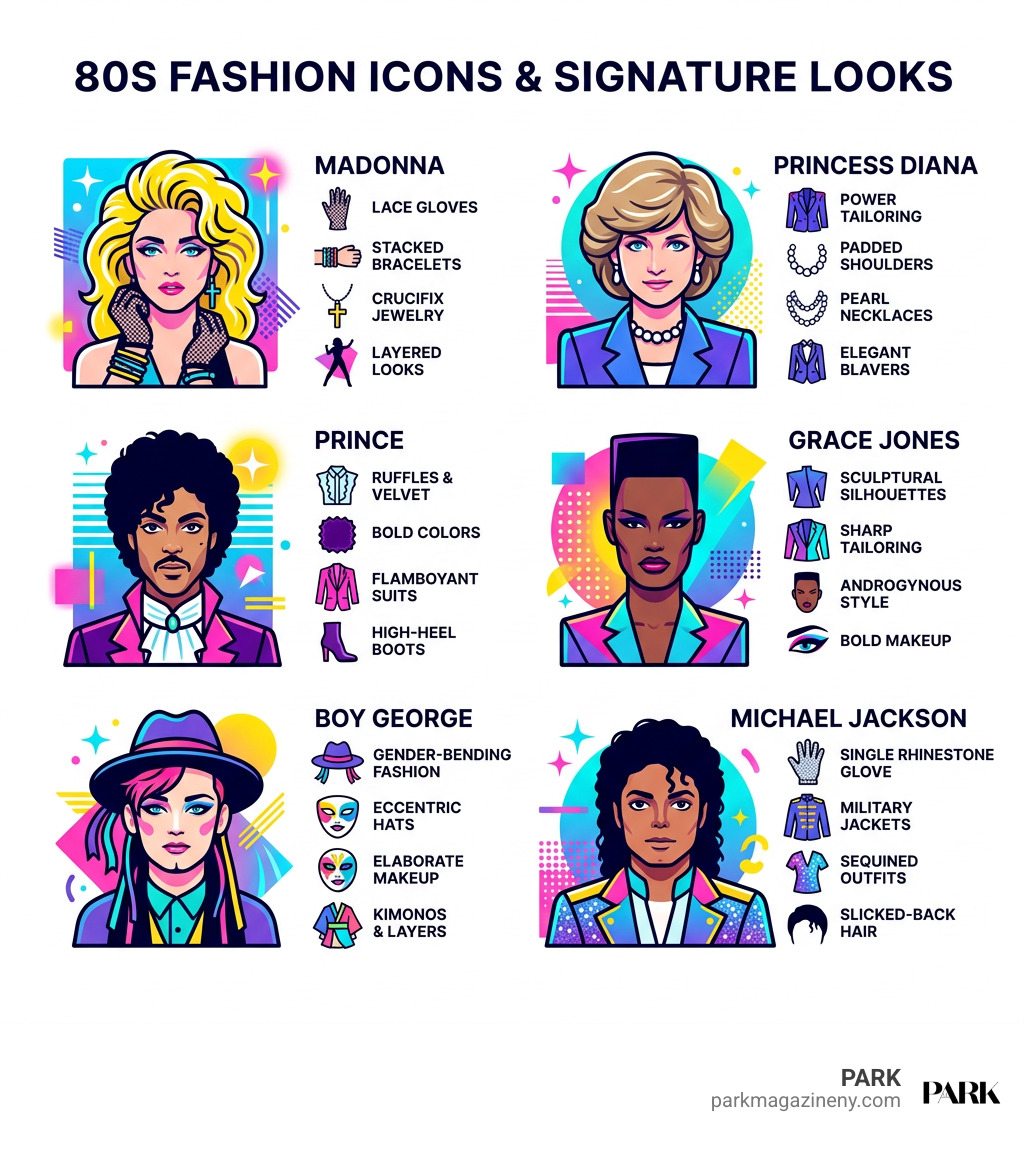
Basic 80s fashion icons terms:
The Definitive 80s Fashion Icons Who Changed Pop Culture Forever

The 1980s was an era defined by bold self-expression, unyielding confidence, and an electric mix of high glamour and street energy. Across New York City and beyond, wardrobes transformed from functional garments into loud personal statements. Celebrities were no longer just dressing for red carpets; they were authoring cultural movements from the stage, the screen, and the runway.
Pop Royalty: Madonna, Prince, and Michael Jackson
When Madonna burst onto the scene in downtown New York, she established an unmistakable look that fused punk grit with thrift-store romance. Guided by French artist and stylist Maripol—whose pioneering work is explored in Dress You Up: Meet Maripol—Madonna popularized stacked rubber jelly bracelets, layered rosary beads, cropped lace corsets, and tulle skirts. Her electrifying performance at the 1984 MTV Video Music Awards in a “Boy Toy” belt buckle and bridal tulle single-handedly brought underwear-as-outerwear to the global mainstream.
Prince completely rewrote the rules of masculinity and performance wear. With his regal purple velvet frock coats, Victorian ruffles, high-heeled boots, and flamboyant tailoring, he showed the world that theatrical romance could coexist with rock-and-roll rebellion. His aesthetic in Purple Rain created an opulent blueprint for anyone building a bold luxury wardrobe.
Michael Jackson delivered an equally powerful sartorial punch. His sharp military tunics, cropped sequined trousers, white socks with penny loafers, single crystal glove, and the legendary red zippered leather jacket from Thriller made visual history. By 1984, millions of teenagers worldwide were wearing red leather jackets, cementing Jackson’s status as a master of iconic fashion moments.
High-Glamour Pioneers: Princess Diana and Grace Jones
Across the Atlantic, Princess Diana redefined royal dressing by infusing aristocratic elegance with accessible charm and contemporary power tailoring. As detailed in the FIT Fashion History Timeline overview, the era embraced wide shoulders, dramatic silhouettes, and vibrant jewel tones. Diana favored structured blazers, polka-dot dresses, pie-crust collars, and breathtaking evening gowns. She balanced high fashion by frequently skipping traditional royal protocol, such as wearing bold casual denim or pairing off-duty varsity jackets with boots, and elevating looks with statement diamond jewelry.
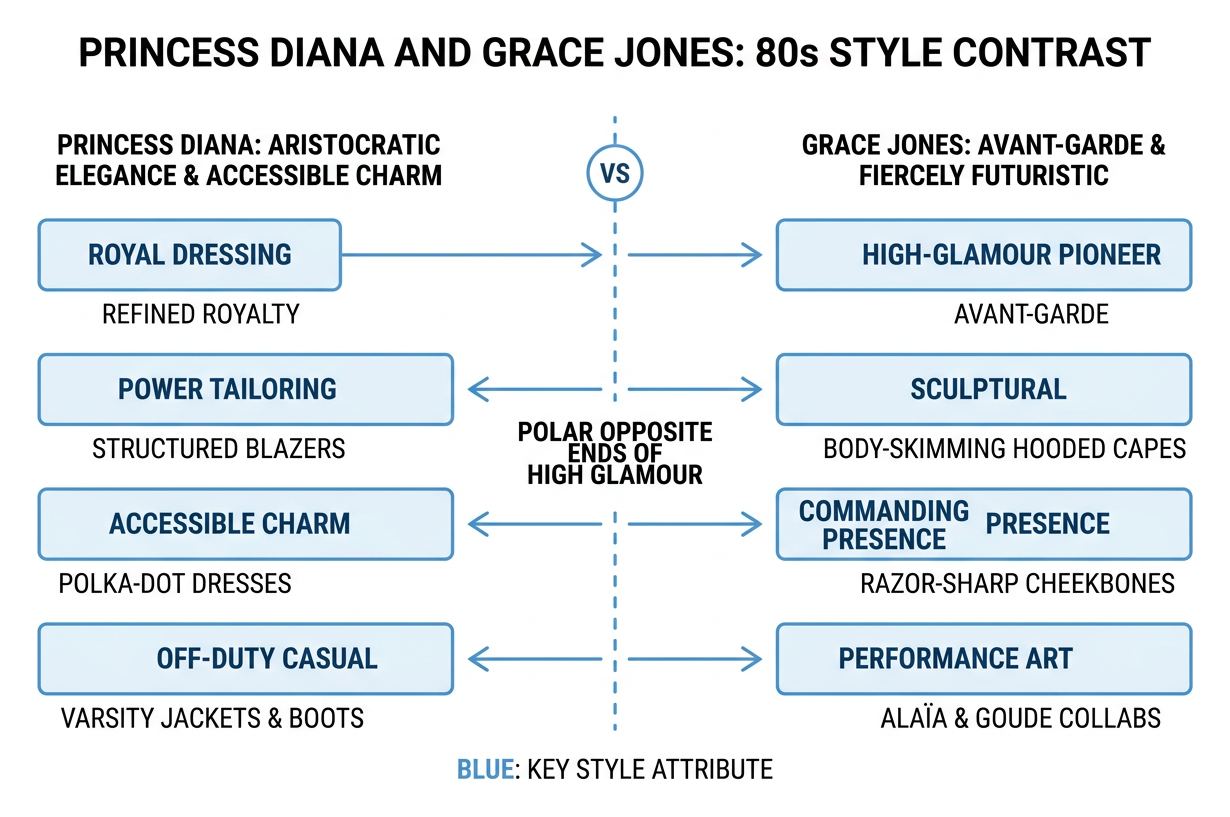
Grace Jones stood at the polar opposite end of high glamour: avant-garde, sculptural, and fiercely futuristic. Working closely with designer Jean-Paul Goude and couturier Azzedine Alaïa, Jones brought angular flattop hair, razor-sharp tailored suits, and body-skimming hooded capes into high fashion. Her razor-sharp cheekbones and commanding presence turned every public appearance into high-concept performance art.
The Rise of the Supermodel: Naomi Campbell and Linda Evangelista
The late 1980s heralded the birth of the supermodel—a new breed of celebrity whose personality, style, and attitude dominated culture. In December 1987, a seventeen-year-old Naomi Campbell made history by gracing the cover of British Vogue in a Karl Lagerfeld Chanel gold tunic, kicking open the doors of high fashion for Black models.
Alongside her was Linda Evangelista, the ultimate fashion chameleon whose career is chronicled in the Linda Evangelista biography. Famous for her sharp bob and dynamic transformations, Evangelista embodied the era’s unapologetic luxury. Together with peers like Cindy Crawford and Christy Turlington, these women showcased the era’s body-conscious glamour, including revisiting the iconic bandage dress pioneered by Hervé Léger and Alaïa.
How Music, Film, and Television Propelled 1980s Trends Mainstream

The 1980s witnessed an unprecedented explosion of mass media. For the first time, visual trends spread around the world within days rather than years. The launch of MTV in 1981 turned music videos into 24-hour style showcases, transforming pop musicians into primary fashion arbiters.
On television, prime-time soap operas like Dynasty and Dallas defined luxury and ambition. Costume designer Nolan Miller dressed stars like Joan Collins and Linda Evans in razor-sharp shoulder pads, metallic lamé, and extravagant furs. These designs directly shaped how women dressed for the corporate boardroom, turning padded shoulders into a badge of authority.
Meanwhile, Hollywood championed elevated casualwear and athletic gear. When Flashdance premiered in 1983, Jennifer Beals’s gym-to-street look triggered an immediate global obsession with off-the-shoulder fleece sweatshirts, footless tights, and slouchy leg warmers. In cinema classics like Pretty in Pink, Molly Ringwald inspired a generation of teenagers to embrace thrifting, layering, and playful accessories when navigating everyday fashion wardrobe decisions.
Subcultures to Runways: Gender Fluidity and Streetwear Revolution
The decade’s most enduring fashion developments originated in underground clubs and city streets before reaching the Paris and Milan runways. Young creatives combined distinct identities, rebellion, and craft, creating a dynamic environment where smart shopping for distinct style replaced rigid designer decrees.
Androgyny and Subversive Style: Boy George to New Romantics
In London’s underground Blitz Club and across New York’s nightlife, the New Romantic movement emerged as an expressive reaction against punk minimalism. Icons like Boy George and Culture Club turned makeup, braided hair, oversized tunic shirts, and fedoras into mainstream chart-topping looks.

These artists blurred gender boundaries effortlessly:
- Theatrical cosmetics: Bold eyeliner, dramatic blush, and painted lips worn unapologetically by men.
- Historicist tailoring: Pirate shirts, ruffled jabots, brocade vests, and military epaulets.
- Fluid silhouettes: Wide-leg trousers and flowing tunics that resisted traditional menswear tailoring.
Hip-Hop Streetwear and Dapper Dan’s Luxury Bootlegs
In New York City, particularly throughout Harlem and Brooklyn, the birth of hip-hop brought an entirely new aesthetic universe to the global stage. Groups like Run-D.M.C. popularized unlaced Adidas Superstar sneakers, black fedoras, leather tracksuits, and heavy gold rope chains.
Simultaneously, Daniel Day—better known as Dapper Dan—opened his Harlem boutique on 125th Street. Dapper Dan took luxury monogram canvas fabrics from brands like Gucci, Fendi, and Louis Vuitton and transformed them into custom, oversized streetwear jackets and tracksuits for hip-hop stars, athletes, and neighborhood legends. His pioneering work laid the groundwork for the modern luxury streetwear phenomenon and reshaped how we approach curating essential New York closet pieces.
Modern Resurgence: How 80s Aesthetics Dominate Contemporary Style
As we look at today’s fashion landscape in September 2026, the spirit of the 1980s remains as vital as ever. The decade’s unapologetic attitude, structural drama, and playful proportions continue to serve as a wellspring of inspiration for contemporary fashion houses and trendsetters worldwide.
Why 80s Fashion Icons Still Rule Current Runways
Modern luxury collections consistently reference the bold geometry and daring silhouettes championed by 1980s tastemakers:
| 1980s Signature Element | Original Style Icon / Pioneer | Contemporary Runway Translation |
|---|---|---|
| Exaggerated Shoulder Pads | Joan Collins, Grace Jones | Boxy, oversized power blazers seen at Saint Laurent and Balenciaga |
| Elevated Tracksuits & Monograms | Dapper Dan, Run-D.M.C. | High-fashion streetwear collaborations from Off-White and Gucci |
| Lycra Bodywear & Spandex | Olivia Newton-John, Jane Fonda | Modernized leggings, catsuits, and cycling shorts featured by Vetements |
| Underwear as Outerwear | Madonna, Jean-Paul Gaultier | Corsetry, exposed lace bralettes, and sheer tailored layers |
| Voluminous Royal Ruffles | Princess Diana, Prince | Romantic collars, puff sleeves, and neo-Victorian detailing |
How 80s Fashion Icons Transformed Everyday Luxury
The legacy of the 1980s lives on in our everyday wardrobe choices. The power suit has evolved from corporate armor into an everyday uniform of effortless cool. Athleisure, which began with 80s dancewear and aerobics crazes, is now a cornerstone of modern casual dressing.
Today’s luxury blends bold color contrasts, oversized layering, and high-low styling into the new language of modern indulgence. The decade taught us that style is not about following quiet conventions—it is about having fun, claiming space, and celebrating your individuality.
Frequently Asked Questions About 80s Style and Trends
Who were the most influential 80s fashion icons?
The most influential icons included Madonna, Prince, Michael Jackson, Princess Diana, Grace Jones, Boy George, and supermodels like Naomi Campbell and Linda Evangelista. Each contributed distinct stylistic breakthroughs, from punk-infused pop glam and androgynous tailoring to royal power dressing and high-fashion diversity.
Why were shoulder pads and power dressing so popular in the 1980s?
Shoulder pads and power suits gained massive popularity because they visually symbolized authority, confidence, and parity as women entered corporate executive spaces in record numbers. Designers like Giorgio Armani, Donna Karan, and Thierry Mugler created wide, structured shoulders to give women a sharp, commanding presence in professional environments.
How did 1980s fashion challenge traditional gender norms?
Pioneers like Prince, Boy George, Grace Jones, and Annie Lennox actively dismantled the gender binary in fashion. Male artists wore lace, velvet, ruffles, high heels, and makeup on international television, while female icons embraced razor-sharp menswear tailoring, buzz cuts, and sculptural, muscular silhouettes. Their fearless approach laid the foundation for modern gender-neutral and fluid fashion collections.
Conclusion
The 1980s was a watershed decade that permanently expanded the boundaries of fashion. By breaking traditional rules of gender, class, and taste, its style pioneers proved that clothing is one of our most powerful tools for personal storytelling. For more in-depth perspectives on vintage style, contemporary trends, and runway movements, explore our comprehensive PARK Magazine fashion coverage.