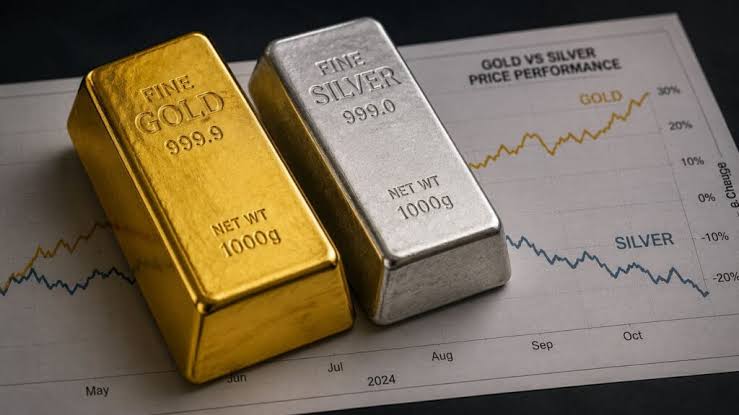
Why does Silver move twice as hard as Gold on the same day?
In 2025, gold surged 78% on MCX while Silver surged 144%. Sam[1] e year, same market conditions, same global tailwinds and yet silver delivered almost double the return. Then, in early 2026, silver reached its highest price ever of $121.64 per [2] ounce, and dropped almost 54% from[3] that price, while gold’s correction was much shallower. This is not unusual. It is the nature of silver in each cycle, in each market.
One of the most crucial market insights that traders should be aware of to trade these precious metals efficiently is the reason why silver swings harder than gold on any given day and sometimes even twice as hard. Here are the reasons why silver moves twice as hard as gold.
The small market size
The biggest factor making silver more volatile than gold is that gold has a much bigger market than silver. According to the World Gold Council’s 2026 data, the gold market is about eight t[4] imes bigger in terms of market capital and transacts about six times more volume per day than silver.
This implies that the same investment in silver will result in a relatively larger percentage change as compared to the same investment in gold. Therefore, silver prices tend to move more than gold prices when investors turn to safe-haven assets, such as gold and silver, during periods of uncertainty, because the silver market is smaller than the gold market.
Silver’s dual identity
Gold is only a precious metal, with no major industrial uses. However, Silver is a precious metal and an industrial metal. According to the Silver Institute’s World Silver Survey, more than half of all silver consumed annually is for industrial purposes.
Silver is a safe-haven asset as well, which means that rising inflation will also boost demand for silver. Together, these two factors drive up demand for silver. Thus, if both factors act in the same direction, silver moves twice as hard as gold.
Renewable energy demand
India’s booming renewable energy industry has introduced a new facet to the silver market. One of the most silver-intensive industrial applications is in the manufacturing of solar PV panels. Solar PV installations in India have been growing, and so has the demand for silver in the industrial sector.
In 2026, the global silver market is currently facing a silver deficit of 46.3 [5] million ounces. Therefore, a market that is in structural deficit is more sensitive to any change in sentiment, because it has less spare inventory to cushion price moves.
The Gold-Silver Ratio
The gold-silver ratio is the number of ounces of silver required to purchase one ounce of gold. The ratio is around 69:1 as o[6] f mid-2026, compared to the average of around 50-80. A high ratio has been interpreted as silver being relatively inexpensive compared to gold.
When it compresses sharply, silver has already run ahead and is more vulnerable to the correction. Tracking silver rates today on MCX alongside this ratio provides traders a comprehensive analysis of where silver stands in its cycle relative to gold, rather than looking at either number in isolation.
Conclusion
Silver does not move twice as hard as gold by accident. It’s moving that way because its market is smaller, its demand base is split between precious metal and industrial uses, and its structural supply-demand is growing from clean energy and technology uses.
For Indian investors, this means silver offers significantly higher return potential in bull phases but also requires high risk tolerance to hold through corrections. Thus, it offers an aggressive growth component to a well-balanced portfolio.