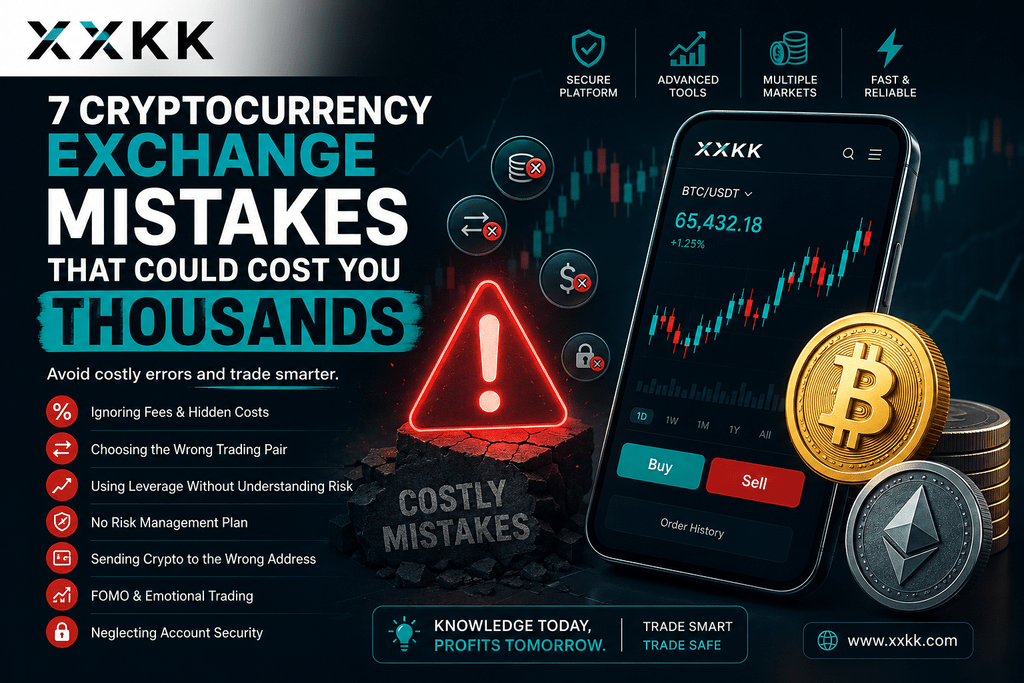
7 Cryptocurrency Exchange Mistakes That Could Cost You Thousands
Cryptocurrency trading can look deceptively simple. You create an account, deposit funds, choose an asset, and place an order. But behind every successful trade are dozens of small decisions involving fees, order types, security, liquidity, networks, and risk management.
A single mistake may cost only a few dollars. Repeated mistakes, however, can quickly turn into hundreds or even thousands of dollars in unnecessary losses.
Choosing the right Crypto Exchange is also an important part of the process. Platforms such as XXKK provide access to spot and futures markets, multiple trading pairs, asset-management tools, and other digital-asset services. However, regardless of the platform you use, the responsibility for reviewing every transaction and understanding the associated risks ultimately remains with you.
Below are seven of the most expensive mistakes traders should avoid and practical ways to prevent them.
1. Ignoring Trading Fees, Spreads, and Slippage
One of the easiest mistakes to overlook is assuming that the displayed asset price is the total amount you will pay.
In reality, the final cost of a trade can include several components. Depending on the transaction, you may encounter a trading fee, bid-ask spread, and slippage. When you make a large trade, even a small percentage difference can have a meaningful effect on your final result.
For example, imagine purchasing $20,000 worth of cryptocurrency. A seemingly minor 0.5% difference represents $100. If similar costs occur repeatedly throughout the month, the total can become substantial.
How to avoid this mistake
Before confirming a transaction:
- Check the current trading fee.
- Look at the bid-ask spread.
- Consider whether the market has sufficient liquidity.
- Understand whether your order is likely to experience slippage.
- Compare the quoted price with the expected execution price.
- Review the final confirmation screen before submitting.
Never assume that a convenient one-click transaction is automatically the cheapest transaction.
The few seconds you spend reviewing the order could save considerably more money later.
2. Choosing the Wrong Trading Pair
Another common mistake is selecting the wrong trading pair.
A trading pair tells you which asset you are buying and which asset you are using to pay for it. For example, in BTC/USDT, BTC is the base asset and USDT is the quoted asset. If BTC/USDT is quoted at 65,000, it means one BTC is valued at 65,000 USDT.
This distinction may sound basic, but traders moving quickly can accidentally select a different pair from the one they intended.
There can also be major differences between pairs in terms of liquidity, trading volume, spread, and minimum order size.
Suppose you intend to buy BTC using USDT but accidentally select another quote currency. You may end up with an unexpected conversion, different execution conditions, or an order that doesn’t behave as expected.
How to avoid this mistake
Before placing an order, verify all of the following:
- The asset you want to purchase.
- The currency or token you’re using to purchase it.
- The trading pair.
- The current market price.
- The available balance.
- The minimum order size.
- The trading volume and order-book depth.
XXKK‘s beginner guidance recommends checking the direction of the trade, order-book depth, bid-ask spread, fees, and minimum order size before selecting a pair. It also notes that larger, more liquid pairs may provide more stable execution and potentially reduce slippage.
A simple habit of reading the pair twice before clicking Buy or Sell can prevent a surprisingly expensive error.
3. Using Leverage Without Understanding Liquidation Risk
Leverage can increase your exposure to a market without requiring you to provide the entire position value as capital. That can make potential gains appear attractive, but it also magnifies losses.
This is where inexperienced traders can get into serious trouble.
A small move in the wrong direction may produce a disproportionately large loss when leverage is involved. In extreme cases, a leveraged position can be liquidated before the market has an opportunity to recover.
That flexibility can be useful for experienced traders who understand derivatives, but it should not be confused with guaranteed profits.
How to avoid this mistake
If you’re new to cryptocurrency trading, consider learning spot trading before experimenting with leveraged products.
Spot trading generally involves purchasing or selling the underlying digital asset without borrowing funds by default. XXKK’s educational material describes spot trading as a simpler starting point compared with futures or derivatives because it does not inherently involve margin leverage or the same liquidation mechanism.
If you eventually use leverage, understand:
- Initial margin.
- Maintenance margin.
- Liquidation price.
- Funding costs.
- Position size.
- Stop-loss mechanisms.
- The maximum amount you can afford to lose.
Most importantly, never choose leverage simply because a platform makes high leverage available.
More leverage does not make a trading strategy better. It simply increases the financial consequences when the trade moves against you.
4. Trading Without a Clear Risk-Management Plan
Many traders focus almost entirely on finding the next profitable asset. They research charts, follow market news, watch social media, and look for promising projects.
What they sometimes fail to determine is how much they are willing to lose.
That is a major mistake.
A trading strategy should not begin with, “How much can I make?” It should begin with, “How much can I afford to lose?”
Without predefined risk limits, emotional decisions can take over. A trader may increase a losing position, move a stop-loss farther away, or continue trading after a series of unsuccessful transactions.
Eventually, one bad position can become much larger than originally intended.
How to avoid this mistake
Create rules before entering a trade.
For example, decide:
- How much capital will be allocated to the position.
- Where you would exit if the trade moves against you.
- What percentage of your portfolio can be exposed to one asset.
- When you will take profits.
- How many trades you are comfortable making in a day.
- When you will stop trading after a losing streak.
A risk-management plan doesn’t guarantee that you’ll avoid losses. Instead, it helps prevent one mistake from becoming a devastating financial event.
5. Sending Crypto to the Wrong Address or Network
Few cryptocurrency mistakes are more stressful than sending funds to the wrong destination.
Blockchain transactions are designed to be irreversible in many circumstances. If you enter an incorrect wallet address or select an incompatible network, recovering the funds may be difficult or impossible.
XXKK recently published a support guide addressing deposits involving the wrong cryptocurrency or an incorrect platform address. It warns that recovery is generally not guaranteed and explains that some eligible recovery cases may require technical intervention, additional information, significant processing time, and applicable recovery fees.
This is why speed should never be the priority when transferring digital assets.
How to avoid this mistake
Before sending funds:
- Confirm the destination address character by character.
- Verify the cryptocurrency.
- Confirm the blockchain network.
- Check whether the receiving platform supports that network.
- Review the minimum deposit or withdrawal requirements.
- Send a small test transaction when appropriate.
- Keep your transaction ID for future reference.
Never copy an address from an unverified message or suspicious website.
Also remember that two networks may use similar-looking address formats while still being incompatible for a particular transaction. Always follow the receiving platform’s instructions.
A 30-second verification can potentially prevent the loss of an entire portfolio.
6. Falling for FOMO and Chasing Fast-Moving Prices
Fear of missing out, commonly called FOMO, is one of the most powerful emotional forces in cryptocurrency markets.
A coin suddenly rises 30%. Social media is filled with people claiming they made huge profits. A trader sees the price climbing and immediately buys because they don’t want to miss the opportunity.
Then the market reverses.
The problem isn’t simply that the asset declined. The deeper issue is that the trader entered without a plan.
Highly volatile markets can move quickly in both directions.
How to avoid this mistake
Before buying an asset that has suddenly surged, ask:
- Why is the price moving?
- What is the trading volume?
- How liquid is the market?
- What is my entry price?
- Where would I exit?
- What happens if the price falls 10%, 20%, or more?
- Am I making this decision based on research or emotion?
If you cannot answer those questions, waiting may be the smarter decision.
There will always be another market opportunity. You don’t need to participate in every price movement.
7. Neglecting Account and Trading Security
Even the best trading strategy cannot protect funds if the account itself is compromised.
Security should therefore be part of your trading process not something you think about only after something goes wrong.
A strong account-security routine can include two-factor authentication, unique passwords, careful device management, phishing awareness, and verification of websites and applications before entering login credentials.
However, platform-level security is only one part of the equation. Users also need to protect their own accounts and devices.
How to avoid this mistake
Use these basic security practices:
- Enable two-factor authentication.
- Use a unique, strong password.
- Never share passwords or authentication codes.
- Avoid clicking suspicious trading links.
- Verify the website address before signing in.
- Keep your phone and computer updated.
- Be cautious with browser extensions and unknown applications.
- Review account activity regularly.
- Don’t trust anyone promising guaranteed cryptocurrency profits.
Phishing attacks often succeed because they create urgency. A message may claim that your account will be suspended unless you act immediately.
Don’t panic.
Open the platform directly through a trusted source instead of following an unknown link.
A Smarter Way to Use a Crypto Exchange
Avoiding mistakes isn’t about eliminating every risk. Cryptocurrency markets remain volatile, and even carefully researched trades can lose money.
The goal is to make your process more deliberate.
Before placing an order, use a simple mental checklist:
Asset: Am I trading the cryptocurrency I actually intended to trade?
Pair: Is the trading pair correct?
Price: Do I understand the current market price?
Cost: Have I checked fees, spread, and potential slippage?
Size: Is the position appropriate for my available capital?
Risk: How much could I lose if the trade goes against me?
Security: Am I using the official website or application and the correct account?
Transfer: If I’m moving funds, have I confirmed the address and network?
This approach may seem slow when markets are moving quickly, but disciplined execution is often more valuable than speed.
Final Thoughts
Cryptocurrency trading doesn’t have to be unnecessarily complicated, but it does require attention to detail.
The most expensive mistakes often aren’t caused by dramatic market crashes. They can come from ordinary oversights: ignoring fees, selecting the wrong pair, using excessive leverage, entering trades emotionally, sending funds to an incorrect address, or neglecting account security.
A reliable crypto exchange can provide the infrastructure and tools needed to participate in digital-asset markets, but no platform can replace careful decision-making by the user.
If you’re getting started, focus first on understanding how orders work, how fees affect returns, how trading pairs are structured, and how to protect your account. XXKK provides educational materials covering topics such as spot trading, trading pairs, order types, security, and transaction safety, making these resources useful starting points for users who want to understand the mechanics before increasing their trading activity.
Remember: successful trading isn’t simply about finding winning trades. It’s also about avoiding preventable losses. When you slow down, verify transaction details, manage risk, and make decisions based on a predefined plan rather than emotion, you give yourself a much stronger foundation for navigating the cryptocurrency market.