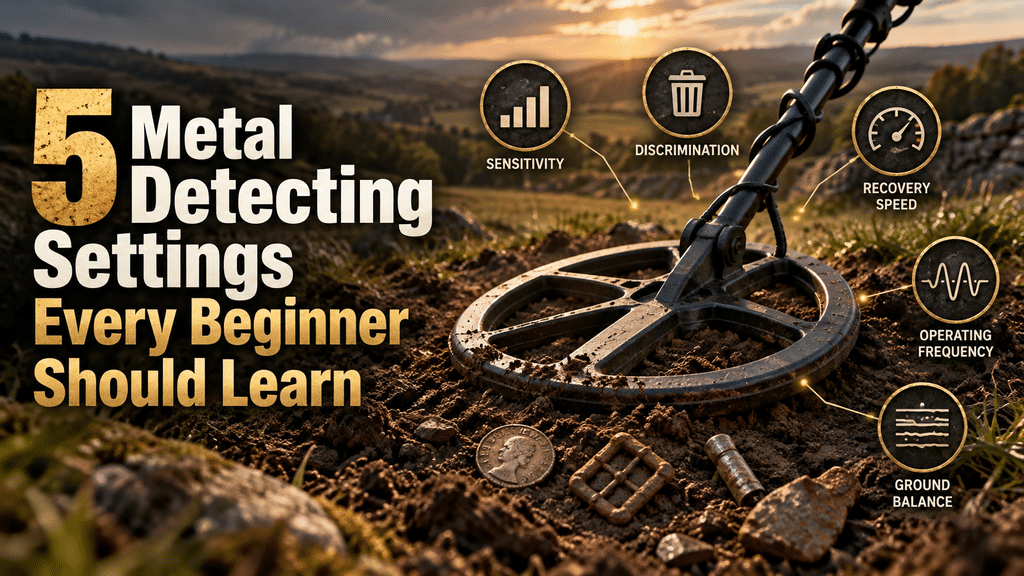
5 Metal Detecting Settings Every Beginner Should Learn
Getting started with metal detecting can feel more complicated than it looks. Modern detectors offer a range of settings that control how they respond to different targets and ground conditions. The good news is that beginners don’t need to understand every advanced feature right away.
Learning a few core settings can make it easier to get stable signals, identify targets, and adapt your detector to different locations. Whether you’re searching parks, fields, beaches, or old sites, these five settings are a good place to start.
1. Sensitivity
Sensitivity controls how strongly a detector responds to targets and changes in the surrounding ground. It can affect how deeply the detector detects objects, but turning it all the way up isn’t always the best approach.
Higher sensitivity can work well in relatively clean and stable ground. However, mineralized soil, electrical interference, or highly variable ground can cause excessive chatter and false signals.
A simple approach for beginners is to increase sensitivity until the detector becomes unstable, then reduce it slightly. A stable detector is generally easier to use than one producing constant false responses.
2. Discrimination
Discrimination helps detectorists distinguish between different types of metal targets. Depending on the detector, you can use discrimination to reduce responses from targets such as common iron trash.
It’s tempting to reject as many unwanted targets as possible, especially when detecting in areas with lots of nails and other debris. However, excessive discrimination can also cause you to miss potentially valuable targets.
For beginners, moderate discrimination is usually a better starting point. Spend some time learning how different targets sound and appear on the detector before rejecting large sections of the target range.
3. Recovery Speed
Recovery speed determines how quickly a detector can respond after detecting a target. This becomes particularly important when several metal objects are close together.
A slower recovery speed can be useful in cleaner ground, while a faster recovery speed can help separate nearby targets in heavily littered locations. The trade-off is that increasing recovery speed can affect the detector’s ability to identify or detect deeper targets under certain conditions.
For example, someone searching an old park filled with nails, bottle caps, and other metal debris may benefit from a faster recovery speed.
The minelab x terra pro is one example of a detector that gives users adjustable recovery-speed options, allowing them to adapt their setup to different detecting environments.
4. Operating Frequency
Operating frequency is another important setting to understand. Different frequencies can influence how a detector responds to targets of different sizes and conductivity.
Lower frequencies can be useful for certain larger or highly conductive targets, while higher frequencies can provide greater sensitivity to some smaller or lower-conductive targets. This doesn’t mean that one frequency is always better than another. The right choice depends on what you’re looking for and where you’re detecting.
If you’re searching for coins, relics, or small pieces of jewelry, experimenting with different frequencies can help you understand how your detector responds to each type of target.
The key for beginners is not to overthink the setting. Start with the frequency recommended for your detecting situation and experiment as you gain experience.
5. Ground Balance
The ground beneath your feet contains naturally occurring minerals that can affect a detector’s performance. Ground balance helps the detector account for these mineralized conditions so that normal soil doesn’t produce excessive unwanted responses.
Ground balance becomes particularly useful when moving between different types of soil or detecting in areas with significant mineralization. Conditions can vary considerably between locations, so a setting that works well in one field may not work equally well somewhere else.
If your detector provides ground-balance controls, take time to learn how they work and adjust them when soil conditions change.
A Simple Starting Setup
Beginners don’t need to constantly change every setting. A simple starting strategy is often more effective:
| Setting | Starting Approach |
| Sensitivity | Increase until the detector becomes unstable, then reduce slightly |
| Discrimination | Keep it moderate |
| Recovery Speed | Increase when searching heavily littered areas |
| Frequency | Choose based on the target and conditions |
| Ground Balance | Adjust when soil conditions require it |
Once you’ve established a stable setup, change one setting at a time. This makes it much easier to understand what each adjustment actually does.
Common Beginner Mistakes
One of the most common mistakes is assuming that maximum settings automatically produce better results. Running maximum sensitivity in difficult ground can create more noise without producing more useful targets.
Another mistake is using too much discrimination. Unwanted targets can be frustrating, but completely filtering them out may also eliminate interesting signals.
Beginners also often use the same settings everywhere. A quiet field, a trash-filled park, and a mineralized beach can require very different approaches.
Finally, avoid changing several settings at once. Make one adjustment, test it, and listen to how the detector responds.
Keep Learning Through Practice
Understanding settings is only part of becoming a better detectorist. Experience with different soils, targets, and environments will help you recognize which adjustments actually make a difference.
If you’re researching detectors, accessories, and metal detecting techniques, metal detector resources on our website can also help you compare equipment and learn more before heading into the field.
The goal isn’t to find one perfect combination of settings. It’s to understand what each setting does and know when to adjust it. Once these five fundamentals become familiar, experimenting with more advanced detector features becomes much easier.