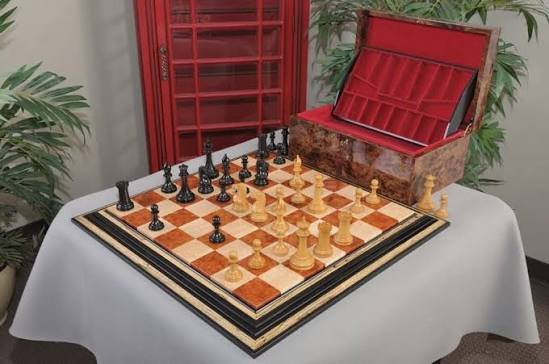
Wooden Chess Set Care: What Actually Prevents Damage
A board can spend one summer beside a sunny window and come away with mismatched halves. In a loose box, knights knock against kings every time it moves. The causes are so ordinary that prevention is mercifully simple. A steady room, occasional dusting and separate storage do more good than a cupboard full of cleaners.
Understand what you are cleaning
First work out what is in front of you. Solid timber, thin veneer and a hinged folding board do not react in exactly the same way. Nor do lacquer, wax, oil and a modern clear coat. Even the underside matters: felt, leather and fabric each dislike different kinds of moisture and adhesive. That is why a bottle marked “for wood” is not specific enough.
The maker’s care note gets the first say. Without one, a dry microfibre cloth is the conservative choice. Water finds veneer edges, alcohol can haze a coating, and some furniture sprays deposit silicone or wax. Try any proposed treatment underneath or on another hidden spot. A little remaining patina is preferable to a bright, irreversible patch in the middle of e4.
The safest routine after play
Food grease and hand cream transfer surprisingly well to pale boxwood, so clean hands are useful before a long game. Afterwards, brush dust out of collars and carved knight manes, then wipe the board along the grain. Pick up a king around its body instead of its cross or finial. The narrowest detail is usually the part a repairer later has to reattach.
For a set left on display, use a cover that breathes. Cling film traps whatever moisture is already present. Never close a fitted case around cool or damp pieces; wait until they have reached room temperature, and count the cloths and pads before shutting the lid.
Choosing equipment that suits the routine
Care begins before purchase. A heavily used family set, a club kit and a display piece face different risks. When comparing a chess set for sale, look beyond colour and piece style. Check the finish, storage supplied, replacement policy and whether the board can remain flat in the intended room. The World Chess Shop groups complete sets with separate chess boards and chess pieces, which makes it easier to see whether a matched set or replaceable components better suit the way it will be used.
Many chess sets for sale are photographed under studio lighting that emphasises grain and polish. For practical comparison, find the dimensions and material description. A professional chess set used every week needs a finish that tolerates handling. A world championship chess set kept mainly for display may justify more careful storage. Club buyers who plan to buy chess boards usually get more value from consistent, easily cleaned surfaces than from rare figuring in the wood. Apply that test to chess boards for sale and chess pieces for sale alike. Equipment used by twenty hands each week should not demand museum handling.
Control light, temperature and humidity
Sunlight rarely changes a board evenly. The exposed half shifts first, while pieces left in their case retain their original colour. Heat from a radiator or fireplace creates a different problem, and a cold air-conditioning stream can produce repeated swings. A normal, stable room is safer than an imperfect location that changes sharply through the day.
Attics, garages and damp basements punish wood season by season. Keep a flat board supported horizontally unless its maker says otherwise. Leaning it behind a cabinet may save space, but months of uneven support can turn a barely visible curve into a board that rocks on the table.
Cleaning the board without streaks
Begin dry. Brush grit loose and collect it with a cloth moving along the grain. If the maker permits damp cleaning, wring the cloth so thoroughly that it feels only cool, then follow with a dry one. Keep poured or sprayed liquid away from veneer edges, printed notation and hinges.
Gloss does not make glass cleaner safe. Unless the manufacturer names a product, keep household sprays away from the board. Furniture polish is troublesome for another reason: the residue may alter how a felted piece stops on a square. The FIDE equipment standards call for a dull or neutral board finish rather than a shiny one. On a tournament chess board, predictable contact is more useful than extra sheen.
Cleaning and inspecting the pieces
Work with a few pieces at a time so none are lost or returned to the wrong compartment. Dust around collars and the knight’s carving with a soft artist’s brush. Check base felt for grit, lifted edges and adhesive residue. A small hard particle caught under a base can scratch a board repeatedly.
If a felt pad begins to detach, stop using that piece until it is repaired. Resist peeling the pad off merely to investigate. A replacement of the same colour and thickness can be surprisingly hard to find. Put away the glue and stain if the chessman is old or valuable. Someone accustomed to restoring chess pieces can inspect it without turning a small fault into a permanent scar.
Storage that prevents contact damage
The ideal case keeps pieces separated or cushioned so they cannot collide. If a box has no fitted compartments, use soft, colourfast wraps or individual pouches. Avoid newspaper, dyed tissue and foam that is breaking down. Store extra queens with the main set so they are available for promotion and do not disappear into a different drawer.
A chess table set presents a different challenge because the board is furniture. Use coasters nearby, keep keys and metal objects off the playing surface and check whether the top receives direct sun during the day. Drawers should close without pressing on tall pieces.
Moving a set safely
Before transport, photograph or note how pieces fit in the case. Fill empty space with clean soft material so nothing shifts, but do not compress delicate details. Lift a folding board around the closed body; the clasp was not made to serve as a handle. During a car journey, keep the case out of the sun. At the destination, bring it indoors rather than leaving wood to roast or freeze in the boot.
Anyone who travels often may get more pleasure from sturdy tournament kit. Plastic men and a roll-up board accept the knocks that soon mark a polished wooden case. The wooden set can remain at home for analysis, while the club set does the mileage.
When professional repair is worth it
Stop home treatment if the board has lifted veneer, a widening crack, severe warping or a cloudy finish that does not disappear after gentle dry cleaning. A loose weight inside a piece, a broken king finial or a split knight also deserves proper repair. DIY sanding often removes more original material than expected and can leave one piece visibly different from the rest.
The decision should reflect value and meaning, not only the original chess set price. Repair may be worthwhile for a family set, a signed item or a well-made board that fits its pieces perfectly. By contrast, badly damaged club equipment may be safer and cheaper to replace through a chess store that can supply compatible parts.
A ten-minute seasonal check
Twice a year, set up the entire position and inspect it under neutral light:
- Look for colour change, cracks or loose joints.
- Run a clean fingertip over the board to find raised edges.
- Check every felt base for grit and lifting.
- Confirm that both extra queens are present.
- Air the storage box briefly in a dry room.
- Review the set’s location as sunlight and heating patterns change.
This simple inspection catches small issues before they spread. Good care is mostly restraint: stable storage, gentle dusting and no chemical treatment without evidence that the finish can accept it. Those habits preserve both the appearance of a wooden set and the clean, predictable handling needed for serious play.