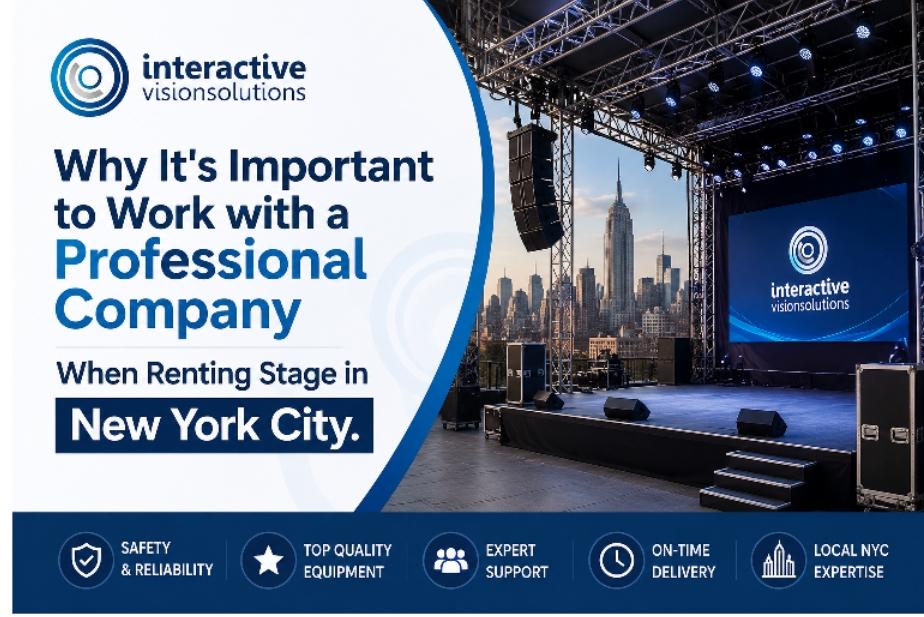
Why It’s Important to Work with a Professional Company When Renting Stage in New York City
Anyone who’s actually organized an event in New York knows the date and the guest list are the easy part. The hard part is everything underneath the surface permits, loading docks, venue quirks, and the stage itself. Search “stage rental near me” at 11pm the night before a corporate gala and you’ll see what I mean. Pages of options, half of them vague about what they actually offer. So here’s the honest case for why the company you pick to handle your stage rental in NYC matters more than people assume going in.
The Stage Holds Up the Whole Event, Literally
Every speaker, every band, every awards host is standing on something that has to carry their weight while a lighting rig hangs above it. A stage that’s put together wrong isn’t just an eyesore. It’s a liability, and NYC venues don’t make avoiding that easy. Javits Center has its own quirks.
So does a converted Brooklyn warehouse, or a rooftop in Manhattan. Floor issues, tight access points, fire code restrictions nobody thinks about until they’re standing in the venue with a truck outside and no real plan.
A company that builds stages for a living has already run into most of this. Maybe not the exact same problem, but something close enough. They know what setup holds up in a 200-person conference room. A 5,000-seat concert floor is a different animal entirely, and they know that too.
What actually separates the good ones is what happens when the venue doesn’t match the floor plan they were handed because that happens more often than you’d think, and improvising well under pressure isn’t something you learn from a manual.
What “Professional” Should Actually Mean
The word gets thrown around constantly in this industry, usually by companies that don’t do much to earn it.
Licensing and insurance come first. Sounds dull, I know. But it’s the line between a smooth event and a legal mess nobody wants to untangle afterward. Real companies carry liability insurance and understand what NYC’s Department of Buildings expects from temporary structures.
When something does go wrong and occasionally it does, even with good crews you want someone accountable on the other end of the phone, not a guy who showed up with a rented truck and no paperwork.
Crews who’ve actually installed stages before. Not just people who can stack platforms and call it done. Weight distribution, bracing, working around a support column or a ceiling that’s six inches lower than the spec sheet claims that takes real experience, the kind you only get from doing it wrong a few times early on and learning from it.
Equipment that isn’t falling apart. Rental gear takes a beating over time. Connectors loosen. Decking gets scratched. Platforms get dropped during transport more often than anyone admits. The better companies actually inspect their inventory between jobs instead of hoping nobody looks too closely.
Where Riser Rental Comes Into It
Stages rarely exist on their own. Most events need some form of riser rental for smaller platforms for speakers, seating sections, camera positions, sometimes a roped-off VIP area. People treat risers like an afterthought a lot of the time, which is honestly a mistake.
Put a riser in the wrong spot and it blocks sightlines. Or it becomes a tripping hazard nobody notices until someone catches a foot on the edge. Or it just sits there looking bolted-on next to a stage that clearly got more attention.
When a single company handles both stage and riser rental, the whole space gets planned as one layout from the start, not pieced together at the last minute by whoever showed up first. Try coordinating that across two or three separate vendors and you’ll see why it rarely comes together as cleanly.
What Cutting Corners Actually Costs You
The lowest quote is always tempting. Of course it is. Still, in a city where labor, logistics, and venue restrictions are already a headache on their own, going with an unlicensed or inexperienced provider rarely ends up cheaper once things start going wrong.
Here’s roughly what that tends to look like in practice. A crew shows up without knowing the freight elevator needs to be booked two days in advance, so setup starts three hours late. Or a structural issue turns up halfway through the build, and now everyone’s rebuilding under a deadline that was already tight to begin with.
Sometimes it’s a permit nobody bothered to check, because the platform height needed city sign-off and no one asked. And sometimes the stage just looks wrong wiring in plain sight, skirting that doesn’t quite match, decking that’s slightly uneven and that drags the whole event down no matter how good the person speaking on it happens to be.
None of this is theoretical. Talk to event planners who’ve been doing this for years in NYC, and most of them have at least one story about a rental that fell apart on them.
Bottom Line
A stage is one of the only things at an event that literally everyone in the room sees, and it’s also one of the few places where a mistake can genuinely hurt someone. Hiring a professional stage rental company in New York isn’t about spending extra money for no reason.
It’s about making sure whatever’s underneath your speakers and performers is safe, built properly, and actually fits the space it’s in. Add some thought into riser rental on top of that, and the whole event ends up looking like someone planned it not like it got thrown together the week of.
If there’s another event coming up, that conversation with a rental company is worth having early. Not the Tuesday before.
A Few Questions Worth Asking Before You Hire Anyone
How long have they worked in New York specifically?
Local experience matters here in a way it might not elsewhere, since every venue has its own access rules, and a company used to working in other cities is going to be figuring things out on your event’s dime.
Can they point to events similar to yours?
A company that’s built for corporate conferences, weddings, and full-scale concerts has probably learned to adapt in ways a single-purpose outfit hasn’t had to.
Is riser rental part of the same conversation, or does that get handled separately?
Companies that bundle it in tend to think about the full footprint of the event rather than just the platform in the center of the room.
Will someone actually come see the venue first?
The serious ones want eyes on the space, or at the very least a detailed floor plan, before they’ll give you a number that means anything.
Whose crew is actually doing the installation with their own people, or whoever’s available that week from a subcontractor list?
There’s usually more consistency, and more accountability, when it’s the former.