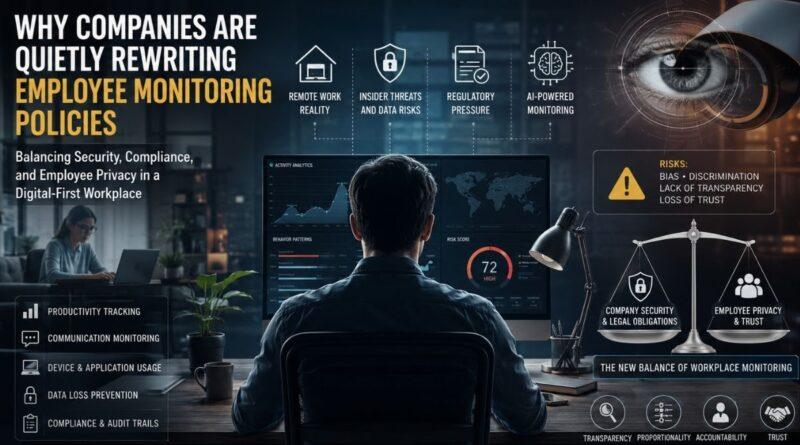
Why Companies Are Quietly Rewriting Employee Monitoring Policies
For years, employee monitoring policies occupied a relatively stable corner of corporate governance. Most organizations disclosed basic oversight practices involving company email systems, internet usage, physical security systems, and workplace communications. The legal assumptions surrounding monitoring were straightforward: employer-owned systems permitted broad managerial oversight, particularly within office environments.
That framework is now under pressure:
“A combination of remote work, artificial intelligence, cybersecurity threats, regulatory scrutiny, insider risk concerns, and workforce distrust has fundamentally altered how companies think about employee surveillance. Organizations are not merely expanding monitoring capabilities. Many are quietly rewriting internal policies to address a workplace environment where traditional distinctions between professional and personal activity have become increasingly blurred”. Says R. Joseph Kramer, Founding Attorney, Kramer Injury Law
Employment attorneys, compliance professionals, privacy consultants, and corporate investigators describe a growing shift inside large organizations. Monitoring policies that once focused narrowly on productivity and acceptable use standards are now being redesigned to manage litigation exposure, data leakage risks, intellectual property protection, and reputational concerns.
At the same time, employers face mounting tension from workers who increasingly view sophisticated monitoring systems as invasive, opaque, and potentially discriminatory.
The Remote Work Shift Changed Employer Visibility:
“The widespread adoption of remote and hybrid work models disrupted one of management’s most basic assumptions: physical visibility. Before large-scale remote work, supervisors often relied on informal observational indicators to assess employee engagement, attendance, responsiveness, and workflow participation. The office itself functioned as a monitoring mechanism. That infrastructure disappeared almost overnight for many organizations. Companies suddenly found themselves managing distributed workforces operating from private homes, shared workspaces, personal devices, and geographically fragmented environments. Traditional oversight methods no longer provided consistent visibility into employee activity”. Says Mike Danko, Trial Attorney & Partner at Danko Meredith Trial Lawyers.
Productivity Tracking Became a Legal Risk Issue:
The public narrative surrounding employee monitoring often focuses on productivity. Internally, however, many organizations are now more concerned about liability.
Insider Threat Concerns:
Corporate security teams increasingly classify insider risks as major operational threats.
Employees possess access to sensitive customer data, trade secrets, confidential communications, proprietary code, pricing structures, and strategic planning materials. Distributed work environments have expanded the number of access points through which sensitive information can move.
Monitoring systems are now frequently positioned as defensive infrastructure rather than management tools.
Compliance experts note that organizations facing data breach risks or intellectual property exposure increasingly view activity tracking as necessary evidence preservation.
A cybersecurity advisor explained that many revised monitoring policies are designed less around “watching workers” and more around establishing investigatory frameworks in the event of future disputes or security incidents.
Regulatory Pressure Is Expanding:
Data privacy regulations and sector-specific compliance obligations are also influencing policy revisions.
Financial institutions, healthcare organizations, government contractors, and highly regulated industries often face obligations to monitor communications, maintain audit trails, or detect unauthorized disclosures.
Remote work complicated those obligations.
Employees may now access regulated data from home networks, personal devices, or unsecured environments. Monitoring systems increasingly function as compliance mechanisms intended to document organizational oversight.
Some compliance professionals argue that companies are rewriting policies not because they want broader surveillance powers, but because regulators increasingly expect proof of governance controls.
Artificial Intelligence Has Intensified Monitoring Capabilities:
“The expansion of AI-assisted analytics has significantly altered workplace monitoring. Traditional surveillance systems primarily collected information. Modern systems increasingly interpret it. Organizations can now deploy software capable of identifying behavioral anomalies, communication patterns, productivity fluctuations, policy violations, or perceived disengagement. This shift has raised difficult questions about fairness, transparency, and algorithmic accountability”. Says Larry Disparti, Founder, Disparti Law Group
Behavioral Scoring and Predictive Analysis:
Some monitoring platforms can generate risk scores based on employee activity patterns.
These systems may analyze:
Typing speed
Communication frequency
Meeting participation
Response times
File access behavior
Work-hour consistency
Collaboration patterns
The objective is often predictive rather than reactive.
Companies increasingly seek to identify burnout risks, insider threats, disengagement indicators, or potential compliance violations before they escalate.
Critics argue that such systems may produce misleading conclusions by reducing complex human behavior into simplified metrics.
A workplace privacy consultant noted that many organizations are now confronting a difficult realization: “The more sophisticated the monitoring becomes, the harder it is to explain how decisions are actually being made.”
The Bias and Discrimination Problem:
AI-assisted monitoring has also triggered concerns regarding discriminatory impact.
Employment lawyers warn that algorithmic systems may unintentionally penalize workers based on disability accommodations, caregiving responsibilities, communication styles, or cultural differences.
For example:
Employees with disabilities may display atypical productivity patterns.
Caregivers working flexible schedules may trigger irregular activity metrics.
Neurodivergent employees may communicate differently than systems expect.
If monitoring outputs influence disciplinary action, promotion decisions, or layoffs, organizations may face legal scrutiny regarding whether automated systems created disparate impact risks.
A labor compliance specialist observed that many companies are quietly revising policies because they recognize their existing frameworks were written before AI-assisted monitoring became operationally significant.
Employees Are Becoming More Skeptical of Surveillance:
The legal permissibility of workplace monitoring does not automatically translate into employee acceptance. Workforce attitudes toward surveillance have shifted sharply in recent years. Many employees now assume some level of digital oversight exists. What concerns workers increasingly is the scale, opacity, and permanence of monitoring systems.
The Transparency Gap:
One recurring criticism from labor advocates involves disclosure practices.
Employees often receive broad policy acknowledgments stating that company systems may be monitored. Yet many workers remain unaware of the extent to which modern monitoring tools can capture behavioral data.
Privacy consultants report growing tension around:
Passive screenshot collection
Webcam monitoring
Keystroke analysis
Productivity scoring
Audio monitoring
Background application tracking
Device-level telemetry
Some organizations are now revising policies specifically to avoid future disputes over inadequate disclosure.
A corporate governance advisor explained: “Companies increasingly realize that vague monitoring language is no longer sufficient once surveillance systems become highly granular.”
Employee Trust Is Becoming a Business Issue:
Several organizational consultants argue that surveillance policy revisions are not driven solely by legal risk.
Retention concerns also matter.
Highly monitored workplaces may experience:
Increased employee distrust
Reduced morale
Burnout concerns
Lower collaboration quality
Recruitment challenges
Reputational damage
In knowledge-based industries, employers increasingly compete for workers who expect autonomy and flexibility.
Aggressive monitoring practices may conflict with those expectations.
As a result, some companies are attempting to redesign monitoring frameworks to appear more proportionate and narrowly tailored.
Personal Devices Created New Legal Gray Areas:
“Bring-your-own-device policies significantly complicated workplace monitoring. When employees conduct business activity through personal smartphones, laptops, or communication platforms, distinctions between personal and corporate information become more difficult to separate. This creates competing legal interests. Employers want visibility into business-related risks. Employees expect privacy regarding personal communications and non-work activities”. Says Robert J. Curcio, Managing Partner, Curcio & Casciato
The Problem of Mixed-Use Devices:
Many organizations now face practical challenges involving:
Business communications on personal messaging apps
Cloud storage synchronization
Personal email use for work matters
Cross-device monitoring systems
Geolocation tracking after work hours
Employment attorneys note that disputes increasingly emerge when organizations attempt to investigate misconduct or data leakage involving personal devices.
Questions frequently arise regarding:
Scope of consent
Data ownership
Preservation obligations
Privacy expectations
Access limitations
Conclusion:
The structural dismantling of physical office spaces has forced a permanent transition from passive managerial oversight to granular digital observation. This rapid evolution in corporate monitoring is no longer a simple measure of employee productivity; it has transformed into a high-stakes mechanism for risk mitigation, legal compliance, and data security. However, as organizations deploy predictive AI analytics and navigate the complex legal gray areas of mixed-use personal devices, they face mounting pushback over algorithmic bias and eroded workforce trust. True corporate governance now requires balancing defensive operational surveillance with essential transparency and employee privacy.