Whole-Home Remodel vs. One Room a Year: a Kent Contractor Runs The Numbers
Anyone who buys an older house in a decent neighborhood eventually has the same argument. The bones are fine, but the inside is tired, and you have to decide: fix it all at once and live in the chaos for a couple of months, or chip away one room a year and spread the money out?
I’d been going back and forth on this for my own place, so I did what I should have done first. I asked someone who watches families make this call for a living and has the invoices to know how it actually shakes out.
Vasile Teterea has run Firm Remodeling LLC for more than a decade. He’s based in Maple Valley and licensed in Washington (LIC# FIRMRRL783PU), and Kent is one of his busiest areas, so he’s a remodeling contractor working all over Kent, WA who’s seen this both ways more times than he could count. I sat down with him to get the math, and more usefully, the parts the math doesn’t show.
The thing most people get wrong
I led with the obvious question. Isn’t one room a year just cheaper?
“That’s what almost everybody assumes,” he said. “On paper the bills are smaller, so it feels cheaper. It usually isn’t. People confuse a smaller invoice with a smaller total.”
His point, which took me a minute to absorb, is that the per-project cost of going slow is higher even though each individual bill is easier to write. Stretched over several years, piecemeal remodeling tends to cost more than bundling the same scope, and you wait a lot longer to live in a house that feels finished.
But cheaper isn’t the only thing people care about, and he was the first to say so. We got to that. First, the numbers.
A real comparison, his figures
I asked him to put actual dollars on it instead of ranges. He walked me through a Kent job he’d finished where the homeowners did things in pieces for the first stretch, then gave up and bundled the rest, which is the only clean way to compare the two on one house.
Standard King County build, late 1980s, around 2,200 square feet. He was clear that another house would land differently depending on finishes and how much plumbing has to move, and that nobody should trust a number off a page instead of a written estimate. Which, coming from the guy who writes the estimates, I took seriously.
Here’s roughly how it broke down.
The first year, they did the hall bathroom as a full gut. New tile, vanity, toilet, a tub-to-shower conversion, fan, lighting, paint. About $24,000. “A standalone bath like that in Kent usually runs the low-to-mid twenties once you’re moving fixtures and retiling,” he said. “Nothing unusual there.”
The second year, flooring on the main level. Carpet out, luxury vinyl plank through the living room, dining room, and hall. Around $11,000.
So two projects, two years, about $35,000. Smaller bills, easy to stomach. That was the appeal, and it’s why the family went that route to begin with.
Then they got tired of waiting and had him do everything else at once: the kitchen, the primary bathroom, the rest of the flooring, and a full interior repaint. Ten weeks of work. They moved the essential kitchen stuff into the dining room and ordered a lot of takeout.
That bundled bill came to about $89,000.
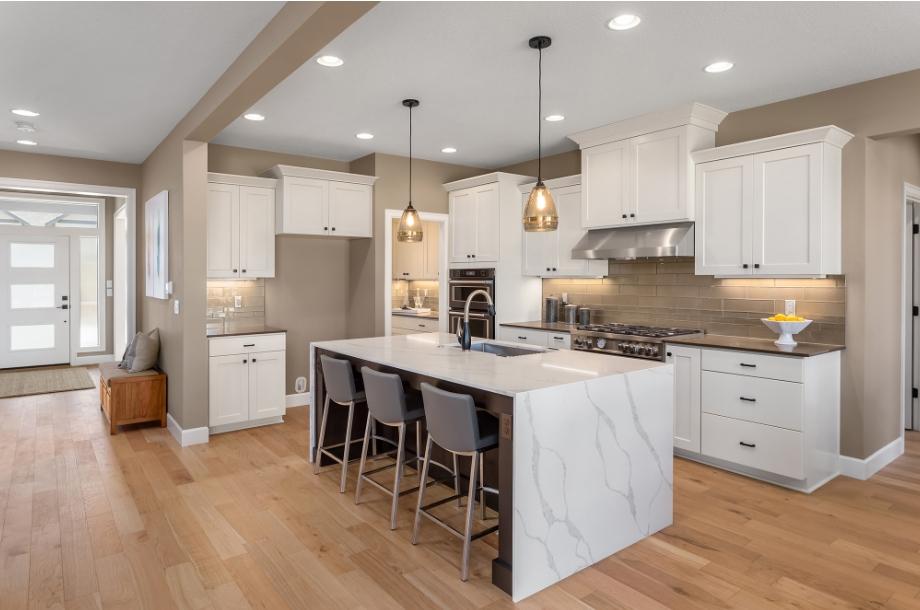
The interesting part is what those same four projects would have cost done separately. Vasile had quoted them individually before the family changed course: roughly $48,000 for the kitchen refresh, $38,000 for the primary bath, $9,000 for the remaining flooring, and $8,000 for the painting. About $103,000 all in.
Same work. Bundled, it ran $89,000. Done one project a year, it would have been around $103,000. The family saved roughly $14,000 by combining it, and got a finished house years sooner.
Where the savings actually come from
I wanted to know why bundling came out cheaper, because it isn’t obvious. His answer came down to a few things, and the one that ended up mattering most was the one I’d never have guessed.
The first is setup, what he calls mobilization. “Every time we start a job there’s a cost before we’ve touched a single tile,” he said. “Floor protection, dust walls, hauling tools in, the dumpster, the permit run. You pay all of that once on a whole-home job. You pay it four separate times if you do four separate projects.”
The second is the overlap between trades. His electrician is already at the house for the kitchen, so the bathroom can lights get done the same afternoon. “Split that into separate jobs months apart and he’s making three trips, three minimum charges, and you’re the one paying for the drive time. Same story with the plumber. Nobody likes telling a customer they’re paying for windshield time, but that’s what fragmented work is.”
Third, permits and inspections consolidate. One combined permit and a coordinated inspection schedule with the city beats filing and paying for several smaller ones, and it cuts the dead time spent waiting between phases.
And fourth, prices climb while you wait. “The kitchen I quote you this year costs more next year,” he said. “Materials, labor, all of it. If you stretch a remodel across five years, you’re buying half of it at future prices. People forget that part because it doesn’t show up until later.”
Why he won’t tell everyone to bundle
This is where I expected a sales pitch, and didn’t get one. I asked whether he just steers everybody toward the bigger project, and he pushed back on that pretty quickly.
“I’m not going to tell everybody to bundle,” he said. “Writing one check for ninety grand isn’t the same as writing a twenty-four thousand dollar check four times. Plenty of people can’t or won’t finance a project that size, and a smaller bite once a year is a lot easier to absorb. And here’s the thing nobody mentions: if bundling means you’re taking out a loan and going slow means you pay cash, the interest can eat that fourteen grand you saved and then some.”
Then there’s living through it. During that ten-week stretch, the family had no real kitchen, drywall dust in rooms that had no business getting drywall dust, and everyone was a little on edge by the end of it. “One room at a time, you’re only ever displaced from one space,” he said. “With little kids or somebody working from home, that matters more than the spreadsheet makes it look.”
The last reason caught me off guard. Going slow lets you change your mind. “People live with that first remodeled bathroom for a year and then they tweak their choices for the rest of the house,” he said. “Tile they swore they loved, they cool on. Do everything at once and you’re locking in every decision up front, before you’ve actually lived with any of them.”
So what should you do
I pushed him for a straight answer. He wouldn’t give me one, and honestly that was the answer.
“It comes down to whether your real problem is money or time, and how you’re going to pay for it,” he said. “If you can swing the bigger project and you mostly just want to be done, bundle it. You’ll usually spend less overall and you stop living in a construction zone years sooner. If cash is tight, or you’d rather not borrow, or a months-long project genuinely doesn’t fit your life right now, go room by room and don’t feel bad about it. You’ll pay a little more across the years, but a little more spread out beats a loan you can’t service.”
The one thing he kept circling back to had nothing to do with sequencing. “Who you hire matters way more than the order you do it in,” he said more than once. The biggest variable in any remodel, in his telling, isn’t whole-home versus piecemeal. It’s the difference between a crew that shows up when it says it will and finishes clean, and one that doesn’t.
His last piece of advice was the most concrete. Get a written estimate that separates demo from materials from labor, whichever path you pick, so you can see what you’re actually paying for. “If a contractor won’t break it down for you,” he said, “that tells you something on its own.”
I walked away thinking I’d had it backwards. I’d assumed slow and steady was the frugal move, and for this house it just wasn’t. Mine might come out the other way. I’m not going to know until I sit down and add it up, which is more than I was willing to do before I talked to him.
This article is based on an interview with Vasile Teterea, owner of Firm Remodeling LLC (Washington LIC# FIRMRRL783PU). Cost figures reflect his past projects in the Kent area and are not a substitute for a written estimate on your own home.