Traditional Italian Focaccia Recipe
Like most staples in Italian cuisine, the focaccia recipe is as old as time. Early references point to Ancient Greek and Etruscan cultures, though the name derives from the Latin “panis focacius”, or “hearthbread”. The traditional focaccia recipe is easy, but it’s also very easy to get it wrong; choosing a slightly lower temperature or skimping on olive oil is enough for baking an unrecognizable dough.
While the baking process is pretty quick, the fermenting process can go overnight, depending on the chosen method. Here’s how to prepare the authentic italian focaccia genovese, and also what to eat with focaccia.
The Trickiest Part
The traditional focaccia recipe takes only five ingredients: all-purpose flour, lukewarm water, extra virgin olive oil, yeast, and salt. Typically, the problem begins with finding the right proportion of water and flour. Unlike classic pizza, focaccia has a very wet dough, with roughly 75% water. It results in a sticky, slimy dough that most beginners will feel tempted to “correct” by adding more flour.
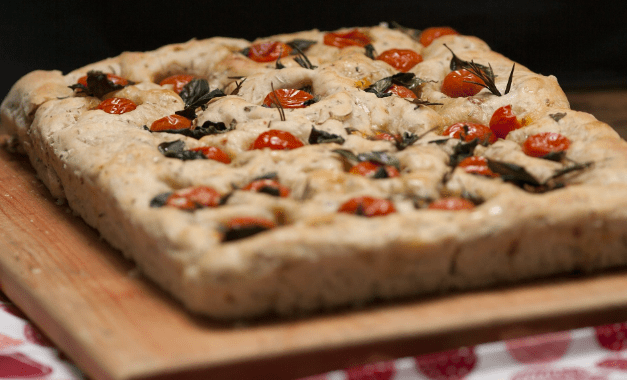
That’s the first and worst mistake, because its texture must be precisely like that to create those delicious dimples. This texture also creates the bread’s signature, air bubbles that trap olive oil and make it look even more appealing. However, one must be gentle during the dimpling process; otherwise, the dough can end up completely deflated.
Finally, the dough must be adequately proofed. If it goes into the oven underproofed, chances are that it will become a chewy flatbread; tasty nonetheless, but nothing close to the traditional focaccia recipe. Meanwhile, an overproofed dough may simply collapse in the oven. It will be perfectly proofed when it’s noticeably puffed up and still jiggles when the pan is shaken, spreading across the pan’s surface.
The Best Part
Once one overcomes the challenges of baking the perfect focaccia, some delicious questions arise: What is the best way to eat focaccia bread? What to eat with focaccia? The original Genova version uses nothing but sea salt and generous amounts of olive oil. Meanwhile, in Puglia, people use black (or green) olives, cherry tomatoes, and fresh oregano.
Other traditional toppings include rosemary, red onions, leeks, herbs, garlic, and anchovies; all drizzled with loads of olive oil. Indeed, the recipe allows for much creativity, and some toppings look almost like pizza. Yet, one must remember that only the simple olive oil and salt topping can deliver that tanned and crusty result. The classic version is around 5 cm tall, but it’s possible to adjust it to about 2 cm for a crispier result.
A Tasty Tradition
What is the best way to eat focaccia bread? It will largely depend on the cook’s taste. It’s even possible to bake sweet focaccia loaves, where sea salt is replaced by cinnamon and sugar. While there are many wrong ways to bake it, there is no wrong way of eating it. Still, first-timers are advised to keep it simple until they get the hang of it, as its preparation can be capricious.