The Small Bedroom Upgrade Most People Overlook: Better Bedside Storage
A small bedroom rarely feels crowded because of the bed itself. It feels crowded because of everything that gathers beside it — phone chargers tangled into a small pile of cords, a half-read book, glasses, lip balm, water bottles, skincare, the small things people reach for at night and then leave out by morning.
The bedside area is one of the most-used zones in any bedroom. It is also one of the least planned. People spend weeks choosing the mattress, the bedding, and the wall colour. The nightstand, by contrast, is often picked late, fast, and small — usually the cheapest one that fits. In a small bedroom, that is the choice that costs the most.
Better bedside storage can lower visual clutter, smooth out morning and bedtime routines, hide the things that should not be on display, and help the entire room feel finished. A nightstand is a small piece of furniture. But chosen well, it changes the way the bedroom works every day.
Why Bedside Clutter Makes a Small Bedroom Feel Smaller
A small bedroom needs visual breathing room. When the bedside surface is overloaded — a book, a charger, a ring dish, a tissue box, a glass of water, three skincare bottles — the whole room reads busy, even when everything else is pristine.
The problem is rarely how much you own. It is that the small things on either side of the bed do not have a proper place to go. Most people end up storing them in the only available place: on top of the nightstand.
A bedside area usually needs to hold:
- A phone and charger
- Glasses or a contact lens case
- A book or e-reader
- Medication or skincare
- A lamp
- A water glass
- Small personal items
- Sometimes a journal, remote, or sleep mask
If the nightstand is just a surface, all of that stays out. In a generous bedroom, the eye absorbs it. In a small bedroom, every visible item carries more weight. Better bedside storage solves this with a single shift: daily essentials stay close, but they do not have to stay visible.
A Good Nightstand Is More Than a Surface
A nightstand is often described as “a small table beside the bed.” That description undersells what it actually does. In a real bedroom, a well-designed nightstand functions as a bedside command center.
It supports your sleep routine. It gives your phone a place to charge without snaking a cord across the floor. It keeps water within reach. It balances the bed visually so the room does not feel lopsided. Most importantly, it gives small items a home — so the bedroom does not look halfway tidied at every hour of the day.
For a guest room, a simple side table is usually enough. For a bedroom you actually live in, storage matters. Drawers, an internal shelf, or an enclosed compartment can be the difference between a room that looks calm and a room that always looks one task away from done.
In a small bedroom, this is amplified. Every piece needs to earn its space — and a nightstand without storage rarely earns much.
Start With Height: Your Nightstand Should Work With Your Bed
Before thinking about style, start with proportion. A nightstand should be comfortable to use from inside the bed. If it is too low, you reach down awkwardly for the phone or the glass of water. If it is too high, it can feel visually heavy and harder to use.
A useful rule: choose a nightstand whose top sits close to the top of your mattress. It does not need to match exactly, but it should feel easy to use from a lying-down position.
| Bed Type | What to Consider | Nightstand Tip |
|---|---|---|
| Platform bed | Lower mattress profile | Choose a lower or mid-height nightstand |
| Standard queen bed | Daily use balance | Keep the top near mattress height |
| King bed | Larger visual scale | Consider wider or paired nightstands |
| Storage bed | Higher mattress profile | Check height carefully before buying |
Height also affects how the bedroom reads. A tiny nightstand beside a tall storage bed looks temporary. A very tall nightstand beside a low platform bed feels chunky. Right-sized proportions are the quiet difference between a bedroom that looks intentional and one that looks assembled.

Choose Drawers If You Want the Room to Stay Calm
Open shelves photograph beautifully and live messily. They show every cable, every loose receipt, every lip balm tube. In a small bedroom, where the bed already takes most of the room, that level of visibility works against you.
A nightstand with drawers is usually the better choice for a small bedroom because it creates hidden storage. It lets you keep the surface edited while still holding everything you actually use at night.
For bedrooms where bedside items pile up faster than you can put them away, the Savanna 3-drawer charging nightstand offers the kind of hidden storage that keeps nighttime essentials close without leaving them on display — and a built-in charging station that quietly handles the cable problem before it becomes one.
A three-drawer layout makes daily organization easier:
- One drawer for tech and charging accessories
- One for books, journals, or personal items
- One for sleep masks, hand cream, medication, and the small things you want nearby
The result is not just “more storage.” It is a calmer bedside surface — the difference between a nightstand and a bedside command center.
Charging Cables Are a Bedroom Design Problem, Too
Modern bedrooms have a cable problem. A phone, a smartwatch, sometimes earbuds, sometimes a tablet, sometimes a laptop overnight — they all want power. Without a plan, the bedside area turns into a quiet tangle of cords that nobody styled and nobody is going to fix this evening.
A nightstand with built-in charging can help, but the real solution is broader: think about where devices actually live overnight before you buy the nightstand.
| Question | Why It Matters |
|---|---|
| Do you charge your phone beside the bed? | You’ll want easy outlet access or built-in charging |
| Do you use a lamp plus multiple devices? | Cable management gets harder fast |
| Is your wall outlet hidden behind the bed frame? | A nightstand with cord routing helps |
| Do cables stay visible on the floor? | Enclosed storage hides backup chargers |
A nightstand with drawers can hide spare cables, backup chargers, and devices that do not need to be out. That sounds like a small detail. In a small bedroom, where every clean surface matters, it is usually one of the bigger ones.
One Nightstand or a Set of Two?
Not every bedroom needs two nightstands. A guest room, a narrow bedroom, or a bed pushed against one wall may only have space for one. But in a primary bedroom — especially with a queen or king bed — a coordinated pair often makes the room feel more complete.
A pair adds symmetry. It gives both sleepers their own storage. It centers the bed. And it signals that the bedroom was planned, not just furnished.
That does not mean the two pieces have to be rigidly identical. Coordination matters more than matching. Height, scale, finish, and silhouette should relate to each other and to the rest of the room. The bedroom should read as one decision, not five separate ones.
If you are still deciding, the Sicotas nightstand collection makes it easy to compare drawer count, width, height, finish, and whether a single piece or a matching pair makes more sense for the room you actually have.
For very small bedrooms, the answer is often one storage-rich nightstand instead of two undersized ones. For larger primary bedrooms, two coordinated pieces almost always create a more polished result.
Small Bedrooms Need Proportion, Not Tiny Furniture
A common small-bedroom mistake is reaching for the smallest piece available. The logic feels right — small room, small furniture — but it usually backfires. A truly tiny nightstand beside a queen or king bed looks temporary. It also rarely holds enough storage to do its job.
The goal is not the smallest piece. It is the right-sized piece for the bed, the room, and the routine.
| Bedroom Problem | Better Nightstand Choice |
|---|---|
| Narrow space beside the bed | Slim nightstand with at least one drawer |
| No closet or limited overall storage | Storage-rich nightstand (2–3 drawers) |
| Tall mattress or storage bed | Taller nightstand to match the bed height |
| Constantly cluttered bedside surface | Multi-drawer nightstand with hidden storage |
| Primary bedroom | Coordinated pair |
| Guest room or studio | Single compact nightstand |
In a small bedroom, proportion is what creates calm. The nightstand should not crowd the walkway, but it should still feel substantial enough to support the bed visually.
Style Matters: The Bedside Area Sets the Bedroom Mood
Nightstands are small, but they sit at eye level when you walk into the bedroom and frame the bed from both sides. Their material, colour, and silhouette quietly shape the mood of the entire room.
Warm wood softens a neutral bedroom. Rattan or woven texture brings a relaxed, natural quality without making the space feel rustic. Clean-lined silhouettes support a modern look. Darker finishes can add contrast — but in small bedrooms, they need natural light to avoid making the room feel heavier than it is.
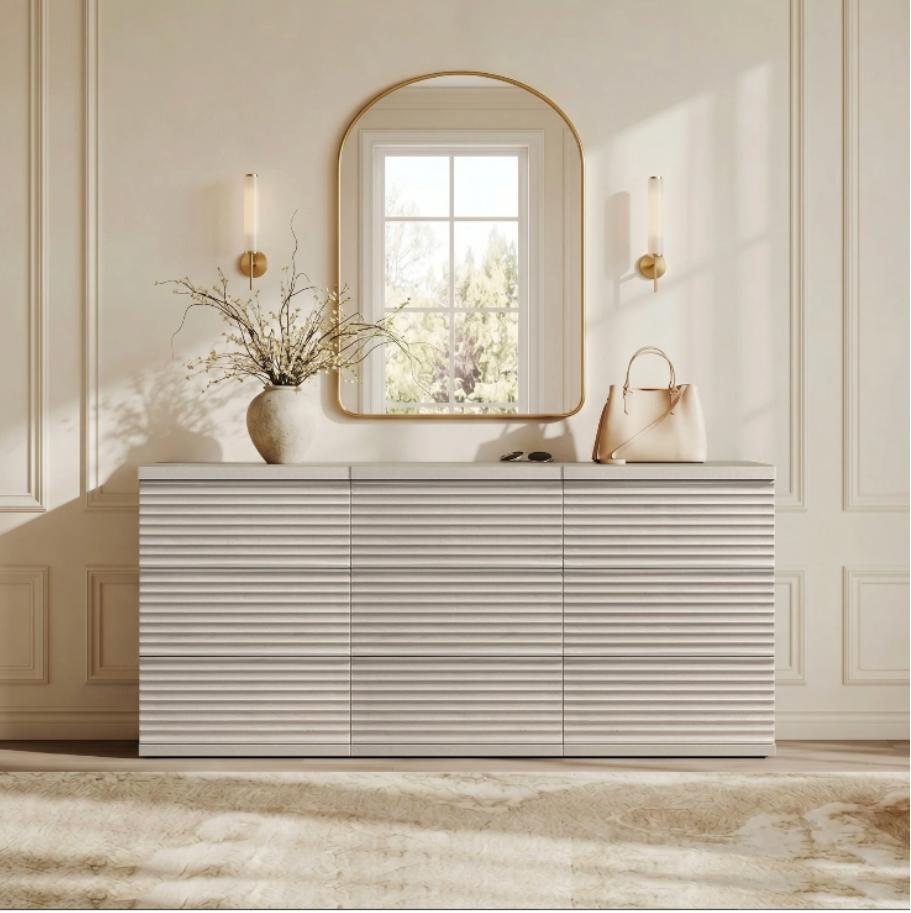
The bedside should also coordinate with the dresser. The two pieces don’t need to match, but they should share at least one element — a wood tone, a hardware style, a similar level of visual weight. A piece like the Stria Dresser with Large Drawers shows what a coordinating dresser looks like at this kind of price point: vertical fluted detailing, generous drawer space, and a silhouette that sits comfortably next to a clean-lined nightstand without competing for attention.
The strongest nightstand choice usually has:
- A clean, restrained shape
- Hidden storage behind drawers or doors
- A warm or neutral finish that pairs easily with the bed and dresser
- Enough surface for a lamp and a few essentials
- A silhouette that does not fight the rest of the room
Function and atmosphere together — that is the combination that makes a small bedroom feel finished.
The Bedside Checklist Before You Buy
Run through this list before placing an order:
| Question | Why It Matters |
|---|---|
| Is the height close to the mattress top? | Makes daily use easier and reduces awkward reaching |
| Does it have enough storage for what you actually use at night? | Keeps bedside clutter hidden, not relocated |
| Does it fit the available width beside the bed? | Prevents crowding in a small bedroom |
| Can the top hold a lamp, phone, and water glass? | Supports the actual nightly routine |
| Does it help manage charging cables? | Keeps the surface visibly cleaner |
| Does it coordinate with the bed and dresser? | Helps the room feel intentional, not assembled |
| Are delivery and assembly expectations clear? | Reduces online buying anxiety |
| Is the return policy visible before checkout? | Helps shoppers feel safer buying furniture online |
A nightstand should make life easier — not just fill the gap beside the bed. If it supports your routine, fits the room, and reduces visible clutter, it is doing its job.
Where Sicotas Fits Into Better Bedside Storage
For most shoppers, the best bedroom piece sits between two extremes. Not disposable. Not designer-priced. Style-aware, but not pretending to be heirloom hardwood.
That middle ground — practical, well-finished, fairly priced — is where most real bedrooms get furnished. The nightstand should look considered, hold what you actually use at night, and fit a real space with real walls and a real outlet location.
For shoppers who want storage-forward bedside pieces with a warmer, more considered look, Sicotas online offers coordinated bedroom collections built for real bedrooms, real routines, and real budgets. The collections are designed to expand over time — start with a nightstand, add a matching dresser later, and bring in a wardrobe or bench when the room is ready.
That phased approach is closer to how most homes actually come together. You do not need to finish a bedroom in one weekend. You need a first piece that fits the room properly and gives the rest of the bedroom something to coordinate with later.
Better Bedside Storage Makes the Whole Bedroom Feel Finished
Better bedside storage looks like a small upgrade. It is not. It changes how the bedroom functions every day — how mornings start, how evenings settle, how the room reads when you walk in.
In a small bedroom, the impact is bigger. Every surface is visible. Every inch counts. Every piece has to support both storage and atmosphere, because there is nowhere for either one to hide.
A well-chosen nightstand makes the room calmer, cleaner, and more finished without changing the bed, repainting the walls, or rethinking the rest of the space. Sometimes the most effective bedroom upgrade is not the largest one. It is the one that finally gives everyday clutter a proper place to go.