The Nd:YAG Laser: Why One Wavelength Works on Every Skin Tone
For most of the history of aesthetic lasers, the fine print said the same thing: excellent results, but not for everyone.
Devices that read pigment aggressively delivered fast outcomes on fair skin and carried a genuine risk of burns and lasting discoloration on deeper complexions. Plenty of people with olive, brown or black skin were told, politely, that they were not candidates.
The Nd:YAG changed that calculation, and it did so through physics rather than marketing.
A longer wavelength, a different logic
The Nd:YAG emits light at 1064 nanometers, considerably longer than the wavelengths used by most cosmetic lasers. Two consequences follow.
First, melanin absorbs it far less efficiently, so the pigment sitting in the upper layers of the skin is largely bypassed rather than heated.
Second, that longer wavelength travels deeper, reaching the dermis and the vascular structures within it.
In practice, the energy passes through the surface with relatively little interference and does its work below. The dermis warms, the body reads that warmth as an injury worth repairing, and the repair response follows: new collagen, new elastin, gradual remodeling over weeks rather than days.
Nothing is ablated, nothing is peeled away, and the outer barrier stays intact throughout.
More versatile than its reputation suggests
Most people first hear about the Nd:YAG in the context of hair removal, where it remains the reference for darker skin types. Its clinical range is considerably wider than that.
Because it is drawn to hemoglobin as well as to pigment, it addresses the vascular complaints that frustrate so many patients: visible capillaries around the nose and cheeks, persistent facial redness, the diffuse flush associated with rosacea.
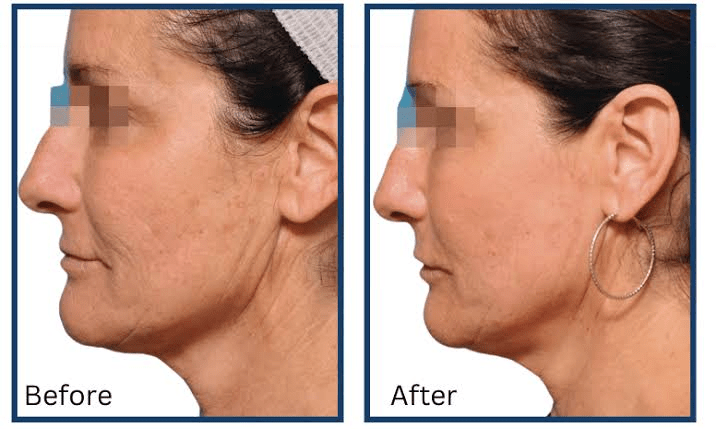
Because it heats the dermis, it improves firmness, softens fine lines, and lifts the dullness that comes from sluggish microcirculation.
It also calms inflammatory acne and reduces the ingrown hairs and razor bumps that follow shaving, a concern that disproportionately affects coarser, curlier hair.
That breadth is the reason clinics tend to keep it running all day. One device, several very different appointments.
The safety argument for deeper complexions
This is where the wavelength earns its standing.
On Fitzpatrick types IV through VI, a shorter wavelength faces a real problem: it cannot easily distinguish the pigment in the target from the pigment in the surrounding skin. The result can be a burn, or post-inflammatory hyperpigmentation that outlasts the issue being treated.
By stepping past most epidermal melanin, the Nd:YAG narrows that margin of error substantially.
It is not a guarantee, and settings still have to be adjusted to the individual, but it is the reason dermatologists regularly describe it as the safest option available for richly pigmented skin.
Anyone who has been turned away from a laser consultation on the basis of their complexion should know that the conversation has moved on.
What a session actually involves
Appointments typically run between fifteen and sixty minutes depending on the area.
Most patients describe the sensation as a series of warm snaps, tempered by the cooling systems built into modern platforms.
Redness and mild swelling are normal afterward and usually settle within a day, which is why the treatment is often booked around a working week rather than around a vacation.
Preparation is undemanding but not optional. Arrive without a recent tan, since sun exposure raises the risk of pigment changes even with a forgiving wavelength, and pause retinoids and exfoliating acids for several days beforehand if your practitioner asks.
Afterward, daily broad-spectrum sunscreen protects the investment more than any serum will.
Results accumulate. Vascular concerns tend to respond within a few sessions, while collagen-driven changes in firmness and texture reveal themselves over two to three months as the remodeling completes.
Clinics that treat it as a course rather than a one-off are describing the biology accurately.
How to choose well
The device matters less than the hand operating it.
Ask which platform will be used, whether it carries more than one wavelength, and how the settings will be chosen for your skin type.
A patch test should be offered as a matter of course, and any practitioner unwilling to identify your Fitzpatrick type before treating you is skipping the step that protects you.
Serious clinics document all of this openly. Centre Esthétique de Montréal, a clinic offering Nd:YAG laser treatments in Montreal, sets out what the technology addresses condition by condition alongside the equipment it runs, which is exactly the transparency worth looking for wherever you book.
The bottom line
The Nd:YAG has no marketing glamour attached to it.
What it has is a wavelength that behaves predictably across the full range of human skin tones, and a clinical range wide enough to cover redness, texture, firmness and unwanted hair with a single device.
In a category where inclusivity is too often a claim, this one is a measurable property of the light itself.