START SPREADING THE FUSIONISM – THE ART WHIRL BUZZ BEHIND SHALOM TOMAS NEUMAN
BY -GEORGE WAYNE
“I am consumed by art-it is my life!” Prompts the provocateur Shalom Tomas Neuman even before the subject could be broached. I am sitting in the back seat of his middling red jalopy of unknown make, as he steers us through the Holland Tunnel to Easton, Pennsylvania and his vast complex in the bucolic town better knonw as the home of Crayola crayons and now as the studios and production facilities of this mad scientist of an artist upending the art world once again with his unflinching dedication to the phantasmagorical genra of contemporary art he’s foistred on the whirl and dubbed- Fusionism. ”Why can’t art be multi-sensory?” He immediately retorts vlearly waiting for the question- what the hell is Fusionism. The 70 year old sage with an encyclopaedical professorial art mindset does not stop talking for the next two hours and twenty minutes to his Pennsylvania artist compound. ”The sight, the sound, the smell. I believe that I am the first to create FusionArt . I did it in the Sixties and it all began when I was a student at Temple University/. In those days I was surrounded by hard edge abrstract expressionists like barnet Newman and sof, Dan Flavin and t ed masters like Rothko and Rauschenberg, Dan Flavin, Krissa and the Czech artist Kupka. These are all teriffic artists whom I respected and learnt from. But the artist who has most inspired me is Jean Tinguely, and especially his Homage To New York which was a self-destructing installation exhibited in the garden of the Museum of Modern Art way back in 1960. Tinguely was the trie precursor of Fusion Art because he combined movement, time, sculpture and painting. I wanted to become a maximalist.”
It’s amazing how time flies when absorbed in the conversation and non-stop diktat of a mind-blowing genius. It is already quite clear that this artist as septugenarian has never been more adamant and more determined about his unfettered creative expression. He was born in Prague more than 70 years ago ”most of my family was gassed by the Nazis,” he spurts unflinchingly, ”but my parents escaped to Prague where I was born.” From there to Israel at 12 years old before the final escape to the United States. By 1982 he was that kooky, brilliant art professor revered by his students at the Cooper Union that famed artistic unstitution in New York’s East Village. The journeyman professorial career over the decades took his in-demand art history mind to other notable schools of higher learning from the Parsons School of Design to the Pratt Institute to Carnegie Mellon. He remains the mind boggling ethereal thiinker who is now adamant that his Act III must be devoted to reminding the art sphere about his unforgettable influence and importance. The quest to school a new generation his generational defining genre he calls Fusionism.
His gallerist, Georges Berges–the Soho art dealer,who in his 11 years in business on West Broadway- is increasingly reffered to as ‘the next leo Castelli’. A reference to the eclectic and often ground-breaking roster of talent he now represents. Castelli, of course, was the pioneering art dealer who first put Soho on the art whirl map of historic lineage. Gallerist Berges is all gungho about his new charge. Besides the fact Shalom was best friends with Max Ernst and William Dekooning what’s the intrigue here?
”Shalom Neuman maintains a historical position especially in the radical high-brow art scene of the 1980’s and the retrospective of his work now on displlay at 462 West Broadway at my gallery is placing him in the stalwart firmament of the 80s art star outlier who never got his due until know. The future is already made and it’s time to herald this fifty years of Fusionism.” So the agenda is set that this must now be the final quest for everlasting relevance.
”We have just crossed the Delaware,” the artist again chimes in with his endearing Czech clipped inflection to the English language. The Delaware River and the bridge we just crossed was the indicator that the equally endearing Pa., college town was about to reveal itself. And it is as charming and bucolic as most every American college town ought to be. The Shalom Express, as in the tiny red Japanese-made motorcar that got us here- pulls up to a nondescrpt building and we are immediately ushered into the vast out-of-this-world, world of Fusionism. ”This building was a former elementary school,” but before that thought could even register we’re thrust into a jarring oscillating multi-sensory dervish. The main room is dominated lwith ten feet tall skeletal metal sculptures wired with assorted gizmos and gadgetry squawking and moving. Maximalist, theatrical, many physical and imposing creations. A fusion of pop and surrealism like nothing you’ve ever seen.
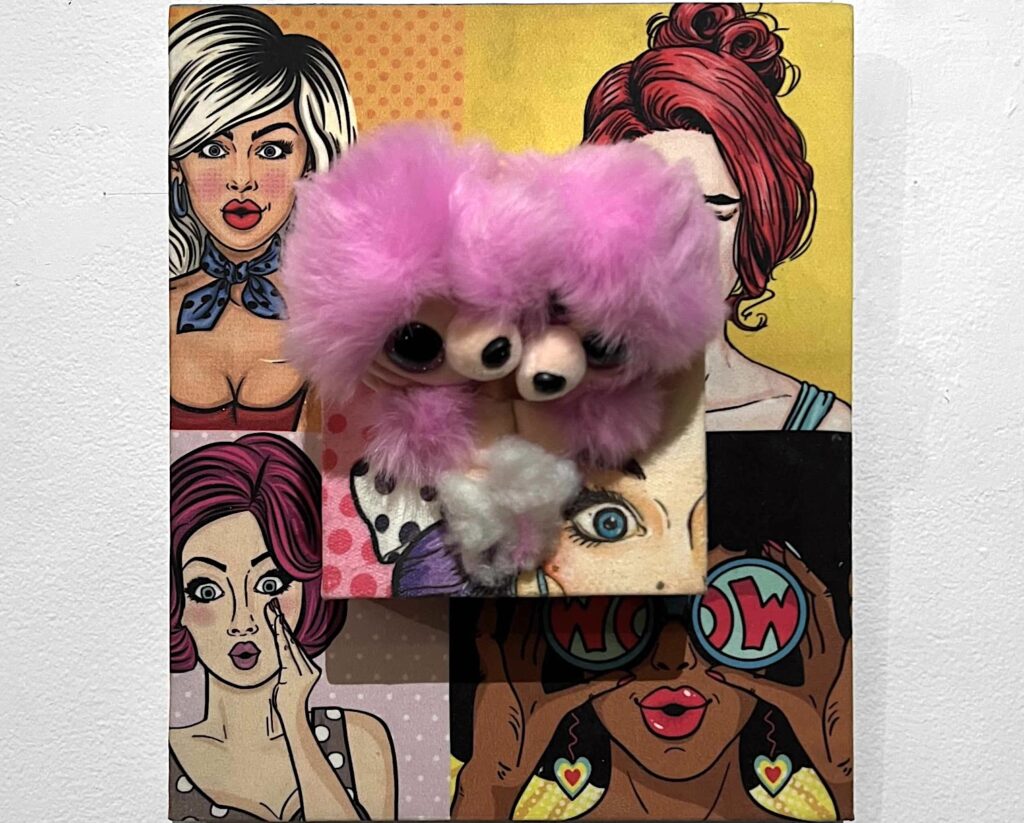
This is experential art created way before the term came to define 21st Century zeitgeist. In other rooms of his quirky Fusion Museum are classical painterly canvases layered and imbued with distorted ghoulish detritus. An earnest decadent mix of Assemblage,Constructivism.Expressionism.Surrealism and early 20th Century technology. In sum- it is pretty mobid existentialism A spectacle of imagery. light a lot of sound and even furniture morphed into these wild creations.
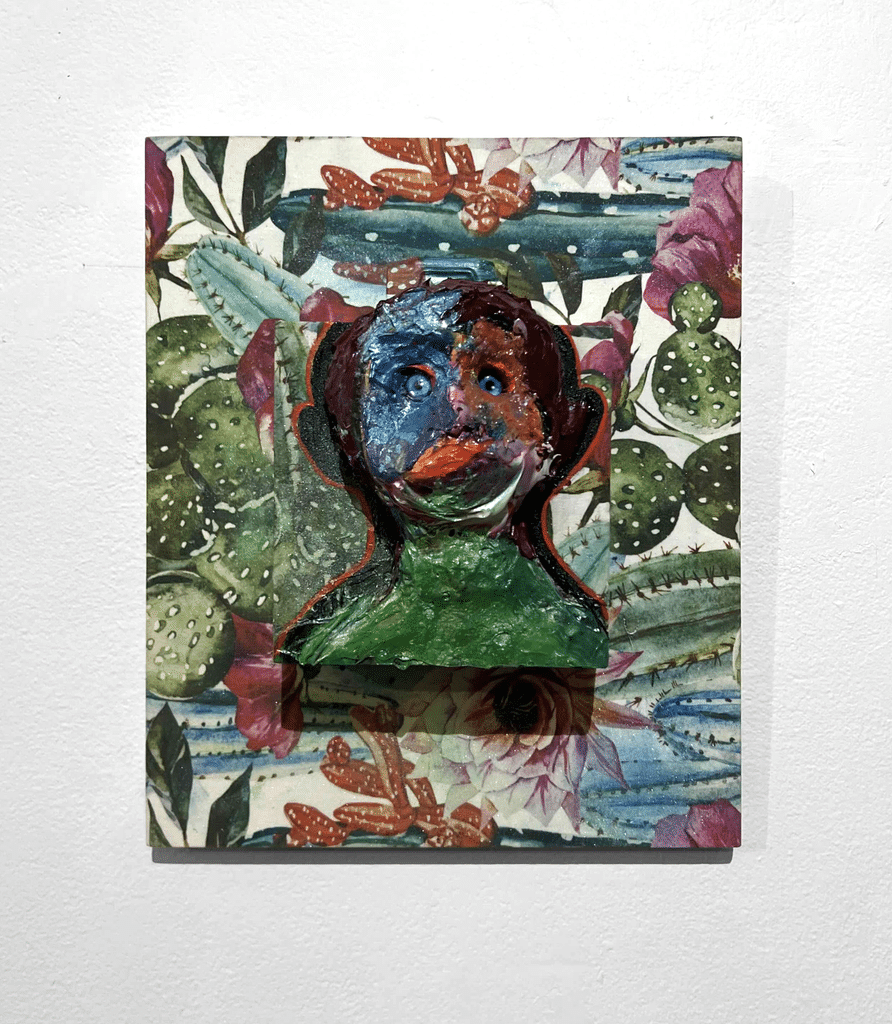
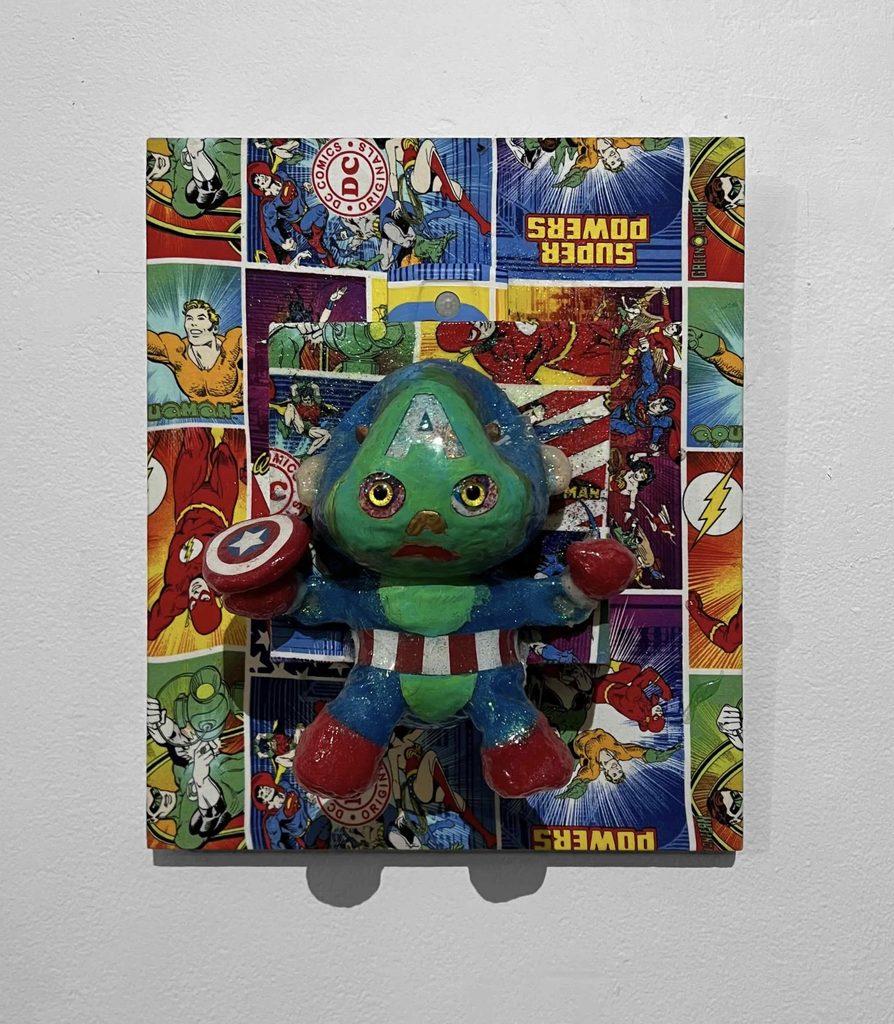
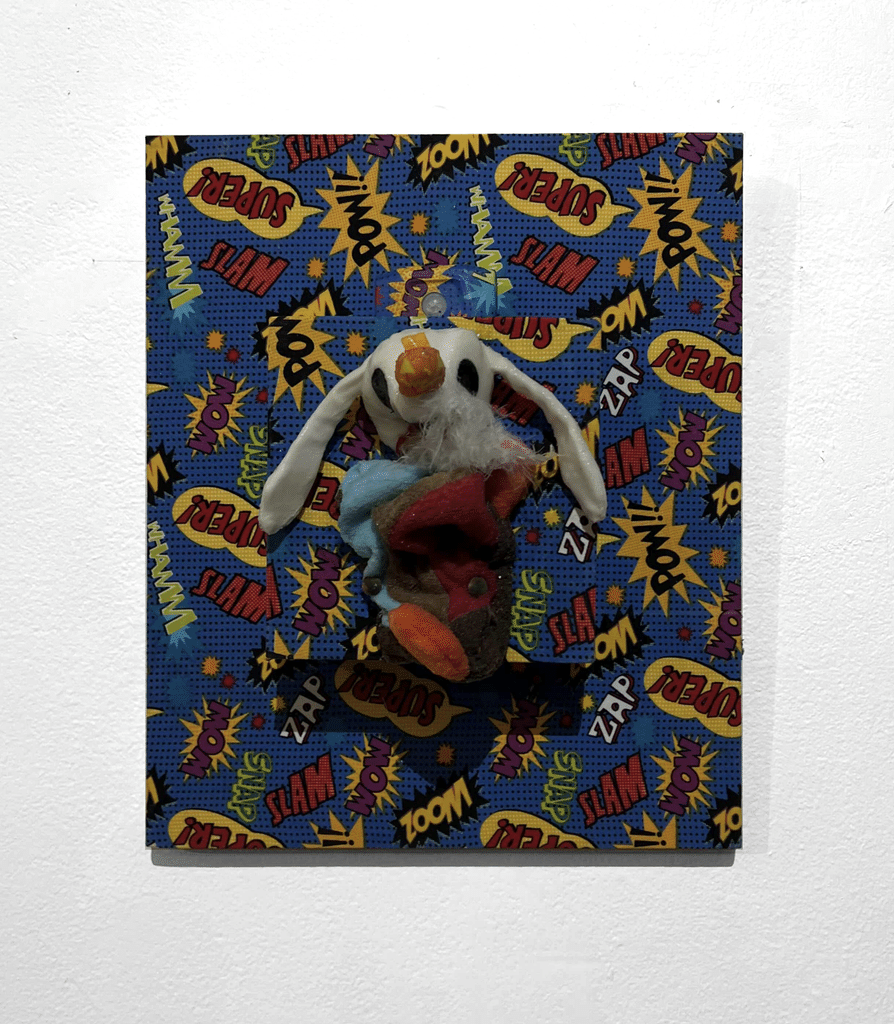
To the base sensibility one could quickly accept the sentiment that one man garbage can create another man’s art. The artist is hardly offended. ”It is true that the best art supplies I have ever found were on the streets of New York City. I rummage everywhere from 99 Cent stores to art supply stores to dumpster diving.” Shalom has no shame in the claim and the arrogance is to be applauded. There is nothing elegant about this work, no attuned sensitivity. The cacophany is complex and beyond eccentric. Art, they say. is meant to spark conversation and this art certainly will spark conversation and beyond that quite a few puzzled expressions. Immersive, three dimensional are all tropes that Shalom Tomas Neuman was exploring more than forty years before such notions were a thing. It is multi-layered and robotic. The world of a mad scientist, prone to hoarding. who fancies himself as an artist first and foremost..The bewildered arbiter here eill lookk to a more salient art critic amongst us ro help define the mmethod to this madness.
So we rely on the famed art historian in Anthony Haden-Guest to further assess Fusionism for the less attuned critics among us. “Fusionism is art making that weaves together all the senses and absorbing materials others would consider detritus. It was a 80s avant garde movement that was best led by Shalom Tomas Neuman.” And how to further decode this artistic mindset? The visual cacophany and the obtuse and bewildering nature to the canon of this fearless and restless artist? Go explore and ponder yourself and visit the GBG Gallery on West Broadway. But not before digesting the probe and parry and the GWQA to learn more about this most distinctive hand of the most audacious artistic signature we’ve personally encountered in quite some time…
GW – Discuss the technical foundation of your Fusionism. The alchemy of your bizarre interactive sculptures
SHALOM – My technical foundation is mastering as many techniques as necessary to create multi-sensory art. My goal has always been to fuse the various art genres into one cohesive artwork.
GW- You are so professorial and possess one of the most expansive and learned minds regarding the whirl of art that I have ever met. So school us further on the layered philosophical reason behind your rambunctious art form.
SHALOM- I studied and taught art history. I can see trajectories. Artists have debated for centuries about what reality is. My philosophy builds on that – we live in a multi-sensory world, and I have always firmly believed that art should reflect that, reflect our environment and our culture. This is why I like using the discarded colored detritus of our society, essentially painting with plastic. The layering is more about layering art forms like painting, sculpture, sound (including spoken word), light and movement.
GW- Shalom, Tomas Neuman is always exploring the intangibles? Is that a fair assessment?
SHALOM – Absolutely. I see that as an important aspect of being an artist, always exploring.
GW- You are most infamous for creating the art movement Fusionism. Way back, as that art world prodigy- Temple University,1967.
SHALOM- That was my epiphany in 1967 – to create a room where the tangible, intangible, physical and ephemeral cannot be distinguished from each other.
GW- And what statement are you mansplaining to the world with this first one-man show you have had in decades, and now on display at the Georges Berges Gallery
SHALOM- I don’t think I have to make a statement. My art speaks for itself.
GW- Your oeuvre is undeniably rooted in avant-gardism. Yes or no?
SHALOM- Yes. It certainly is rooted in the evolution of contemporary art. Surrealism and kinetic art have clearly influenced me. But all the major art movements ultimately helped me arrive at who I am as an artist.
GW- Some folk will find your art aggressively theatrical and even kooky. You are known for being revered for your mind by some of the greats who were more famous than you, such as Rothko and Max Ernst
Didn’t they think your art was simply nuts?
SHALOM- I don’t really care what other people think of my work. Artwork that doesn’t engender a reaction, positive or negative, is just decoration.
GW- Shalom always seems to be experimenting…
SHALOM- Shalom IS always experimenting.
GW- Talk about The Amerika Series (2007-2011). Jot your brief thesis
SHALOM- They are a perfect example of seamlessly fusing painting, sculpture, found objects, light, sound and motion. They have morphed into the Mini Amerika series, which is in this current exhibit.
GW- By the way, what is a Golem? It’s a constant reference
SHALOM- The robot is a kindred spirit to a golem, a legendary, soulless humanoid created from clay by the Jewish mystic Rabbi Judah Loew of Prague. According to legend, the golem was created to serve and protect the Jewish people and was animated through divine names. Eventually, it became uncontrollable and was deactivated, returning to the clay from which it originated.
GW- Yours is an unmistakable visual language that totally disrupts the senses.
SHALOM- That’s the point.
GW- Why was the 20th-century provocateur Jean Tinguely such an inspiration?
SHALOM- Because he was the first artist to fuse painting and sculpture and create kinetic, whimsical art. There was humor in his art. And I believe his self-destructing machine at the Museum of Modern Art was a brilliant philosophical commentary on what art is as opposed to what a museum defines art to be. For me, he is the most important artist of the 20th century.
GW- How do you retool when it’s hard to find your focus?
SHALOM- I don’t retool – it’s like eating for me. I don’t have to find my focus. I agree with Sandro Darnini – art is sustenance.
GW- The most impactful book you have ever read and why?
SHALOM- Night by Elie Wiesel. It’s my history. And I owe my life to the people who don’t make it out.
GW- One notoriously infamous work of yours is known as Big Dick, which a famous art historian, Donald Kuspit, once dubbed ”a grotesque character with a swollen head.” Is it part of this show? Or will the connoisseurs out there have to trek to your museum in Easton, Pa., to see that monstrosity
SHALOM- He will be there along with his brother Womanizer.
GW- In sum, Shalom Tomas Neuman has a distinctive hand with the most audacious, unfettered and determined creative expression on a whole other level.
SHALOM- I will agree that my art is audacious. So is life.