Red Light Therapy for Wrinkles: What It Can and Can’t Do for Aging Skin
The skincare conversation has shifted from what can be applied to skin toward what can change its behavior. Serums and retinoids work largely at the surface or the upper layers; red light therapy makes a deeper proposition. Specific wavelengths of light, delivered at meaningful intensity, appear to influence the cells that manufacture collagen and elastin in the first place. It is the rare wellness trend with genuine peer-reviewed research behind it, and also one where the marketing routinely outruns the data.
Readers who prefer to start at the practical end can go straight to a detailed guide to the best red light therapy devices for skin and anti-aging, which works through wavelength, intensity, and design criteria device by device. And for a sense of what the first two months actually feel like, one writer’s candid at-home test of red light therapy captures the real arc: two weeks of nothing, then gradual texture change under the fingertips before anything showed in the mirror. The science below explains why patience is part of the protocol.
How Light Reaches Collagen
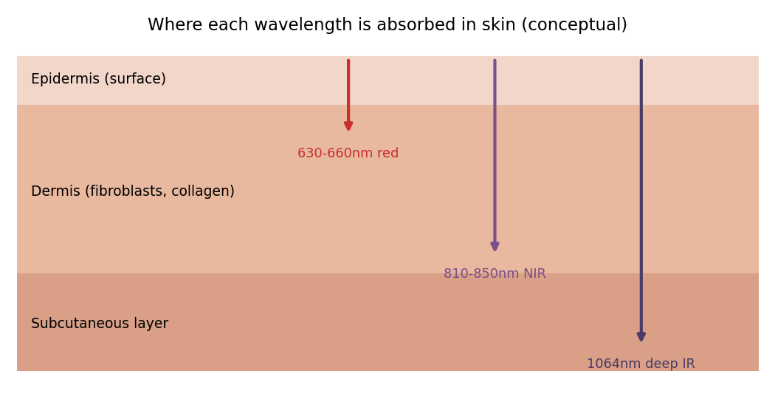
The dermis, the skin’s structural layer, is maintained by fibroblasts, cells that synthesize collagen and elastin. Their output declines steadily with age, which is the biological substance of what shows up as fine lines, thinning, and loss of firmness. Red wavelengths around 630 to 660 nanometers are absorbed in the skin’s upper layers, while near-infrared wavelengths around 810 to 850 nanometers reach into the dermis where fibroblasts live. The absorbed light appears to stimulate mitochondrial activity within these cells, and the working hypothesis, supported by clinical observation, is that energized fibroblasts maintain and rebuild structural proteins more effectively.
What the Studies Actually Show
Two findings anchor the category. A controlled split-protocol study (PubMed ID 17566756) documented measurable improvements in skin texture, fine lines, and elasticity across a course of red light sessions. Later clinical work on combined red and near-infrared exposure (PubMed ID 37522497) linked consistent use to fibroblast stimulation and collagen production, with participants showing measured improvement in complexion over the study period. The wavelengths recurring across successful protocols, 633 and 830 nanometers used together, have become the de facto reference pairing for skin work.
Note the shape of these results: gradual, cumulative, and measured in weeks. Study protocols run multiple sessions per week over one to three months before assessing change. Nothing in the literature supports overnight transformation.
What It Cannot Do
Red light therapy will not erase deep, established wrinkles, reverse significant sun damage, or substitute for procedures that physically resurface or fill. It does not replace sunscreen, which prevents the damage light therapy can only partially address afterward. And results plateau and fade without maintenance, because fibroblasts respond to ongoing stimulus, not past sessions. Anyone promising a facelift from a lamp is selling something other than the evidence.
At Home Versus In Office
Professional LED treatments deliver controlled doses with clinical-grade equipment, at a per-session price that accumulates quickly across the multi-week courses the research describes. Home panels trade some intensity for unlimited sessions and consistency, which is precisely the variable the studies reward. For committed users, the economics favor a well-chosen home device within a few months. The transparency of the spec sheet matters more than the setting: wavelengths matching the studied bands, published intensity measurements, and flicker-free output are what separate serious hardware from decorative red glow.
Frequently Asked Questions
How many sessions per week do skin protocols use?
Most published protocols and manufacturer guidance land between three and seven sessions weekly, at 10 to 20 minutes per session, sustained for at least eight weeks before judging results.
Is red light safe for all skin tones?
The wavelengths used in skin protocols are non-UV and are generally considered safe across skin tones, with photosensitivity conditions and photosensitizing medications the notable exceptions. When in doubt, a dermatologist should make the call.
Can it be combined with retinoids and acids?
Many users pair them, typically applying actives after evening sessions rather than before. Because both approaches influence skin behavior, introducing them separately makes it easier to attribute changes and catch irritation early.
This article is general wellness information, not medical advice. Speak with a qualified healthcare provider before starting any new therapy.