NYC–Tokyo: A Guide to Flying Business Class
New York is one of the stronger US departure points for business-class flights to Tokyo, offering a range of carriers, cabin products, and routing options that differ in ways that matter for the journey. Japanese and US airlines approach the long-haul experience differently, and the choice between Haneda and Narita on arrival affects how the trip comes together.
At roughly 14 hours in the air, a nonstop flight from New York to Tokyo is long enough that aircraft type, seat layout, and cabin design have a real effect on rest and how you arrive. Knowing what separates the available options makes it easier to choose the combination that fits the trip.
Flying Business Class to Tokyo from NYC: Airport Options
John F. Kennedy International Airport (JFK) offers the widest selection for this route. It handles more long-haul international departures than the other New York-area airports, with a broader range of airlines and lounge options. Both nonstop and connecting itineraries to Tokyo operate from JFK, which gives more room to compare cabin products across carriers.
Newark Liberty International Airport (EWR) is worth considering for travelers originating from New Jersey or lower Manhattan, where the drive or transit time to the airport is shorter than JFK. It is smaller and generally easier to navigate than JFK, which can matter when coming from New Jersey or the west side of Manhattan. The tradeoff is a narrower selection of airlines and lounges, and less variety when comparing premium cabins.
LaGuardia Airport (LGA) is not a practical option for this route. It has no nonstop flights to Tokyo, limited lounge access, and only applies if the itinerary connects through another US hub.
Direct vs Connecting Business-Class Flights to Tokyo
The choice between a nonstop and a connecting itinerary affects more than convenience. Connecting flights can open up different departure times, alternative carriers, and, in some cases, lower fares, although the price gap varies significantly depending on how far in advance you book.
Nonstop business-class fares from New York to Tokyo fluctuate considerably by booking window:
- All Nippon Airways (ANA): advance bookings start at about $6,400; close-in tickets can reach $18,400 or more.
- Japan Airlines (JAL): early bookings often begin at $6,500, rising to the $12,800–$22,700 range closer to departure.
- United Airlines: advance round-trip tickets start near $6,200, with last-minute fares rising to about $13,000.
Connecting itineraries can be a reasonable option when the layover is well timed, and the connecting airport has a strong lounge. Fares on these routes tend to be more stable, although the range is still wide:
- All Nippon Airways (ANA) and United Airlines: round-trip fares generally range from $6,200 to $15,700.
- Japan Airlines (JAL) and American Airlines: round-trip fares generally range from $7,500 to $14,400.
Once the route type is clear, the more consequential question is which cabin provides the strongest JFK to Tokyo business-class experience, or the best alternative from Newark. This comes down to aircraft and seat design.
ANA The Room Business Class
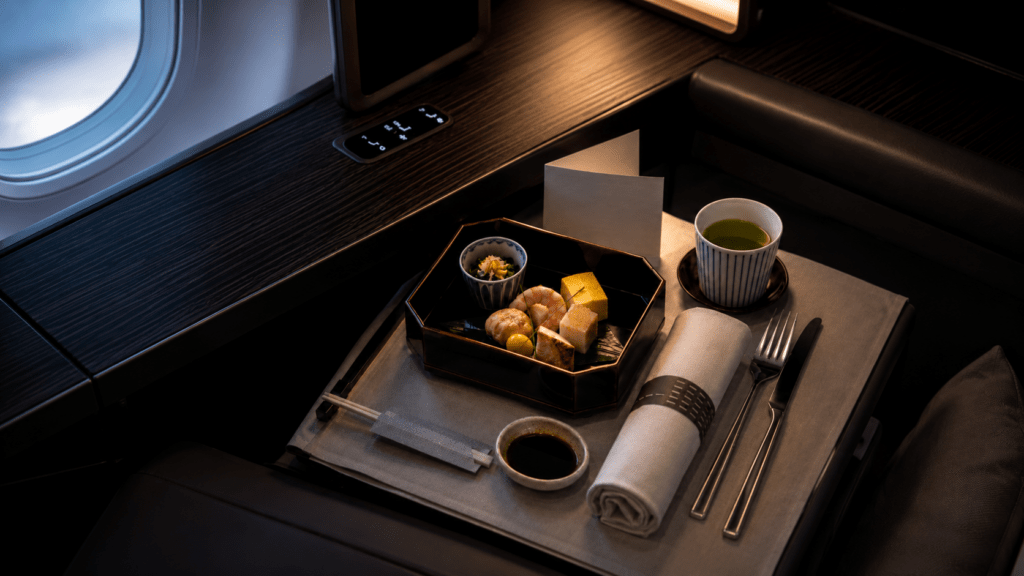
All Nippon Airways (ANA) is one of the strongest Japanese carriers for business class to Tokyo, especially if privacy and personal space matter more than a flashy cabin. Its standout product is ANA The Room business class, which operates on select Boeing 777-300ER aircraft. The cabin launched in 2019, with a design by Japanese architect Kengo Kuma in collaboration with British design firm Acumen, and Safran manufactured the seats.
The Room uses a 1-2-1 configuration with alternating forward- and rear-facing rows. Each suite has a sliding door, a 35-inch-wide seat (89 cm), a 72-inch lie-flat bed (183 cm), and a 24-inch screen, with Japanese rosewood and ash wood finishes that give the cabin a calm, residential feel. The width gives passengers room to sleep, work, and dine without feeling tight, while the door reduces exposure to the aisle.
ANA’s onboard service matches the cabin’s controlled rhythm, with Japanese and international dining suited to a long overnight flight. Eligible passengers can use Star Alliance partner lounges at JFK before departure, and the ANA Arrival Lounge in Tokyo offers a place to freshen up after landing.
In New York, ANA departs from JFK and usually arrives at Haneda. This routing combines ANA’s strongest business-class cabin with Tokyo’s more convenient arrival airport, which shortens the transfer into central Tokyo and makes the overall journey more efficient.
JAL International Business Class
Japan Airlines (JAL) is another strong Japanese carrier for NYC to Tokyo flights, with polished service, direct aisle access in business class, and a cabin experience built around privacy and order. Many travelers are familiar with JAL Sky Suite III on Boeing 787-9 aircraft, but Japan Airlines currently uses Airbus A350-1000 planes on this route, so JAL International Business Class is the more relevant product here.
The Airbus A350-1000 cabin uses a 1-2-1 layout, giving every passenger direct aisle access. Translucent panel doors add privacy without closing off the suite, while the 24-inch 4K screen, headrest-mounted speakers, wireless smartphone charging, carry-on storage, and personal wardrobe make the seat feel practical rather than crowded with extras.
The onboard experience stays connected to Japan through attentive service and Japanese and Western dining. Before boarding, JAL business-class passengers can use Oneworld partner lounges, including American Airlines facilities at JFK, depending on eligibility and operating hours.
JAL’s direct flights from New York depart from JFK and almost always land at Haneda, while connecting itineraries may provide more Narita options.
United Polaris Business Class
United Airlines is another practical choice for business-class flights to Tokyo from the New York area. United flies to both Haneda and Narita, with direct flights from Newark and one-stop options from LaGuardia, which makes it useful if those airport options fit your schedule better.
On NYC-to-Tokyo flights, United Airlines uses Boeing 777-200ER aircraft with United Polaris seats in a 1-2-1 configuration. Each seat provides direct aisle access, converts into a lie-flat bed, and includes a large entertainment screen, small-item storage, power outlets, and a side surface for a drink, device, or laptop. The airline also provides Saks Fifth Avenue bedding, which improves sleep comfort on a long overnight crossing.
United does not create the same Japanese-carrier atmosphere as All Nippon Airways or Japan Airlines, but it gives travelers a practical business-class setup with direct aisle access, a consistent seat layout on the flights to Tokyo, and a strong ground experience at Newark.
United Airlines makes the most practical case for travelers based in New Jersey or lower Manhattan, where Newark is the closest departure point. The Polaris Lounge adds meaningful value before a 14-hour flight, and the option of both Haneda and Narita gives more flexibility on the arrival end.

Haneda vs Narita: Which Tokyo Airport Is Better
Not all New York–Tokyo flights arrive at the same airport, and the difference matters. Haneda and Narita sit at very different distances from central Tokyo, which means the airport attached to a given flight is part of what makes that flight more or less practical.
Haneda is about 9 miles (15 km) from the city center, with rail and taxi connections that put most central Tokyo hotels within 30–40 minutes of landing. That proximity makes it the more practical arrival point for short stays, business trips, and itineraries where the first day matters.
Narita sits 37 miles (60 km) from central Tokyo, and the transfer typically takes 60–90 minutes by rail. The Narita Express and Keisei Skyliner both cover the route reliably, which keeps the airport functional despite the distance. Where Narita makes sense is when the flight option itself, the aircraft, the cabin product, or the schedule, is meaningfully stronger than what operates into Haneda.
For most business-class travelers arriving from New York, Haneda is the easier arrival. Narita becomes the right choice when the flight justifies the longer transfer.
Final Takeaway
New York offers more meaningful variation for business-class travel to Tokyo than most US departure points, across airlines, cabin products, aircraft types, and arrival airports. It is often difficult to make the right choice, but platforms like BusinessClass.com can be a helpful tool in identifying the most convenient business-class flight to Tokyo while keeping the comparison focused on the details that matter.
The strongest choice is rarely the most recognizable airline name; on a 14-hour transpacific flight, it is the one where seat design, aircraft, and arrival airport align with the trip.