Mississauga’s Commercial Construction Boom: What’s Driving Demand for Local Contractors
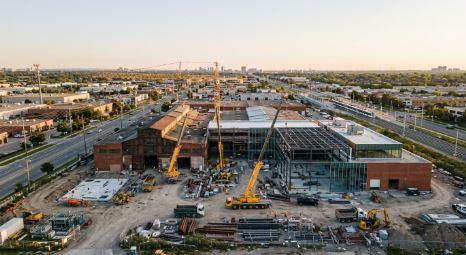
Mississauga’s commercial construction pipeline looks nothing like it did even a few years ago. The city now carries roughly 153 million square feet of commercial inventory across industrial, office, and retail, and a tight industrial market, a light rail line reshaping an entire corridor, and almost no greenfield land left are combining to push a wave of demand onto local contractors who can move fast and manage complex conversions. For developers and landlords trying to keep pace, understanding what’s actually driving this activity matters as much as finding a contractor to execute it.
Why the industrial market is running so hot
Mississauga’s industrial sector has spent the last several years in a genuinely unusual position: sub-2% vacancy and bidding wars over available space. That’s easing slightly heading into this year, with GTA-wide availability contracting to around 4.8% and asking net rents for modern, high-ceiling warehouse space stabilizing between roughly $17 and $21 per square foot, higher still in the Northeast Mississauga airport hub. Even with that modest stabilization, the window for genuinely prime industrial space stays narrow, and demand from e-commerce logistics and supply chain modernization shows no real sign of slowing.
What makes Mississauga’s situation distinct is what’s actually feeding new supply into that tight market. With almost no greenfield land left in the city, most of what counts as “new” commercial real estate now comes from redeveloping older Class-C buildings into modern Class-A facilities, rather than building on open land the way developers could a decade ago. That shift changes the entire nature of the construction work landlords need done. It’s less about ground-up builds on open lots and increasingly about complex conversions, retrofits, and repositioning of buildings that were never designed for their new use.
Warehouse conversions are reshaping the contractor relationship
As warehouse conversions and retail buildouts accelerate across the region, developers are leaning on an established commercial general contractor mississauga landlords already have on file, rather than starting a vetting process from scratch. That preference makes sense given what’s actually involved in these projects. Converting an older Class-C industrial building into a modern, high-clearance, front-loading facility isn’t a simple renovation, it often means reworking structural elements, upgrading electrical and HVAC systems to modern standards, and coordinating around a tenant or leasing timeline that developers don’t want slipping. A contractor who’s already delivered similar conversion work for a given landlord carries institutional knowledge, about the building stock, the permitting relationships, the local subtrade network, that a new vendor simply can’t replicate on day one.
That preference for known relationships isn’t just convenience, either. In a labour and materials market where subtrades book out months in advance, a contractor with existing local relationships is often the difference between a project starting on schedule and one that stalls waiting for crews to become available.
Retail buildouts along the LRT corridor
The Hazel McCallion Light Rail Transit line, an 18-kilometre line running along Hurontario Street through Mississauga and Brampton, is entering its final testing and commissioning phase, and it’s already functioning as a catalyst for higher-density development along the corridor it runs through. New transit infrastructure tends to pull retail and commercial investment toward the stations and corridor it serves, and Mississauga’s Hurontario corridor is a clear example of that pattern playing out in real time. Retail buildouts, boutique storefronts, flagship locations, and mixed-use ground-floor retail, are following the same trajectory transit-oriented corridors have followed elsewhere in the GTA, and that’s translating directly into demand for contractors who specialize in retail fit-outs and tenant improvement work on compressed timelines.
Why design-build is becoming the default model
Several of these projects are also moving to a design & build contractor model, letting a single firm manage design and construction together and shortening the timeline from permit to occupancy. That shift makes particular sense for warehouse conversions and retail buildouts, where the design and construction phases are tightly interdependent in ways they aren’t on a simpler ground-up build. A conversion project often needs structural assessment happening in parallel with design decisions, since what the existing building can actually support shapes what the new layout can be. Splitting that work between a separate architect and a separate contractor introduces a coordination lag that a design-build structure eliminates by design.
For a developer working against a leasing deadline or a tenant’s move-in date, that compressed timeline isn’t a minor efficiency gain, it’s often the difference between hitting a signed lease’s occupancy clause and paying a penalty for missing it.
A market defined by scarcity, not stagnation
It’s worth being clear about what “boom” actually means in this context, because Mississauga’s market isn’t expanding through new supply the way a growing suburban market typically would. Recent industrial development in the city increasingly takes the form of smaller-format industrial condominium projects, subdividing existing or redeveloped sites into individual units rather than large single-tenant footprints, a response to the same land scarcity driving conversion activity elsewhere in the market. That pattern reinforces the same conclusion from a different angle: growth here is coming from doing more with a fixed amount of land, not from expanding onto new land, and that reality is exactly what’s reshaping the kind of construction expertise developers need.
What this means for owners choosing contractors right now
Given the pace and complexity of what’s actually getting built, contractor selection in Mississauga right now favours firms with specific conversion and retrofit experience over generalists, even generalists with strong ground-up construction credentials. A contractor who’s spent the last several years building on open industrial land in Milton or Vaughan may have excellent fundamentals but limited exposure to the structural and code complexities of converting a 1990s Class-C warehouse into a modern logistics facility. That distinction matters more in Mississauga’s current market than it would in a market still building primarily on greenfield sites.
Common mistakes developers make in this market
The most common mistake is underestimating how differently conversion projects behave compared to ground-up builds, treating a Class-C to Class-A retrofit like a standard renovation when it often carries structural, electrical, and code-compliance complexity closer to new construction. Another frequent misstep is waiting too long to lock in a contractor given how tight the local subtrade market is; a project that starts its contractor search after design is finalized often finds preferred trades already committed elsewhere for months. And some developers underestimate how much the LRT corridor’s momentum is compressing retail buildout timelines, assuming a tenant fit-out will move at the pace it might have five years ago, when compressed lease timelines now often demand a design-build approach from the outset.
Tips for developers and landlords navigating the boom
Start contractor conversations early, ideally before design is finalized, especially for conversion projects where structural constraints should inform the design rather than the other way around. Prioritize firms with documented conversion and retrofit experience specifically, not just general commercial construction volume. Consider a design-build structure seriously for any project with a hard leasing or occupancy deadline, since the coordination savings compound on tight timelines. And lean on existing contractor relationships where they exist, the institutional knowledge a known firm brings to a familiar building type is a genuine advantage in a market moving this fast.
Final thoughts
Mississauga’s commercial construction boom isn’t driven by open land and new ground-up development the way past cycles were, it’s driven by scarcity, transit-oriented growth, and the conversion of an aging building stock into something the current market actually needs. That shift is changing what developers should look for in a contractor, favouring proven conversion experience, established local relationships, and increasingly, a design-build structure that keeps design and construction moving together rather than in sequence. Understanding that shift now is what separates developers hitting their occupancy dates from the ones scrambling to catch up.