Minneapolis Pest Calendar: What Homeowners Should Expect
Most Minneapolis homeowners think about pests twice a year: once in fall when the boxelder bugs show up on the siding, and once in summer when mosquitoes get unbearable. That’s the wrong mental model, and it costs people money. Pest pressure in the Twin Cities never fully stops. It just changes shape. This guide lays out what’s actually happening in and around your home across all four seasons, and what you can realistically do to stay ahead of it.
Why Minneapolis Is a Year-Round Pest Problem
The city’s climate creates an almost perfect storm. Harsh winters push rodents and overwintering insects to find warmth inside structures. Humid summers generate explosive mosquito and ant activity. The freeze-thaw cycle in spring cracks foundations and opens new entry points. And the dense tree canopy that makes Minneapolis neighborhoods beautiful also gives carpenter ants, boxelder bugs, and spiders ideal habitat right next to your exterior walls.
Nationally, the pest control industry is responding to that pressure. According to a 2024 report published by the National Pest Management Association (NPMA), the structural pest control industry in the United States generated $12.654 billion in service revenue in 2024, a nearly 8% increase over the previous year. That growth doesn’t happen in a vacuum. It reflects how many homeowners are finally treating pest management as maintenance rather than emergency response.
“These impressive figures reflect the essential nature of pest management services and the industry’s ability to adapt to changing economic conditions.”- Dominique Stumpf, CAE, CEO, National Pest Management Association, 2024 Industry Revenue Report. Minneapolis fits that pattern precisely. The combination of old housing stock, proximity to lakes and parks, and a climate that swings 100 degrees between January and July means there’s always something happening pest-wise. The question is whether you’re paying attention at the right time.
The Four-Phase Pest Pressure Model
Forget thinking about this as four clean seasons. In reality, pest pressure in Minneapolis runs in four overlapping phases, each one setting conditions for the next. Call it the Four-Phase Pest Pressure Model.
- Phase one is entry (late fall through winter), when pests look for ways inside and establish themselves in wall voids, attics, and crawl spaces.
- Phase two is activity (late spring through early summer), when colonies expand and foraging becomes visible.
- Phase three is peak (July through August), when mosquitoes, wasps, and ant populations hit their highest numbers.
- Phase four is reinvasion (September through October), when overwintering species make another run at the interior of your home before temperatures drop.
Understanding the overlap is what matters. Most homeowners only address pests during phase three, when the problem is already visible. The better play is to disrupt phases one and two before activity ever becomes obvious.
What’s Happening Season by Season
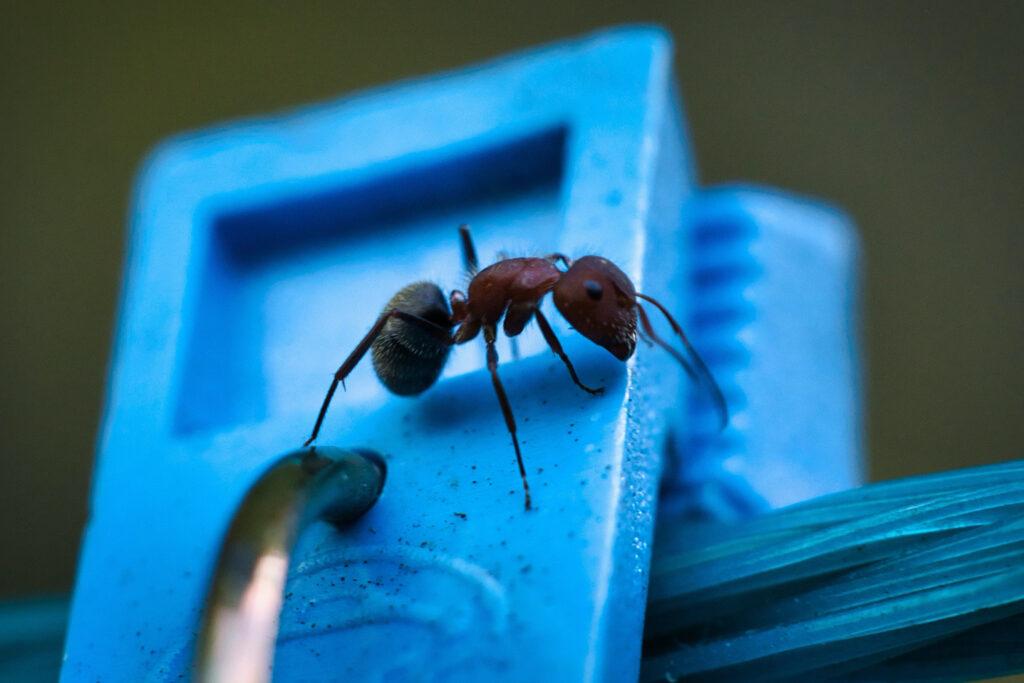
Spring is the season that catches people off guard the most. Imagine it’s a Saturday morning in late March. There’s been a snowmelt weekend, the ground is soft, and you’re noticing a thin trail of carpenter ants moving along the windowsill near your kitchen. They didn’t just arrive. They spent the winter in a damp wall void or in the softwood of your window frame, and the warmth of your house has activated them early. By the time you see that trail, there’s a colony already established. That’s a spring carpenter ant problem, and it’s one of the most common calls pest control companies get across the Minneapolis metro in April and May. Spiders also increase in spring as their prey insects emerge. Wasps start scouting for nesting sites around eaves, decks, and overhangs. None of this is dramatic yet, but it’s the phase where a small intervention has the biggest payoff.
Summer shifts the conversation entirely. Mosquitoes move to the front of everyone’s mind, especially in yards near the city’s lakes and park corridors. Yellowjackets become aggressive around mid-July as their colonies peak and food competition increases. Ant activity hits its highest levels, and spiders in basements and garages become more noticeable as they follow the insect population indoors. This is the phase that looks and feels the worst, even though it’s technically the most predictable.
Fall is when smart homeowners pay close attention. Boxelder bugs and Asian lady beetles aggregate on sun-warmed exterior walls before moving inside. Rodents begin probing foundations, gaps around utility lines, and damaged soffits for entry points. A mouse can fit through an opening the size of a dime. Your home is warm. The math is simple.
Winter doesn’t mean quiet. Rodents are active indoors year-round once established. Spiders that made it inside during fall are still hunting. The problem is invisible in winter, which is exactly when it tends to grow.
| Pest | Peak Pressure Period | Primary Entry Point | First Warning Sign |
|---|---|---|---|
| Carpenter Ants | March – May | Damaged wood, window frames | Trail near moisture source |
| Mosquitoes | June – August | Standing water, yard perimeter | Bites in yard at dusk |
| Yellowjackets / Wasps | July – September | Eaves, deck joists, ground nests | Repeated wasp activity near one spot |
| Boxelder Bugs | September – October | Window frames, siding gaps | Clustering on south-facing walls |
| Mice / Rodents | October – February | Foundation gaps, utility penetrations | Droppings, gnaw marks, scratching sounds |
| Spiders | Year-round (peak fall) | Basement windows, garage doors | Webs in corners of low-traffic areas |
How to Build a Pest-Proof Habit Year Round
There’s no single treatment that covers everything in the table above. What works instead is a layered approach that runs on a seasonal rhythm. Here’s what that actually looks like in practice:
- February – March: Inspect your foundation, utility entry points, and roofline for gaps larger than a quarter-inch. Seal with caulk or steel wool before the soil thaws and rodents start moving.
- April – May: Trim any tree branches that contact your roofline. Carpenter ants use overhanging branches as a highway from the yard into your structure.
- June: Eliminate standing water in the yard, from clogged gutters to plant saucers to low-lying areas near the foundation. Each source is a potential mosquito breeding site.
- July – August: Watch for repeated wasp activity near the same exterior point. A single scout wasp returning to the same spot usually means a nest is under construction nearby. Address it early, before colony populations peak.
- September: Recheck all foundation seals, door sweeps, and garage thresholds before overnight temperatures drop below 50 degrees. This is the highest-impact window for exclusion work.
- October – November: Reduce clutter in basements and utility rooms. Rodents nest in undisturbed materials. A clean space makes early detection far easier.
If you’re working through this checklist and realizing that two or three items have already slipped past you this year, that’s not unusual. A local professional running seasonal inspections can catch conditions you miss because they’re looking at hundreds of homes across the same neighborhoods and know exactly what the current season is producing. For homeowners who want that kind of local knowledge applied to their property, working with a team that focuses specifically on pest control Minneapolis residents deal with means the treatment plan reflects actual Twin Cities conditions, not a generic national template.
The U.S. Bureau of Labor Statistics projects that employment of pest control workers will grow 5 percent from 2024 to 2034, faster than the average for all occupations, with roughly 13,400 new openings per year. That growth signals real demand. More homeowners are recognizing that professional pest management is less expensive than repairing the damage that pests cause when left unchecked.
The Bottom Line
Pests in Minneapolis aren’t a fall problem or a summer problem. They’re a year-round problem that follows a predictable schedule. Once you understand the Four-Phase Pest Pressure Model and map your own home’s vulnerabilities to the seasonal calendar, you stop reacting and start staying ahead. The homeowners who never have a serious infestation aren’t lucky. They’re paying attention at the right time of year. Which phase are you in right now, and what have you already missed?