The New Diamond Wardrobe: How Lab-Grown Diamonds Became an Everyday Luxury
On a Tuesday morning on the Upper East Side, a pair of diamond studs might catch the light between a video call and a coffee run — not saved for evening, just there, the way a good watch is there. Farther downtown, a tennis bracelet slides against a wristwatch at a gallery opening; a bezel-set pendant sits under a white oxford shirt; a right-hand ring, chosen alone, catches candlelight at a dinner that turns, unexpectedly, into a toast. None of these moments required a proposal.
That shift is at the center of one of the more interesting developments in American fine jewelry: lab-grown diamond jewelry has grown from a niche category into a considered, everyday choice, not a substitute for tradition but an addition to it.
From Bridal Choice to Modern Mainstay
The numbers explain why. According to The Knot’s 2026 Real Weddings Study, lab-grown diamonds accounted for 61 percent of engagement ring center stones purchased by U.S. couples in 2025 — up 239 percent since 2020, a shift the study’s researchers describe as a fundamental change in the market. Lab-grown diamond engagement rings are no longer a workaround; for most American couples, they are simply the default.
That volume matters beyond bridal. When six in ten couples choose a lab-grown center stone for the ring meant to last a lifetime, it builds the kind of consumer confidence that flows naturally into fashion jewelry — earrings, bracelets and pendants bought for pleasure rather than for a proposal.
Part of that confidence is simply chemistry. As the Gemological Institute of America notes, laboratory-grown diamonds have essentially the same chemical composition, crystal structure, and optical and physical properties as diamonds formed underground; the difference lies in origin, not in what the stone is. A lab-grown diamond graded by GIA or another major laboratory is evaluated against the same cut, color, clarity and carat criteria as its mined counterpart. That parity is what has allowed the category to move from a value-driven bridal choice to a considered purchase in everyday diamond jewelry, where design and versatility, not price alone, determine what a customer chooses to wear.
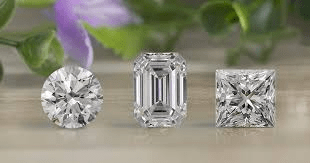
Round remains a constant — still one of the most requested shapes at counters across the city — but the current mood favors elongated silhouettes. Oval, marquise, pear, radiant and elongated cushion cuts read larger on the hand and catch light differently than a traditional round brilliant. Emerald cuts, with their cool, architectural lines, have found a following among women who want restraint over sparkle for its own sake.
Setting choices have shifted just as much as shapes. Bezel settings, once reserved for sportier pieces, now wrap solitaires and pendants alike, prized for a clean silhouette and the practical fact that a rubbed edge protects a stone through a full New York day. East-west settings turn an oval or marquise diamond sideways, an easy way to make a familiar shape feel considered rather than default. Gold bands have gotten thicker and more sculptural, and mixed-shape, stackable designs — a marquise band beside a bezel-set round, an emerald-cut pendant layered with a plain gold chain — let a wearer assemble a personal arrangement rather than buy a single finished statement, jewelry shaped around the person wearing it rather than the occasion.
European Craft, Designed for the American Market
For an American shopper, that emphasis on personalization raises a practical question: where does a diamond come from, and who stands behind it once it’s on your hand? LaBrilliante sells lab-grown diamonds to U.S. clients and jewelers while producing its stones in Europe, pairing a manufacturing tradition built around close attention to cut and finish with a sales and service operation shaped around American buying habits. For clients and jewelers looking for greater choice, LaBrilliante lab-grown diamonds combine European production expertise with service tailored to the U.S. market.
That combination matters as fashion jewelry, not just bridal, becomes a growth category for European-made lab-grown diamonds. A customer replacing a pair of studs or adding a line bracelet to an existing collection is often less interested in a stone’s backstory than in fit, finish and reliability — the sense that a supplier understands both the product and the market it’s selling into.
Four Pieces in the New Diamond Wardrobe
Everyday diamond studs. The classic round stud remains a wardrobe staple, but fancy-shape studs — oval, pear or cushion — have become an easy way to wear a diamond daily without it reading as an event piece. A single well-cut stone does more work than a cluster of smaller ones.
The line bracelet or necklace. Once considered a special-occasion piece, the tennis bracelet has become an everyday layering staple, stacked with gold bangles or worn alone against a watch. The same logic applies to diamond line necklaces, which sit close to the collarbone and pair easily with everything from a blazer to a plain T-shirt.
The right-hand ring. For many women, the right-hand ring has become a self-purchase marker — a promotion, a milestone birthday, or simply a decision made independently of a relationship. Bezel and east-west settings are especially popular here, since they read as considered rather than bridal.
The custom pendant. Custom lab-grown diamond jewelry — an unconventional cut or shape set on a personal pendant — lets a customer build something that isn’t available off the shelf, a way to make a single piece feel specific to the person wearing it rather than interchangeable with what’s in a case.
This isn’t a shopping list so much as a way of thinking about a collection: pieces added over time, each one chosen for how it’s actually going to be worn.
What to Look for When Choosing a Lab-Grown Diamond
Whether the piece in question is a modest pair of studs or a five-figure custom ring, a few criteria hold steady. Cut and proportion matter more than carat weight alone — a well-cut stone in a flattering shape reads brighter and larger than a poorly cut stone of the same size. Color, clarity and carat are best considered together, in the context of the design, rather than chased individually; a warmer color grade can all but disappear in yellow gold.
An independent grading report, where one is available, gives a buyer an objective record of what they’re purchasing rather than a seller’s word alone — certified lab-grown diamonds allow for genuine comparison shopping. Beyond the stone, it’s worth asking where a diamond was produced and how transparently that’s shared, along with how the piece was made; setting, prong work and finishing often determine how jewelry wears over years, not just how it photographs. Finally, the reliability of the seller or supplier is its own form of quality control: a jeweler willing to source a nonstandard shape, color or fully custom design signals flexibility that off-the-shelf retail often can’t match.
The Supplier Behind More Personal Jewelry
As fashion jewelry becomes a larger share of what lab-grown diamonds are used for, the businesses supplying those stones matter almost as much as the stones themselves. Jewelers assembling a case of studs, bracelets and pendants — or fielding a request for a one-of-a-kind right-hand ring — need a partner who can move beyond a narrow bridal catalog and offer real range in shape, size and design.
For retail assortments and custom projects, working with a trusted U.S.-based lab-grown diamond supplier can give jewelers the flexibility to respond to changing preferences in shape, size and design. That flexibility is what separates a supplier from a source: not just access to diamonds, but the ability to meet a request that doesn’t fit a standard SKU, whether an elongated cushion cut for a pendant or a matched pair of pear-shape stones for asymmetrical studs.
Conclusion
What’s changed isn’t the diamond itself — a lab-grown stone still measures out in the same cut, color, clarity and carat as one pulled from the earth — but the occasions on which people choose to wear one. The new diamond wardrobe isn’t built around a single milestone purchase; it’s assembled piece by piece, worn on ordinary days as often as extraordinary ones. Rarity and size still matter to some buyers, but increasingly, modern luxury is defined by design, craftsmanship, transparency about where a stone comes from, and how naturally it fits into a life already in motion. For a growing number of New Yorkers, that’s the point: diamonds that don’t wait for an occasion.
About the Brand
LaBrilliante is a lab-grown diamond company serving the U.S. market with production in Europe. The company works with loose diamonds, finished jewelry and custom projects, helping private clients, jewelers and retail buyers find stones and designs suited to their individual requirements.