
Kimi API and the Long-Context Problem It Actually Solves: When to Route Long Documents to a Specialist Model
The Kimi API earns its slot in a stack for one specific job: reading very long documents whole, in a single pass. Built by Moonshot AI, it takes an entire contract, codebase, or research set as context rather than as retrieved fragments, which is precisely the part chunk-and-search pipelines handle worst. You don’t need a new vendor relationship to test that thesis: the Kimi API sits behind the same chat-completions format you already call, and the model leaderboard is where you can see how models compare on price and latency before you route anything real to them.
The reason this is live now is that most teams solved long documents with retrieval, and retrieval has a known blind spot. When an answer depends on two passages far apart (a defined term early in a contract, and an obligation that only means something because of it), similarity search fetches each fragment on its own, and the model never sees the connection. Long context collapses that pipeline: no chunking jobs, no embedding refresh, no retrieval tuning, just the document. As context windows grew and per-token prices fell, the question changed from “can a model read the whole thing” to “when is that worth paying for,” and that is a routing decision, not a research project.
What is Kimi, and who builds it?
Kimi is two things that share a name. The first is the assistant: the chat product Moonshot AI launched in late 2023. It built its reputation on a single trick that mattered: hand it a hundred-page PDF and it would actually read it, then answer with the far end of the document still in view. Long context was not a feature bolted on later; it was the founding premise.
The second is the model family behind it. Moonshot AI, founded in Beijing in 2023, has kept long context as its technical identity across generations, and the Kimi K2 line continued the pattern with open weights, which matters if your compliance team wants the option of self-hosting. For a developer the split is simple: the assistant is for humans, the API on Moonshot’s open platform is for your code, and both draw on the same lineage. When this article says “the Kimi API,” it means the platform side.
How do you get API access and make your first call?
Access is the boring kind, which is a compliment. There is no sales conversation, and the documentation and pricing are public, so you can read both before you hand over anything. From zero to a first call is three steps:
• Register on Moonshot’s open platform and create an API key.
• Point your existing client at the Moonshot base URL and set the model name. The API speaks the same chat-completions format most tooling already uses, so the rest of your stack stays put.
• Send one whole-document prompt and read the answer against the far end of the input.
Concretely, that second step is a two-string change:
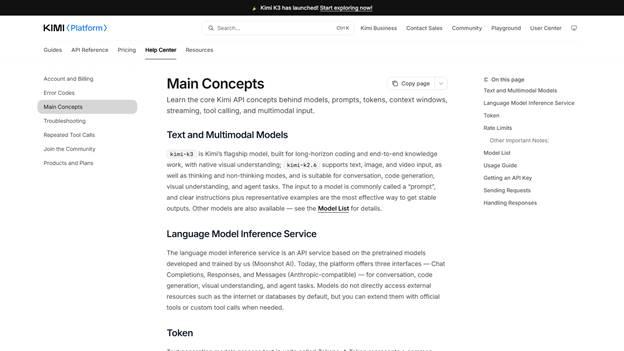
kimi-latest is an alias that tracks Moonshot’s current release, so you are not pinning to a frozen snapshot on day one. Two things to check in the docs before you ship: the exact model IDs your account can call, and the rate limits attached to your tier. Long-context requests are heavier on the server side, and the published limits reflect that: a pipeline firing hundreds of whole-document calls per minute should plan around them rather than discover them in production.
What actually fits in a long context, and what does it cost to send?
What fits: workloads where the answer is distributed across the input. A signed contract with every schedule and amendment attached, where a defined term on page one changes what an obligation means deep in the body. A service codebase where one function is defined in a file you never open and called from six that you do. A deposition stack where the contradiction lives between an early page and a late one.
A quarter of support transcripts where the useful summary is a map of how issues evolved, not a list of what any single ticket said. The common shape: parts of the input have to be read against each other. That is what a large window buys you, and it is what retrieval approximates badly.
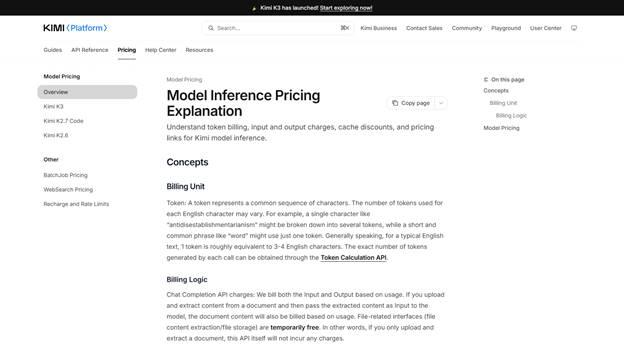
What it costs: input tokens dominate the bill. You pay per token to send the document, and the pricing table captured below prices each model by input and output, tiered by context length. Three mechanics decide whether that bill is sensible.
A one-shot analysis is one input charge: send the document once, get the answer, done. Multi-turn is where costs grow, because every turn resends the document unless you use context caching, which Moonshot offers and which discounts repeated prefixes. And tier choice matters: sending a short document to the largest-window tier is paying for headroom you never use. Measure your corpus with a tokenizer before you budget: page counts and token counts are different animals, and the gap between them is where overruns live.
When does Kimi beat a cheaper general-purpose model, and when does it not?
Where it wins: cross-reference work. Contract consistency checks, codebase-wide questions, whole-thread synthesis, discovery review: anywhere the alternative is not “a cheaper model” but “a cheaper model plus an embedding pipeline plus someone to maintain it.” That is the honest comparison, and when the chunking pipeline needs custom logic to keep tables, defined terms, and headers intact, sending the document whole is often cheaper all-in, before you even count the failure modes retrieval introduces.
Where it does not: short prompts, high-volume classification, latency-sensitive paths, and anything where search has already found the one paragraph that answers the question. If your prompt is a few hundred tokens, a giant window is dead weight; you pay per token either way, and a smaller general model answers faster and cheaper. And if your “long document” is really five hundred independent one-page records, that is a batch job for a cheap model, not a context problem.
The test I apply before routing anything: does the answer require two parts of the input to be read against each other? If yes, long context earns its price. If no, the cheapest model that answers well wins, every time.
Applied to the common cases:
| Job shape | Route it to | Why |
| Contract review, discovery, codebase audits, transcript synthesis | The long-context model, whole document | The answer needs two parts of the input read against each other |
| Five hundred independent one-page records | A batch job on the cheapest model that answers well | No passage depends on any other |
| Short prompts, classification, latency-sensitive paths | Your default route | A giant window is dead weight when every token is billed |
| Search already found the one paragraph that answers | Your default route | Retrieval did the work; the long window adds cost, not accuracy |
How do you add it without opening a second billing relationship?
The friction was never the API call; it is procurement. A second vendor means a second account, a second key to rotate, a second invoice to reconcile, a second quota to watch. OrcaRouter collapses that: one account, one key, one endpoint in the same chat-completions format, with Kimi available as a model choice (the provider page linked at the top of this article shows the current setup).
In practice, adopting it is a configuration edit: long-document jobs get routed to Kimi, everything else stays on your default. Two operational benefits fall out of that. You can trial a long-context job against your existing setup by changing one field, on real traffic, this week. And if Kimi’s pricing or limits move, rerouting is a configuration change rather than a migration. The leaderboard linked in the opening is the honest way to choose a model for each job: it compares them on what you will actually feel (price and latency) rather than on benchmark tables nobody’s workload reproduces.
The takeaway
Kimi is a specialist hire, not a default. If your backlog contains whole-document work (contract review, discovery, codebase audits, transcript synthesis), it does a job the cheap general model on your default route genuinely cannot, and it deserves a slot. If your traffic is short prompts and quick answers, it does not, and adopting it as a default would just raise the invoice. Route by job shape: cross-reference work to the long window, everything else to the cheapest model that answers well. A router turns that split into a one-line change, which means you can test the thesis on one real workload this week instead of debating it for a quarter.
Sourcing note: Model names, context limits, and per-token prices on Moonshot’s platform change as new Kimi generations ship. This guide reflects the public documentation and pricing pages as they stood on 2026-09-04, and the screenshots above were captured from those pages; where a figure matters to a buying decision, the pricing page is the source of truth.