Inside the High-End Gaming Setup: What Serious Players Invest In
The gaming room used to be a corner of the house nobody photographed. It has become, over the past decade, a genuine design category — considered, expensive, and treated with the same seriousness as a home studio or a wine room.
What is interesting is not the spending itself but where experienced players direct it. The instinct from outside is that the money goes into the computer. In practice, people who have been doing this for years distribute it very differently, and the pattern is instructive.
The display comes first
Ask anyone with a properly built setup where they would spend first and the answer is almost always the monitor.
The reasoning is simple. It is the component you look at continuously, it lasts far longer than the computer driving it, and its qualities are perceptible in a way that internal specifications are not. A superb panel remains superb across three generations of hardware behind it.
At the higher end the conversation is about refresh rate, response time and panel technology rather than size. Larger is not automatically better — beyond a certain point the eye cannot track the full surface quickly enough, which is why competitive players often choose smaller, faster displays over the largest available.
Then the things you touch
Peripherals occupy the second tier, and here the culture resembles mechanical watches more than consumer electronics.
Keyboards are the clearest example. The enthusiast market has produced an entire craft economy — machined aluminium cases, hand-lubricated switches, dyed keycaps, small-batch runs that sell out in minutes. The functional difference between a good keyboard and an exceptional one is real but modest. The tactile difference is considerable, and that is the point.
Chairs are the quiet correction of the past few years. The aggressively styled racing chair that dominated the market has steadily lost ground among people who actually sit for long stretches, replaced by proper ergonomic office seating from established manufacturers. It costs more, looks less dramatic, and is markedly better for anyone spending real hours at a desk.
Desks have moved the same direction — solid wood, height adjustment, thoughtful cable management, finishes chosen to sit comfortably in a room rather than announce themselves.
The environment around it
The most refined setups treat the room as part of the equipment.
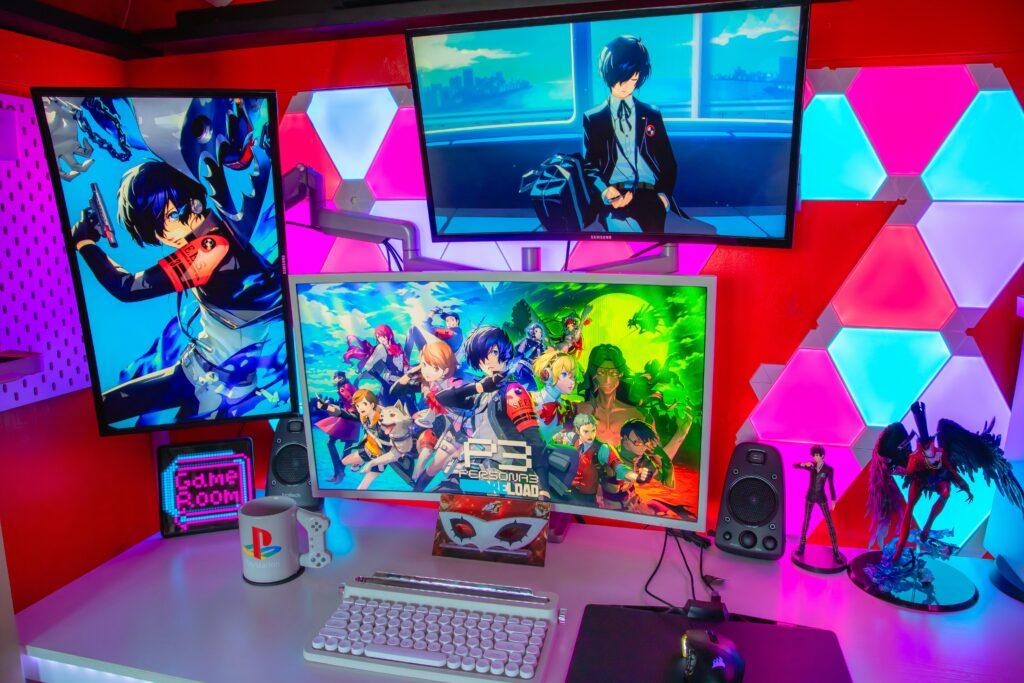
Lighting is handled indirectly — bias lighting behind the display to reduce contrast against a dark room, warm ambient sources elsewhere, nothing shining directly at the screen. The garish colour-cycling look has aged badly and been replaced by something closer to gallery lighting.
Acoustics receive attention too. Soft furnishings, rugs, occasional treatment panels. Partly this improves what the room sounds like, and partly it addresses the fact that a serious machine under load is audible.
Audio itself splits the field. Some invest heavily in open-back headphones and dedicated amplification. Others keep it modest, on the reasonable grounds that competitive audio is about positional accuracy rather than richness.
Where the money does not go
Two omissions are consistent among experienced players.
The first is that the computer is usually not the most expensive item in the room. It is replaced more often than anything else, so spending is calibrated to a sensible lifespan rather than maximum specification.
The second is that decorative components are treated with suspicion. Illuminated cooling systems, transparent cases and elaborate liquid loops photograph beautifully and contribute little. People building their third setup tend to skip them.
The upgrade that costs nothing
There is a final element that appears in every properly built setup and appears on no invoice.
A well-specified machine running default settings does not perform anywhere near its potential, and the gap is often larger than the difference between hardware generations. Experienced players spend real time on configuration — adjusting the parameters a game runs with, editing settings by hand, tuning for consistency rather than peak numbers. Anyone curious about how deep that goes can see the full guide that competitive players work from.
It is the least visible part of the room and, per hour invested, comfortably the most valuable. Which is a familiar principle in any field where equipment matters: the finest instrument still needs setting up properly, and the people who understand that are usually the ones worth listening to.