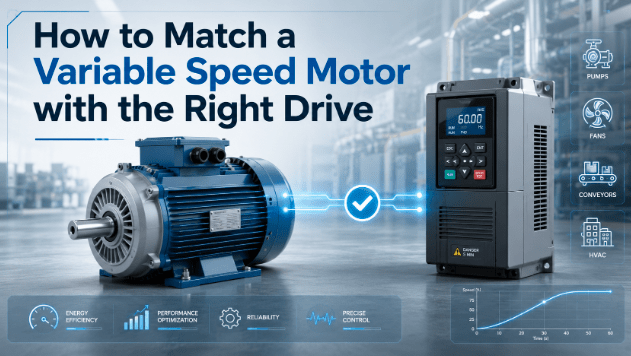
How to Match a Variable Speed Motor with the Right Drive
Industrial facilities across the UK are under increasing pressure in order to improve energy efficiency, reduce operating costs, and maintain reliable production output.
One of the most effective ways to achieve these goals is to use a variable speed motor system paired with the appropriate drive technology.
However, choosing a motor is only half the equation. Even the most efficient motor can underperform if it is not matched with the correct drive.
Whether you are specifying equipment for manufacturing, water treatment, HVAC systems, food processing, or material handling applications, understanding how to match a variable speed motor with the correct drive is essential. Doing so will result in long-term performance and reliability.
This guide explains the main factors engineers, facility managers, and maintenance professionals should consider when selecting compatible variable frequency drives, ensuring maximum efficiency and operational success.
Why Is It Important To Match A Variable Speed Motor And Drive?
A variable speed motor allows operators to adjust the speed of the motor according to actual process requirements instead of running it continuously at full speed.
The drive, typically a Variable Frequency Drive (VFD), controls the motor by varying the frequency and voltage supplied to it. Together, the motor and drive form an integrated system that delivers:
- Improved energy efficiency
- Reduced mechanical wear
- Better process control
- Lower operating costs
- Extended lifespan of the equipment
- Reduced maintenance requirements
An improperly matched system can cause overheating, excessive vibration, poor torque performance, nuisance tripping, and premature component failure.
For UK businesses focusing on reducing energy consumption and meeting sustainability targets, proper motor-drive selection is specifically important.
Understanding Variable Frequency Drives
Before selecting a drive, it is important to understand its role within the system.
Variable frequency drives regulate the speed of the motor by adjusting the electrical frequency supplied to the motor. Since the speed of the motor is directly related to input frequency, changing the frequency allows precise speed control.
Modern VFDs offer various advantages:
- Soft starting and stopping
- Reduced inrush current
- Improved process accuracy
- Energy savings
- Remote monitoring capabilities
- Integration with industrial automation systems
The effectiveness of these advantages largely depends on selecting a drive that matches both the motor and the application.
Step 1: Check Motor Voltage Compatibility
The first and most critical factor is voltage compatibility. The drive output voltage must match the rated voltage of the motor.
Common UK industrial motor voltages include:
- 230V single-phase
- 400V three-phase
- 690V industrial applications
Always verify the motor nameplate and ensure the selected drive supports the required operating voltage.
A voltage mismatch can lead to equipment damage, inefficient operation, or complete system failure.
Step 2: Match the Current Rating of the Motor
Many buyers focus mainly on horsepower or kilowatt ratings when selecting drives. However, experienced engineers know that motor current is often the most important sizing factor.
When selecting a drive:
- Check the full-load current of the motor
- Ensure the drive’s continuous current rating meets or exceeds the motor requirement
- Allow additional capacity for overload conditions
A drive with insufficient current capability may overheat or trip during operation, especially during acceleration or high-load situations.
Step 3: Understand the Load Type
Different applications place different demands on variable speed electric motors. Therefore, understanding load characteristics is essential when selecting drive capacity.
Variable Torque Applications
These include:
- Centrifugal pumps
- HVAC fans
- Ventilation systems
- Cooling towers
Torque requirements decrease as speed decreases, making these applications highly energy-efficient when controlled by VFDs.
Examples include:
- Conveyors
- Mixers
- Crushers
- Extruders
These applications require consistent torque throughout the operating speed range and typically require heavy-duty drive ratings.
Constant Horsepower Applications
Examples include:
- Machine tools
- Winding equipment
- Spindle drives
These applications often operate at high speeds and require specialised drive configurations.
Understanding the application helps ensure the drive can meet performance demands under all operating conditions.
Step 4: Verify Motor Type
Not all motors are designed to operate with VFD technology.
When selecting a drive, determine whether the motor is:
Inverter-Duty Motor
These motors are specifically engineered for use with variable frequency drives and feature:
- Enhanced insulation systems
- Better thermal management
- Improved low-speed performance
- Resistance to voltage spikes
Standard AC Motor
Many standard induction motors can operate with VFDs, but limitations may exist.
Potential issues include:
- Excessive heat generation
- Bearing damage
- Reduced lifespan
- Limited speed range
For new installations, inverter-duty motors are generally the preferred option.
Step 5: Consider Required Speed Range
A key advantage of variable motors is their ability to operate at different speeds.
However, every application has unique speed requirements.
Ask the following questions:
- What is the minimum operating speed?
- What is the maximum required speed?
- Will the motor run continuously at low speeds?
- Are rapid speed changes required?
Operating at very low speeds can reduce cooling effectiveness because the motor’s cooling fan rotates more slowly.
Applications requiring extended low-speed operation may require:
- Forced ventilation
- Independent cooling fans
- Specialised motor designs
Ignoring cooling requirements can significantly shorten motor life.
Step 6: Evaluate Environmental Conditions
Industrial environments across the UK can vary significantly.
Drive selection should account for environmental conditions such as:
Temperature
High ambient temperatures reduce drive performance and may require derating.
Dust and Contaminants
Manufacturing facilities, woodworking shops, and processing plants often contain airborne particles that can affect electronics.
Suitable enclosure ratings may include:
- IP20 for clean environments
- IP54 for dusty environments
- IP65 for harsh industrial locations
Moisture
Water treatment facilities, food production plants, and outdoor installations often require additional environmental protection.
Choosing the correct enclosure helps ensure long-term reliability.
Step 7: Assess Starting Torque Requirements
Some applications require significant torque during startup.
Examples include:
- Loaded conveyors
- Crushers
- Heavy mixers
- Material handling equipment
In these cases, drive overload capability becomes critical.
Many industrial drives offer:
- 120% overload capacity for normal-duty applications
- 150% overload capacity for heavy-duty applications
Always select a drive capable of handling peak torque demands.
Step 8: Review Communication and Automation Requirements
Modern industrial facilities increasingly rely on automation and data-driven decision-making.
Many advanced variable frequency drives support:
- Modbus RTU
- Modbus TCP
- Ethernet/IP
- PROFINET
- BACnet
- SCADA integration
These communication features allow operators to:
- Monitor performance remotely
- Track energy consumption
- Receive maintenance alerts
- Optimise production efficiency
Selecting a drive with future expansion capabilities can help avoid costly upgrades later.
Step 9: Consider Energy Efficiency Goals
The UK continues to prioritise industrial energy efficiency through sustainability initiatives and carbon reduction programmes.
Properly matched variable speed electric motors and VFD systems can significantly reduce energy consumption.
Energy savings are particularly noticeable in:
- Pumping systems
- HVAC equipment
- Ventilation systems
- Fan applications
Even small speed reductions can produce substantial energy savings due to the affinity laws governing centrifugal loads.
For many facilities, the energy savings achieved through variable speed control can deliver a rapid return on investment.
Common Mistakes to Avoid
When matching a variable speed motor with a drive, avoid these common errors:
- Selecting a drive based solely on motor power rating
- Ignoring full-load current requirements
- Understanding startup torque demands
- Using standard motors in demanding VFD applications
- Overlooking environmental conditions
- Failing to plan for future automation integration
- Ignoring cooling requirements during low-speed operation
Avoiding these common mistakes can improve reliability and reduce lifecycle costs.
Conclusion
Choosing the correct drive for a variable speed motor involves more than matching voltage and power ratings. Engineers must consider motor current, load characteristics, environmental conditions, speed range requirements, communication capabilities, and future operational needs.
A correctly matched combination of variable frequency drives and variable motors delivers greater efficiency, improved process control, reduced maintenance costs, and longer life of the equipment.
For businesses in the UK who want to optimise industrial performance while lowering energy consumption, investing time in proper motor-drive selection available at Industrial Motor Warehouse is one of the most effective steps in order to achieve reliable and cost-effective operations.
FAQs
How do I size a variable frequency drive correctly?
The drive should match the motor voltage and provide a continuous current rating equal to or greater than the motor’s full-load current. Load characteristics and overload requirements should also be considered.
Can any motor be used with a VFD?
Many standard AC motors can operate with variable frequency drives, but inverter-duty motors are specifically designed for variable-speed applications and generally offer superior performance and reliability.
Why is motor current more important than horsepower?
Drives deliver current to produce torque. Since motors with the same horsepower can have different current requirements, sizing based on current provides a more accurate selection method.
Do variable speed motors reduce energy consumption?
Yes. In applications such as pumps, fans, and HVAC systems, speed reduction can significantly lower energy use, often resulting in substantial cost savings.
What industries commonly use variable speed electric motors?
Common industries include manufacturing, food processing, water treatment, pharmaceuticals, HVAC, logistics, mining, and material handling.